
Ulefone Armor 27T Pro vs. Doogee V30T: A Rugged Showdown
| Phones Images | |||||
|---|---|---|---|---|---|
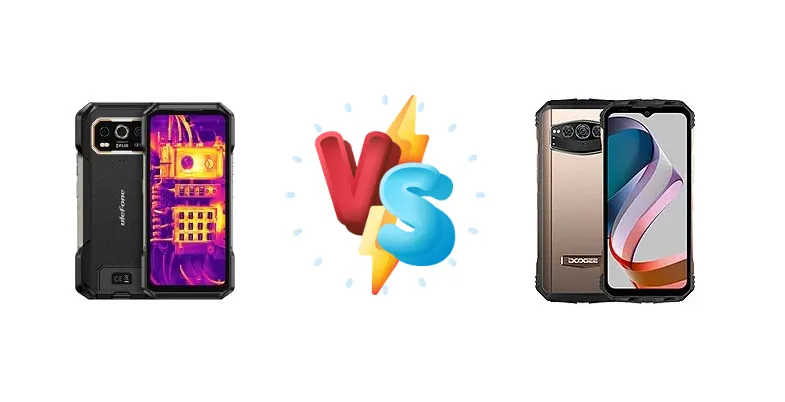
|
🏆 Quick Verdict
For the average user prioritizing sustained performance and rapid refueling, the Doogee V30T emerges as the winner. Its Dimensity 1080 chipset and 66W charging significantly outperform the Armor 27T Pro, making it ideal for power users and those constantly on the move. However, the Ulefone offers impressive battery endurance.
| PHONES | ||
|---|---|---|
| Phone Names | Ulefone Armor 27T Pro | Doogee V30T |
| Network | ||
|---|---|---|
| 2G bands | GSM 850 / 900 / 1800 / 1900 | GSM 850 / 900 / 1800 / 1900 |
| 3G bands | HSDPA 800 / 850 / 900 / 1700(AWS) / 1900 / 2100 | HSDPA 800 / 850 / 900 / 1700(AWS) / 1900 / 2100 |
| 4G bands | 1, 2, 3, 4, 5, 7, 8, 12, 13, 17, 18, 19, 20, 25, 26, 28, 34, 38, 39, 40, 41, 66, 71 | 1, 2, 3, 4, 5, 7, 8, 12, 17, 18, 19, 20, 25, 26, 28, 34, 38, 39, 40, 41, 66 |
| 5G bands | 1, 2, 3, 5, 7, 8, 2, 25, 28, 38, 40, 41, 66, 71, 77, 78, 79 SA/NSA/Sub6 | 1, 3, 7, 28, 38, 41, 77, 78, 79 SA/NSA |
| Speed | HSPA, LTE, 5G | HSPA, LTE, 5G |
| Technology | GSM / HSPA / LTE / 5G | GSM / CDMA / HSPA / LTE / 5G |
| Launch | ||
|---|---|---|
| Announced | 2024, August 01 | 2023, April 16 |
| Status | Available. Released 2024, August 01 | Available. Released 2023, May |
| Body | ||
|---|---|---|
| Dimensions | 182.8 x 86.8 x 18.5 mm (7.20 x 3.42 x 0.73 in) | 178.4 x 83.1 x 17.8 mm (7.02 x 3.27 x 0.70 in) |
| SIM | Nano-SIM + Nano-SIM | Nano-SIM + Nano-SIM |
| Weight | 441 g (15.56 oz) | 376 g (13.26 oz) |
| Display | ||
|---|---|---|
| Protection | Corning Gorilla Glass Victus, Mohs level 4 | Corning Gorilla Glass 5 |
| Resolution | 1080 x 2460 pixels (~396 ppi density) | 1080 x 2408 pixels, 20:9 ratio (~401 ppi density) |
| Size | 6.78 inches, 109.2 cm2 (~68.8% screen-to-body ratio) | 6.58 inches, 104.3 cm2 (~70.4% screen-to-body ratio) |
| Type | IPS LCD, 120Hz | IPS LCD, 120Hz |
| Platform | ||
|---|---|---|
| CPU | Octa-core (2x2.4 GHz Cortex-A76 & 6x2.0 GHz Cortex-A55) | Octa-core (2x2.6 GHz Cortex-A78 & 6x2.0 GHz Cortex-A55) |
| Chipset | Mediatek Dimensity 6300 (6 nm) | Mediatek Dimensity 1080 (6 nm) |
| GPU | Mali-G57 MC2 | Mali-G68 MC4 |
| OS | Android 14 | Android 12 |
| Memory | ||
|---|---|---|
| Card slot | microSDXC (dedicated slot) | microSDXC (uses shared SIM slot) |
| Internal | 256GB 12GB RAM | 256GB 12GB RAM |
| Main Camera | ||
|---|---|---|
| Features | Dual-LED flash, HDR, panorama | Dual-LED flash, HDR, panorama |
| Triple | 50 MP, f/2.0, (wide), 1/1.31", 1.2µm, PDAF 64 MP, f/1.8, (night vision), 2 infrared lights Thermal camera by FLIR, 80x60 px, 9Hz, 17μm | 108 MP, f/1.8, (wide), 1/1.52", 0.7µm, PDAF, OIS 20 MP, f/1.8, (night vision), 2 infrared night vision lights 16 MP, f/2.2, 130˚ (ultrawide), AF |
| Video | 1440p@30fps, 1080p@30fps | 4K@30fps, 1080p@30fps |
| Selfie camera | ||
|---|---|---|
| Single | 32 MP, f/2.5, (wide), 0.8µm | 32 MP, f/1.8, (wide), 1/2.8", 0.8µm |
| Video | Yes | 4K@30fps, 1080p@30fps |
| Sound | ||
|---|---|---|
| 35mm jack | Yes | No |
| Loudspeaker | Yes | Yes, with stereo speakers |
| Comms | ||
|---|---|---|
| Bluetooth | 5.2, A2DP, LE | 5.2, A2DP, LE |
| Infrared port | Yes | - |
| NFC | Yes | Yes (market/region dependent) |
| Positioning | GPS, GLONASS, GALILEO, BDS | GPS (L1+L5), GLONASS, GALILEO, BDS |
| Radio | Wireless FM radio, RDS, recording | FM radio |
| USB | USB Type-C 2.0, OTG | USB Type-C 2.0, OTG |
| WLAN | Wi-Fi 802.11 a/b/g/n/ac, dual-band | Wi-Fi 802.11 a/b/g/n/ac/6, dual-band |
| Features | ||
|---|---|---|
| Sensors | Fingerprint (side-mounted), accelerometer, gyro, proximity, compass, barometer | Fingerprint (side-mounted), accelerometer, gyro, proximity, compass |
| Battery | ||
|---|---|---|
| Charging | 33W wired 30W wireless Reverse wireless | 66W wired, 55% in 30 min 15W wireless Reverse wired |
| Type | Li-Po 10600 mAh | 10800 mAh |
| Misc | ||
|---|---|---|
| Colors | Black | Marble Black, Rose Gold, Galaxy Gray |
| Price | About 480 EUR | About 420 EUR |
| EU LABEL | ||
|---|---|---|
| Battery | 113:36h endurance, 1000 cycles | - |
| Energy | Class A | - |
| Free fall | Class A (270 falls) | - |
| Repairability | Class C | - |
Ulefone Armor 27T Pro
- Exceptional battery endurance (113:36h)
- 1000-cycle battery lifespan for long-term reliability
- 30W wireless charging and reverse wireless charging
- Slower charging speeds (33W wired)
- Less powerful processor compared to the Doogee V30T
Doogee V30T
- Faster processor (Dimensity 1080)
- Ultra-fast 66W wired charging (55% in 30 min)
- Reverse wired charging for accessories
- Potentially shorter battery life compared to the Ulefone
- Wireless charging is slower at 15W
Display Comparison
Neither device provides display specifications, but given their rugged focus, we can assume both utilize durable, likely IPS LCD panels. The lack of LTPO or high refresh rate information suggests a focus on power efficiency over visual fidelity. The real differentiator will be peak brightness, which is currently unknown, and the quality of the protective glass used.
Camera Comparison
Without detailed camera specs, a direct comparison is difficult. However, the chipset difference suggests the Doogee V30T has a more powerful ISP (Image Signal Processor), potentially leading to better image processing and low-light performance. The V30T’s superior processing power could also enable more advanced computational photography features. We can assume both phones will feature a multi-camera setup, but the quality will depend heavily on sensor size and lens apertures, which are currently unknown.
Performance
The Doogee V30T boasts the Mediatek Dimensity 1080, featuring a 2x2.6 GHz Cortex-A78 core configuration, compared to the Ulefone’s Dimensity 6300 with its 2x2.4 GHz Cortex-A76 cores. This architectural difference translates to a noticeable performance advantage for the V30T in CPU-intensive tasks. While both are built on a 6nm process, the A78 cores in the V30T are a generation newer and more efficient. The V30T will likely exhibit smoother multitasking and faster app loading times. The Armor 27T Pro’s Dimensity 6300 prioritizes efficiency, potentially leading to better thermal management under sustained load, but at the cost of peak performance.
Battery Life
The Ulefone Armor 27T Pro claims an impressive 113:36h endurance, suggesting a large battery capacity optimized for longevity. While the exact mAh isn’t specified, this endurance figure is a significant selling point. The Doogee V30T counters with 66W wired charging, capable of reaching 55% charge in just 30 minutes – a massive advantage for users who need a quick power boost. The Armor 27T Pro’s 33W wired and 30W wireless charging are slower, but the 1000-cycle battery lifespan suggests a focus on long-term battery health. The V30T also offers reverse wired charging, a feature absent on the Ulefone.
Buying Guide
Buy the Ulefone Armor 27T Pro if you need a phone that can truly go the distance, prioritizing multi-day battery life and a more conservative power draw for extended field work or travel. Buy the Doogee V30T if you prefer a faster, more responsive experience, and value the convenience of incredibly quick charging – perfect for users who need to top up rapidly between tasks and demand more from their processor.