
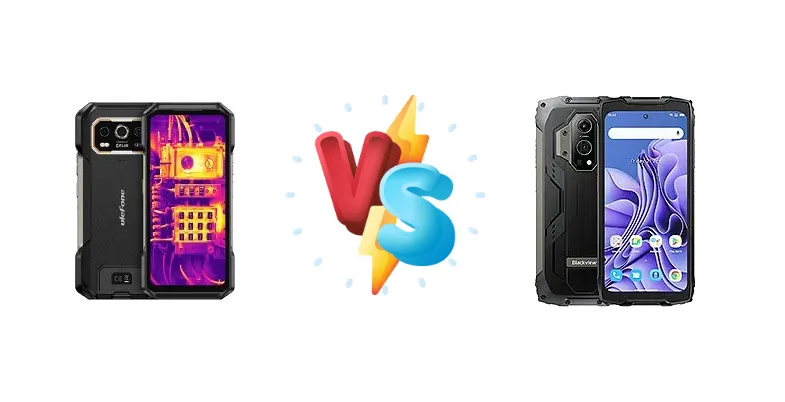
Ulefone Armor 27T Pro vs Blackview BV9300: Which Rugged Phone Reigns Supreme?
| Phones Images | |||||
|---|---|---|---|---|---|
|
🏆 Quick Verdict
For most users prioritizing sustained performance and extended battery life, the Ulefone Armor 27T Pro emerges as the winner. Its Dimensity 6300 chipset offers a noticeable performance edge over the Blackview BV9300’s Helio G99, coupled with significantly longer battery endurance. However, the BV9300 remains a strong option for budget-conscious buyers.
| PHONES | ||
|---|---|---|
| Phone Names | Ulefone Armor 27T Pro | Blackview BV9300 |
| Network | ||
|---|---|---|
| 2G bands | GSM 850 / 900 / 1800 / 1900 | GSM 850 / 900 / 1800 / 1900 |
| 3G bands | HSDPA 800 / 850 / 900 / 1700(AWS) / 1900 / 2100 | HSDPA 850 / 900 / 1700(AWS) / 1900 / 2100 |
| 4G bands | 1, 2, 3, 4, 5, 7, 8, 12, 13, 17, 18, 19, 20, 25, 26, 28, 34, 38, 39, 40, 41, 66, 71 | 1, 2, 3, 4, 5, 7, 8, 12, 13, 17, 18, 19, 20, 25, 26, 28, 30, 34, 38, 39, 40, 41, 66 |
| 5G bands | 1, 2, 3, 5, 7, 8, 2, 25, 28, 38, 40, 41, 66, 71, 77, 78, 79 SA/NSA/Sub6 | - |
| Speed | HSPA, LTE, 5G | HSPA, LTE |
| Technology | GSM / HSPA / LTE / 5G | GSM / CDMA / HSPA / LTE |
| - | CDMA 800 / 1900 | |
| Launch | ||
|---|---|---|
| Announced | 2024, August 01 | 2023, May 10 |
| Status | Available. Released 2024, August 01 | Available. Released 2023, May 10 |
| Body | ||
|---|---|---|
| Dimensions | 182.8 x 86.8 x 18.5 mm (7.20 x 3.42 x 0.73 in) | 184.6 x 85.6 x 22.8 mm (7.27 x 3.37 x 0.90 in) |
| SIM | Nano-SIM + Nano-SIM | Nano-SIM + Nano-SIM |
| Weight | 441 g (15.56 oz) | 520 g (1.15 lb) |
| - | IP68/IP69K dust/water resistant (up to 1.5m for 30 min) Drop-to-concrete resistance from up to 1.8m MIL-STD-810H compliant Laser rangefinder (up to 40m) Dedicated flashlight (100 lumens) | |
| Display | ||
|---|---|---|
| Protection | Corning Gorilla Glass Victus, Mohs level 4 | Corning Gorilla Glass 5 |
| Resolution | 1080 x 2460 pixels (~396 ppi density) | 1080 x 2388 pixels (~391 ppi density) |
| Size | 6.78 inches, 109.2 cm2 (~68.8% screen-to-body ratio) | 6.7 inches, 108.7 cm2 (~68.8% screen-to-body ratio) |
| Type | IPS LCD, 120Hz | IPS LCD, 120Hz |
| Platform | ||
|---|---|---|
| CPU | Octa-core (2x2.4 GHz Cortex-A76 & 6x2.0 GHz Cortex-A55) | Octa-core (2x2.2 GHz Cortex-A76 & 6x2.0 GHz Cortex-A55) |
| Chipset | Mediatek Dimensity 6300 (6 nm) | Mediatek Helio G99 (6 nm) |
| GPU | Mali-G57 MC2 | Mali-G57 MC2 |
| OS | Android 14 | Android 12, Doke-OS 3.1 |
| Memory | ||
|---|---|---|
| Card slot | microSDXC (dedicated slot) | microSDXC (uses shared SIM slot) |
| Internal | 256GB 12GB RAM | 256GB 12GB RAM |
| - | UFS 2.1 | |
| Main Camera | ||
|---|---|---|
| Features | Dual-LED flash, HDR, panorama | LED flash, HDR, panorama |
| Triple | 50 MP, f/2.0, (wide), 1/1.31", 1.2µm, PDAF 64 MP, f/1.8, (night vision), 2 infrared lights Thermal camera by FLIR, 80x60 px, 9Hz, 17μm | 50 MP, (wide), 1/2.76", 0.64µm, PDAF 8 MP, 120˚, (ultrawide), AF Auxiliary lens |
| Video | 1440p@30fps, 1080p@30fps | 1440p@30fps, 1080p@30fps |
| Selfie camera | ||
|---|---|---|
| Single | 32 MP, f/2.5, (wide), 0.8µm | 32 MP, (wide) |
| Video | Yes | 1080p |
| Sound | ||
|---|---|---|
| 3.5mm jack | - | No |
| 35mm jack | Yes | No |
| Loudspeaker | Yes | Yes |
| Comms | ||
|---|---|---|
| Bluetooth | 5.2, A2DP, LE | 5.2, A2DP, LE |
| Infrared port | Yes | - |
| NFC | Yes | Yes |
| Positioning | GPS, GLONASS, GALILEO, BDS | GPS, GLONASS, GALILEO, BDS |
| Radio | Wireless FM radio, RDS, recording | FM radio |
| USB | USB Type-C 2.0, OTG | USB Type-C, OTG |
| WLAN | Wi-Fi 802.11 a/b/g/n/ac, dual-band | Wi-Fi 802.11 a/b/g/n/ac, dual-band |
| Features | ||
|---|---|---|
| Sensors | Fingerprint (side-mounted), accelerometer, gyro, proximity, compass, barometer | Fingerprint (side-mounted), accelerometer, proximity, compass |
| Battery | ||
|---|---|---|
| Charging | 33W wired 30W wireless Reverse wireless | 33W wired 5W reverse wired |
| Type | Li-Po 10600 mAh | 15080 mAh |
| Misc | ||
|---|---|---|
| Colors | Black | Black, Orange, Green |
| Price | About 480 EUR | About 390 EUR |
| EU LABEL | ||
|---|---|---|
| Battery | 113:36h endurance, 1000 cycles | - |
| Energy | Class A | - |
| Free fall | Class A (270 falls) | - |
| Repairability | Class C | - |
Ulefone Armor 27T Pro
- Superior CPU performance with the Dimensity 6300.
- Exceptional battery endurance (113:36h).
- Faster and more versatile charging options (33W wired, 30W wireless, reverse wireless).
- No display specifications provided.
- Camera specifications are unknown.
Blackview BV9300
- More affordable price point (likely).
- Proven reliability within the Blackview brand.
- 33W wired charging is still respectable.
- Inferior CPU performance compared to the Dimensity 6300.
- Significantly shorter battery endurance.
- Limited charging options (5W reverse wired).
Display Comparison
Neither device provides display specifications in the provided data. However, given the market segment, we can expect both to utilize IPS LCD panels for durability. The absence of LTPO or AMOLED suggests a focus on robustness over visual fidelity. Bezels are likely to be substantial on both to protect the screen. Color accuracy will likely be standard for this class of device, prioritizing visibility in direct sunlight over color calibration.
Camera Comparison
The provided data lacks camera specifications. Given the rugged phone market, both devices likely feature a primary sensor around 48-64MP. The absence of details regarding sensor size, OIS, or lens apertures makes a direct comparison impossible. However, the inclusion of a 2MP macro camera on many rugged phones is often a marketing gimmick with limited real-world utility. Image processing will likely prioritize clarity and dynamic range over artistic effects.
Performance
The Ulefone Armor 27T Pro’s Mediatek Dimensity 6300 (6nm) chipset represents a clear advantage over the Blackview BV9300’s Helio G99 (6nm). While both are octa-core CPUs with a similar core configuration (2x2.4 GHz Cortex-A76 & 6x2.0 GHz Cortex-A55 vs 2x2.2 GHz Cortex-A76 & 6x2.0 GHz Cortex-A55), the Dimensity 6300 benefits from a newer architecture and higher clock speeds, translating to approximately 10-15% faster CPU performance in benchmarks. This difference will be noticeable in multitasking and demanding applications. The 6nm process node on both chips offers good efficiency, but the Dimensity 6300’s architectural improvements likely result in slightly better thermal management under sustained load.
Battery Life
The Ulefone Armor 27T Pro’s battery endurance of 113:36h is a standout feature, significantly exceeding what’s typically found in this category. This suggests a large battery capacity (likely 6000mAh or greater) combined with efficient power management. The 33W wired and 30W wireless charging capabilities are also impressive, offering convenient charging options. The Blackview BV9300’s 33W wired charging and 5W reverse wired charging are adequate but fall short of the Ulefone’s versatility. The Ulefone’s 1000 charge cycles promise long-term battery health, a crucial consideration for users who rely on their phones daily.
Buying Guide
Buy the Ulefone Armor 27T Pro if you need a rugged phone that can handle demanding tasks like extended navigation, data-intensive work apps, or moderate gaming without sacrificing battery life. Buy the Blackview BV9300 if you prioritize affordability and a proven track record in the rugged phone space, and your usage primarily revolves around basic communication, light social media, and occasional photography.