
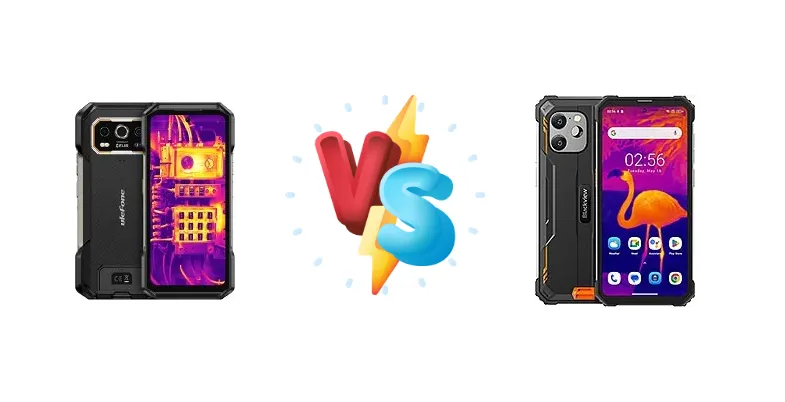
Ulefone Armor 27T Pro vs Blackview BV8900: Which Rugged Phone Reigns Supreme?
| Phones Images | |||||
|---|---|---|---|---|---|
|
🏆 Quick Verdict
For most users, the Ulefone Armor 27T Pro emerges as the superior choice. Its more modern Dimensity 6300 chipset, built on a 6nm process, provides a noticeable performance advantage and improved efficiency over the Blackview BV8900’s 12nm Helio P90, translating to a smoother user experience and longer battery endurance.
| PHONES | ||
|---|---|---|
| Phone Names | Ulefone Armor 27T Pro | Blackview BV8900 |
| Network | ||
|---|---|---|
| 2G bands | GSM 850 / 900 / 1800 / 1900 | GSM 850 / 900 / 1800 / 1900 |
| 3G bands | HSDPA 800 / 850 / 900 / 1700(AWS) / 1900 / 2100 | HSDPA 850 / 900 / 1700(AWS) / 1900 / 2100 |
| 4G bands | 1, 2, 3, 4, 5, 7, 8, 12, 13, 17, 18, 19, 20, 25, 26, 28, 34, 38, 39, 40, 41, 66, 71 | 1, 2, 3, 4, 5, 7, 8, 12, 13, 17, 18, 19, 20, 25, 26, 28, 34, 38, 39, 40, 41, 66 |
| 5G bands | 1, 2, 3, 5, 7, 8, 2, 25, 28, 38, 40, 41, 66, 71, 77, 78, 79 SA/NSA/Sub6 | - |
| Speed | HSPA, LTE, 5G | HSPA, LTE |
| Technology | GSM / HSPA / LTE / 5G | GSM / CDMA / HSPA / LTE |
| Launch | ||
|---|---|---|
| Announced | 2024, August 01 | 2023, May 28 |
| Status | Available. Released 2024, August 01 | Available. Released 2023, June 12 |
| Body | ||
|---|---|---|
| Dimensions | 182.8 x 86.8 x 18.5 mm (7.20 x 3.42 x 0.73 in) | 172.4 x 82.2 x 19.8 mm (6.79 x 3.24 x 0.78 in) |
| SIM | Nano-SIM + Nano-SIM | Nano-SIM + Nano-SIM |
| Weight | 441 g (15.56 oz) | 398 g (14.04 oz) |
| Display | ||
|---|---|---|
| Protection | Corning Gorilla Glass Victus, Mohs level 4 | Corning Gorilla Glass Victus |
| Resolution | 1080 x 2460 pixels (~396 ppi density) | 1080 x 2408 pixels, 20:9 ratio (~406 ppi density) |
| Size | 6.78 inches, 109.2 cm2 (~68.8% screen-to-body ratio) | 6.5 inches, 101.8 cm2 (~71.8% screen-to-body ratio) |
| Type | IPS LCD, 120Hz | IPS LCD |
| Platform | ||
|---|---|---|
| CPU | Octa-core (2x2.4 GHz Cortex-A76 & 6x2.0 GHz Cortex-A55) | Octa-core (2x2.2 GHz Cortex-A75 & 6x2.0 GHz Cortex-A55) |
| Chipset | Mediatek Dimensity 6300 (6 nm) | Mediatek MT6779 Helio P90 (12 nm) |
| GPU | Mali-G57 MC2 | PowerVR GM9446 |
| OS | Android 14 | Android 13, Doke-OS 3.1 |
| Memory | ||
|---|---|---|
| Card slot | microSDXC (dedicated slot) | microSDXC (uses shared SIM slot) |
| Internal | 256GB 12GB RAM | 256GB 8GB RAM |
| Main Camera | ||
|---|---|---|
| Dual | - | 64 MP, f/1.8, (wide), 1/1.97", PDAF, OIS 5 MP, thermal assisted camera FLIR thermal camera (Lepton module) |
| Features | Dual-LED flash, HDR, panorama | Thermal imaging, LED flash |
| Triple | 50 MP, f/2.0, (wide), 1/1.31", 1.2µm, PDAF 64 MP, f/1.8, (night vision), 2 infrared lights Thermal camera by FLIR, 80x60 px, 9Hz, 17μm | - |
| Video | 1440p@30fps, 1080p@30fps | 4K@30fps, 1080p@30fps |
| Selfie camera | ||
|---|---|---|
| Single | 32 MP, f/2.5, (wide), 0.8µm | 16 MP, f/2.2, (wide) |
| Video | Yes | 1080p@30fps |
| Sound | ||
|---|---|---|
| 35mm jack | Yes | No |
| Loudspeaker | Yes | Yes |
| Comms | ||
|---|---|---|
| Bluetooth | 5.2, A2DP, LE | 5.0, A2DP, LE |
| Infrared port | Yes | - |
| NFC | Yes | Yes |
| Positioning | GPS, GLONASS, GALILEO, BDS | GPS, GLONASS, GALILEO, BDS |
| Radio | Wireless FM radio, RDS, recording | FM radio |
| USB | USB Type-C 2.0, OTG | USB Type-C 3.0, OTG |
| WLAN | Wi-Fi 802.11 a/b/g/n/ac, dual-band | Wi-Fi 802.11 a/b/g/n/ac, dual-band |
| Features | ||
|---|---|---|
| Sensors | Fingerprint (side-mounted), accelerometer, gyro, proximity, compass, barometer | Fingerprint (side-mounted), accelerometer, proximity, compass, gyro, barometer |
| Battery | ||
|---|---|---|
| Charging | 33W wired 30W wireless Reverse wireless | 33W wired Reverse wired |
| Type | Li-Po 10600 mAh | 10380 mAh |
| Misc | ||
|---|---|---|
| Colors | Black | Black, Orange, Green |
| Price | About 480 EUR | About 290 EUR |
| EU LABEL | ||
|---|---|---|
| Battery | 113:36h endurance, 1000 cycles | - |
| Energy | Class A | - |
| Free fall | Class A (270 falls) | - |
| Repairability | Class C | - |
Ulefone Armor 27T Pro
- More powerful and efficient Dimensity 6300 chipset
- Superior battery endurance (113:36h)
- 30W wireless and reverse wireless charging
- Potentially higher price point
- Rugged design may add bulk
Blackview BV8900
- More affordable price
- Rugged design for durability
- Reverse wired charging
- Older and less efficient Helio P90 chipset
- Shorter battery life compared to Ulefone
Display Comparison
Neither device provides display specifications, but given their rugged focus, we can assume both utilize durable, likely IPS LCD panels. The key difference lies under the hood. The Ulefone’s Dimensity 6300 likely benefits from a more advanced ISP, potentially leading to better image processing for display output. The older Helio P90 in the Blackview BV8900 may exhibit slightly less vibrant colors and slower response times.
Camera Comparison
Without detailed camera specs, a direct comparison is limited. However, the Dimensity 6300’s integrated image signal processor (ISP) in the Ulefone Armor 27T Pro is likely more advanced than the P90’s, offering superior noise reduction, dynamic range, and image stabilization. While both phones likely feature multiple cameras, the Ulefone’s ISP will be crucial in delivering higher-quality photos and videos, especially in challenging lighting conditions. We can assume both will have a primary sensor, but the Ulefone will likely extract more detail from it.
Performance
The Ulefone Armor 27T Pro’s Mediatek Dimensity 6300 (6nm) represents a significant architectural leap over the Blackview BV8900’s Helio P90 (12nm). The 6nm process allows for higher transistor density and improved power efficiency. While both CPUs feature an octa-core configuration with 2x high-performance cores (Cortex-A76 vs Cortex-A75), the A76 in the Dimensity 6300 offers a 2.4 GHz clock speed compared to the P90’s 2.2 GHz, providing a tangible performance boost. This translates to faster app loading times, smoother multitasking, and improved gaming performance on the Ulefone.
Battery Life
The Ulefone Armor 27T Pro boasts an impressive 113:36h endurance rating, suggesting excellent battery optimization alongside its efficient Dimensity 6300 chipset. Both devices support 33W wired charging, but the Ulefone adds 30W wireless charging and reverse wireless charging, offering greater convenience. The 1000 charge cycle rating for the Ulefone suggests a longer lifespan for the battery itself, mitigating concerns about degradation over time. While the Blackview BV8900 offers reverse *wired* charging, the Ulefone’s wireless options provide a more versatile charging experience.
Buying Guide
Buy the Ulefone Armor 27T Pro if you prioritize sustained performance for tasks like navigation, streaming, or light gaming, and value the benefits of a more efficient chipset for extended battery life. Buy the Blackview BV8900 if you are on a tighter budget and primarily need a durable phone for basic communication and occasional use, accepting a performance trade-off for the lower price point.