
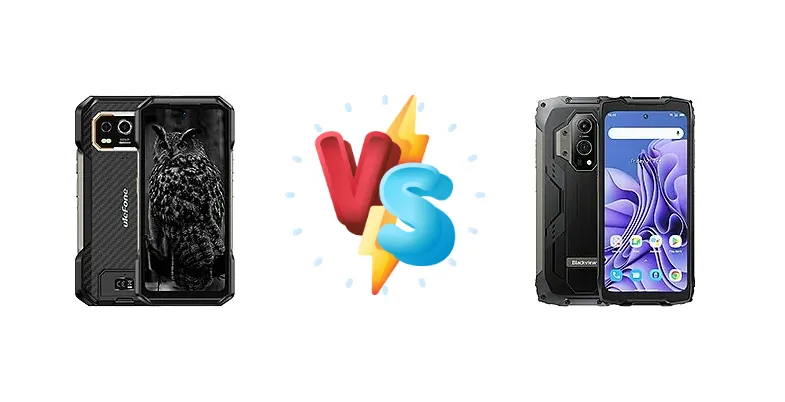
Ulefone Armor 27 vs Blackview BV9300: A Deep Dive into Rugged Performance
| Phones Images | |||||
|---|---|---|---|---|---|
|
🏆 Quick Verdict
For the average user prioritizing longevity and convenience, the Ulefone Armor 27 emerges as the winner. Its significantly longer 112-hour endurance rating and inclusion of 30W wireless charging provide a substantial advantage over the Blackview BV9300, despite both sharing the same Helio G99 chipset.
| PHONES | ||
|---|---|---|
| Phone Names | Ulefone Armor 27 | Blackview BV9300 |
| Network | ||
|---|---|---|
| 2G bands | GSM 850 / 900 / 1800 / 1900 | GSM 850 / 900 / 1800 / 1900 |
| 3G bands | HSDPA 800 / 850 / 900 / 1700(AWS) / 1900 / 2100 | HSDPA 850 / 900 / 1700(AWS) / 1900 / 2100 |
| 4G bands | 1, 2, 3, 4, 5, 7, 8, 12, 13, 17, 18, 19, 20, 25, 26, 28, 34, 38, 39, 40, 41, 66, 71 | 1, 2, 3, 4, 5, 7, 8, 12, 13, 17, 18, 19, 20, 25, 26, 28, 30, 34, 38, 39, 40, 41, 66 |
| Speed | HSPA, LTE | HSPA, LTE |
| Technology | GSM / CDMA / HSPA / LTE | GSM / CDMA / HSPA / LTE |
| - | CDMA 800 / 1900 | |
| Launch | ||
|---|---|---|
| Announced | 2024, November | 2023, May 10 |
| Status | Available. Released 2024, November | Available. Released 2023, May 10 |
| Body | ||
|---|---|---|
| Dimensions | 182.8 x 86.8 x 18.5 mm (7.20 x 3.42 x 0.73 in) | 184.6 x 85.6 x 22.8 mm (7.27 x 3.37 x 0.90 in) |
| SIM | Nano-SIM + Nano-SIM | Nano-SIM + Nano-SIM |
| Weight | 441 g (15.56 oz) | 520 g (1.15 lb) |
| - | IP68/IP69K dust/water resistant (up to 1.5m for 30 min) Drop-to-concrete resistance from up to 1.8m MIL-STD-810H compliant Laser rangefinder (up to 40m) Dedicated flashlight (100 lumens) | |
| Display | ||
|---|---|---|
| Protection | Corning Gorilla Glass Victus, Mohs level 4 | Corning Gorilla Glass 5 |
| Resolution | 1080 x 2460 pixels (~396 ppi density) | 1080 x 2388 pixels (~391 ppi density) |
| Size | 6.78 inches, 109.2 cm2 (~68.8% screen-to-body ratio) | 6.7 inches, 108.7 cm2 (~68.8% screen-to-body ratio) |
| Type | IPS LCD, 120Hz | IPS LCD, 120Hz |
| Platform | ||
|---|---|---|
| CPU | Octa-core (2x2.2 GHz Cortex-A76 & 6x2.0 GHz Cortex-A55) | Octa-core (2x2.2 GHz Cortex-A76 & 6x2.0 GHz Cortex-A55) |
| Chipset | Mediatek Helio G99 (6 nm) | Mediatek Helio G99 (6 nm) |
| GPU | Mali-G57 MC2 | Mali-G57 MC2 |
| OS | Android 14 | Android 12, Doke-OS 3.1 |
| Memory | ||
|---|---|---|
| Card slot | microSDXC (dedicated slot) | microSDXC (uses shared SIM slot) |
| Internal | 256GB 12GB RAM | 256GB 12GB RAM |
| - | UFS 2.1 | |
| Main Camera | ||
|---|---|---|
| Features | Dual-LED flash, HDR, panorama | LED flash, HDR, panorama |
| Triple | 50 MP, f/2.0, (wide), 1/1.31", 1.2µm, PDAF 50 MP, f/2.2, 117˚ (ultrawide) 64 MP, f/1.8, (night vision), 2 infrared lights | 50 MP, (wide), 1/2.76", 0.64µm, PDAF 8 MP, 120˚, (ultrawide), AF Auxiliary lens |
| Video | 1440p@30fps, 1080p@30fps | 1440p@30fps, 1080p@30fps |
| Selfie camera | ||
|---|---|---|
| Single | 32 MP, f/2.5, (wide), 0.8µm | 32 MP, (wide) |
| Video | Yes | 1080p |
| Sound | ||
|---|---|---|
| 3.5mm jack | - | No |
| 35mm jack | Yes | No |
| Loudspeaker | Yes | Yes |
| Comms | ||
|---|---|---|
| Bluetooth | 5.2, A2DP, LE | 5.2, A2DP, LE |
| Infrared port | Yes | - |
| NFC | Yes | Yes |
| Positioning | GPS, GLONASS, GALILEO, BDS | GPS, GLONASS, GALILEO, BDS |
| Radio | Wireless FM radio, RDS, recording | FM radio |
| USB | USB Type-C 2.0, OTG | USB Type-C, OTG |
| WLAN | Wi-Fi 802.11 a/b/g/n/ac, dual-band | Wi-Fi 802.11 a/b/g/n/ac, dual-band |
| Features | ||
|---|---|---|
| Sensors | Fingerprint (side-mounted), accelerometer, gyro, proximity, compass, barometer | Fingerprint (side-mounted), accelerometer, proximity, compass |
| Battery | ||
|---|---|---|
| Charging | 33W wired 30W wireless 5W reverse wireless | 33W wired 5W reverse wired |
| Type | Li-Po 10600 mAh | 15080 mAh |
| Misc | ||
|---|---|---|
| Colors | Black | Black, Orange, Green |
| Price | About 340 EUR | About 390 EUR |
| EU LABEL | ||
|---|---|---|
| Battery | 112:15h endurance, 1000 cycles | - |
| Energy | Class A | - |
| Free fall | Class A (270 falls) | - |
| Repairability | Class C | - |
Ulefone Armor 27
- Superior battery endurance (112h)
- 30W wireless charging support
- 5W reverse wireless charging
- 1000 charge cycle battery lifespan
- Potentially higher price point
- Rugged design may be bulky
Blackview BV9300
- Competitive price
- 33W wired charging
- Rugged and durable build
- Helio G99 provides adequate performance
- Shorter battery life (estimated)
- Lacks wireless charging
Display Comparison
Both devices are expected to feature similar LCD panels given their market segment, but specific details like resolution and peak brightness are missing. The absence of LTPO technology suggests neither will offer adaptive refresh rates for power saving. Bezels are likely comparable, focusing on durability rather than minimizing size. Color accuracy will likely be standard for rugged phones, prioritizing visibility in direct sunlight over color fidelity.
Camera Comparison
Without detailed camera specifications, a direct comparison is limited. Both phones likely feature a multi-camera setup, but the quality will hinge on sensor size and image processing. The inclusion of a 2MP macro camera on either device is largely a marketing tactic, offering minimal practical benefit. The aperture of the main sensor will be a key differentiator, impacting low-light performance. Image processing style – whether leaning towards natural or heavily saturated colors – will also influence user preference.
Performance
Both the Ulefone Armor 27 and Blackview BV9300 utilize the Mediatek Helio G99 chipset, featuring an octa-core CPU configuration with 2x2.2 GHz Cortex-A76 and 6x2.0 GHz Cortex-A55 cores. This means CPU performance will be virtually identical for everyday tasks and moderate gaming. Thermal management will be crucial; while the 6nm process is efficient, sustained loads could lead to throttling. The lack of information on RAM type (LPDDR4X vs LPDDR5) and storage speed (UFS 2.2 vs UFS 3.1) prevents a deeper analysis of multitasking and app loading times.
Battery Life
The Ulefone Armor 27’s 112-hour endurance rating is a significant advantage over the Blackview BV9300, which lacks a published endurance figure. This translates to considerably longer usage between charges. While both support 33W wired charging, the Ulefone adds 30W wireless charging and 5W reverse wireless charging, offering greater flexibility. The Ulefone also claims 1000 charge cycles, suggesting a longer lifespan for the battery itself. A full 0-100% charge via wired connection is estimated to take around 1 hour 45 minutes for both, but the Ulefone’s wireless charging provides a convenient alternative, albeit slower.
Buying Guide
Buy the Ulefone Armor 27 if you need maximum uptime between charges and value the convenience of wireless charging, especially for extended outdoor adventures or work in remote locations. Buy the Blackview BV9300 if you prioritize a slightly lower initial cost and don't mind relying solely on wired charging, accepting a shorter overall battery life.