
Ulefone Armor 26 Ultra vs. Nokia XR21: A Deep Dive into Rugged Smartphone Performance
| Phones Images | |||||
|---|---|---|---|---|---|
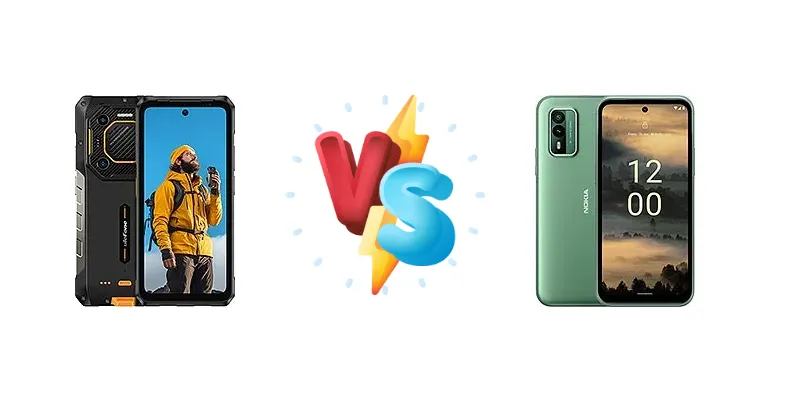
|
🏆 Quick Verdict
For users prioritizing raw power and rapid charging, the Ulefone Armor 26 Ultra is the clear winner. Its Dimensity 8020 chipset delivers significantly higher performance. However, the Nokia XR21 offers a more refined, energy-efficient experience and benefits from Nokia’s software support, making it ideal for everyday use and those less concerned with peak performance.
| PHONES | ||
|---|---|---|
| Phone Names | Ulefone Armor 26 Ultra | Nokia XR21 |
| Network | ||
|---|---|---|
| 2G bands | GSM 850 / 900 / 1800 / 1900 | GSM 850 / 900 / 1800 / 1900 |
| 3G bands | HSDPA 850 / 900 / 1700(AWS) / 1900 / 2100 | HSDPA 850 / 900 / 1700(AWS) / 1900 / 2100 |
| 4G bands | 1, 2, 3, 4, 5, 7, 8, 12, 13, 17, 18, 19, 20, 25, 26, 28, 34, 38, 39, 40, 41, 66, 71 | 1, 2, 3, 4, 5, 7, 8, 12, 13, 17, 20, 25, 26, 28, 32, 38, 39, 40, 41, 42, 43, 48, 66, 71 |
| 5G bands | 1, 2, 3, 5, 7, 8, 20, 25, 28, 38, 40, 41, 66, 71, 77, 78, 79 SA/NSA/Sub6 | 1, 2, 3, 5, 7, 20, 25, 28, 40, 41, 66, 71, 77, 78, 79 SA/NSA |
| Speed | HSPA, LTE, 5G | HSPA, LTE, 5G |
| Technology | GSM / CDMA / HSPA / LTE / 5G | GSM / HSPA / LTE / 5G |
| Launch | ||
|---|---|---|
| Announced | 2024, April | 2023, May 03 |
| Status | Available. Released 2024, April | Available. Released 2023, June 11 |
| Body | ||
|---|---|---|
| Build | - | Glass front (Gorilla Glass Victus), plastic back, plastic frame |
| Dimensions | 179 x 83 x 25.5 mm (7.05 x 3.27 x 1.00 in) | 168 x 78.6 x 10.5 mm (6.61 x 3.09 x 0.41 in) |
| SIM | Nano-SIM + Nano-SIM | Nano-SIM + Nano-SIM + eSIM (max 2 at a time) |
| Weight | 609 g (1.34 lb) | 231 g (8.15 oz) |
| - | IP68/IP69K dust/water resistant (up to 1.5m for 60 min) Drop-to-concrete resistance from up to 1.8m MIL-STD-810H compliant | |
| Display | ||
|---|---|---|
| Protection | Corning Gorilla Glass 5, Mohs level 4 | Corning Gorilla Glass Victus |
| Resolution | 1080 x 2460 pixels (~396 ppi density) | 1080 x 2400 pixels, 20:9 ratio (~406 ppi density) |
| Size | 6.78 inches, 109.2 cm2 (~73.5% screen-to-body ratio) | 6.49 inches, 101.7 cm2 (~77.0% screen-to-body ratio) |
| Type | IPS LCD, 120Hz | IPS LCD, 120Hz, 450 nits (typ), 550 nits (HBM) |
| Platform | ||
|---|---|---|
| CPU | Octa-core (4x2.6 GHz Cortex-A78 & 4x2.0 GHz Cortex-A55) | Octa-core (2x2.2 GHz Kryo 660 Gold & 6x1.7 GHz Kryo 660 Silver) |
| Chipset | Mediatek Dimensity 8020 (6 nm) | Qualcomm SM6375 Snapdragon 695 5G (6 nm) |
| GPU | Mali-G77 MC9 | Adreno 619 |
| OS | Android 13 | Android 12 |
| Memory | ||
|---|---|---|
| Card slot | microSDXC (dedicated slot) | Unspecified |
| Internal | 512GB 12GB RAM | 128GB 6GB RAM |
| Main Camera | ||
|---|---|---|
| Dual | - | 64 MP, f/1.8, (wide), 1/2.0", PDAF 8 MP, f/2.2, (ultrawide), 1/4.0", 1.12µm |
| Features | Quad-LED flash, HDR, panorama | Dual-LED dual-tone flash, second LED flash, HDR, panorama |
| Quad | 200 MP, f/1.8, (wide), 1/1.4", 0.56µm, PDAF 8 MP, (telephoto), 3.2x optical zoom 50 MP, f/2.2, 117˚ (ultrawide) 64 MP, f/1.8, (night vision), 2 infrared night vision lights | - |
| Video | 4K@30fps, 1080p@30fps | 1080p@30fps |
| Selfie camera | ||
|---|---|---|
| Single | 50 MP, f/2.3, (wide), 1.0µm | 16 MP, f/2.4 (wide) |
| Video | 1080p@30fps | 1080p@30fps |
| Sound | ||
|---|---|---|
| 3.5mm jack | - | Yes |
| 35mm jack | Yes | Yes |
| Loudspeaker | Yes | Yes, with stereo speakers |
| Comms | ||
|---|---|---|
| Bluetooth | 5.2, A2DP, LE | 5.1, A2DP, LE, aptX Adaptive |
| Infrared port | Yes | - |
| NFC | Yes | Yes (market/region dependent) |
| Positioning | GPS (L1+L5), GLONASS, GALILEO, BDS, QZSS | GPS (L1+L5), GLONASS (G1), BDS (B1I+B1c+B2a), GALILEO (E1+E5a), QZSS (L1+L5), NavIC (L5) |
| Radio | Wireless FM radio, RDS, recording | Unspecified |
| USB | USB Type-C 3.1, OTG | USB Type-C 2.0, OTG |
| WLAN | Wi-Fi 802.11 a/b/g/n/ac/6, dual-band | Wi-Fi 802.11 a/b/g/n/ac/6, dual-band |
| Features | ||
|---|---|---|
| Sensors | Fingerprint (side-mounted), accelerometer, proximity, compass, gyro, barometer | Fingerprint (side-mounted), accelerometer, gyro, proximity, compass, barometer |
| Battery | ||
|---|---|---|
| Charging | 120W wired 33W wireless (via docking station with pins) Reverse wired | 33W wired, PD2.0, QC3 |
| Type | Li-Po 15600 mAh | Li-Po 4800 mAh |
| Misc | ||
|---|---|---|
| Colors | Black | Midnight Black, Pine Green |
| Price | € 442.99 / $ 371.99 | About 570 EUR |
| EU LABEL | ||
|---|---|---|
| Battery | 151:31h endurance, 1000 cycles | - |
| Energy | Class B | - |
| Free fall | Class A (270 falls) | - |
| Repairability | Class B | - |
Ulefone Armor 26 Ultra
- Significantly faster processor (Dimensity 8020)
- Ultra-fast 120W wired charging
- Long battery life (151:31h endurance)
- 1000 charge cycles for extended battery health
- Potentially higher price point
- May generate more heat under sustained load
Nokia XR21
- Reliable Snapdragon 695 5G chipset
- Efficient power consumption
- Nokia’s software support and updates
- More affordable price (likely)
- Slower charging speed (33W)
- Lower processing power compared to Ulefone
Display Comparison
Display specifications are absent from the provided data, but considering the target market, both likely feature durable, scratch-resistant panels. The Ulefone, positioned as 'Ultra', may offer a higher resolution or refresh rate. However, without specific details like peak brightness (nits) or panel technology (LTPO), it's difficult to assess a clear advantage. Bezels are likely minimized on both to maximize screen real estate, but the Ulefone's focus on premium features suggests a potentially more refined display experience.
Camera Comparison
Camera details are limited. However, the absence of any mention of a high-resolution sensor on the Nokia XR21 suggests a more modest camera system focused on practicality. The Ulefone, with its 'Ultra' branding, likely features a more advanced camera setup, potentially with a larger sensor and more sophisticated image processing. Without specific sensor sizes or aperture information, it’s difficult to make a definitive judgment, but the Ulefone is positioned to offer a superior photographic experience.
Performance
The performance gap is substantial. The Ulefone Armor 26 Ultra’s Mediatek Dimensity 8020 (6nm) boasts an octa-core configuration with 4x2.6 GHz Cortex-A78 cores and 4x2.0 GHz Cortex-A55 cores, representing a significant leap in processing power compared to the Nokia XR21’s Qualcomm Snapdragon 695 5G (6nm) with its 2x2.2 GHz Kryo 660 Gold and 6x1.7 GHz Kryo 660 Silver cores. The Dimensity 8020’s higher clock speeds and more powerful core architecture translate to faster app loading, smoother multitasking, and superior gaming performance. While both chipsets are fabricated on a 6nm process, the Dimensity 8020’s architecture is demonstrably more capable. The Ulefone will benefit users who need to run demanding applications or enjoy graphically intensive games.
Battery Life
The Ulefone Armor 26 Ultra claims an impressive 151:31h endurance and supports 120W wired charging, alongside 33W wireless charging via a docking station. This combination offers incredibly fast charging times and exceptional battery life, with the added benefit of 1000 charge cycles suggesting long-term battery health. The Nokia XR21, with 33W wired charging (PD2.0, QC3), is significantly slower. While the Nokia XR21’s battery capacity is unknown, the Ulefone’s charging speed and endurance rating provide a clear advantage for users who prioritize minimizing downtime.
Buying Guide
Buy the Ulefone Armor 26 Ultra if you need a rugged phone capable of demanding tasks like mobile gaming, video editing, or running resource-intensive applications, and value the fastest possible charging speeds. Buy the Nokia XR21 if you prefer a dependable, long-lasting device for communication, navigation, and basic smartphone functions, prioritizing software updates and a more balanced power consumption profile.