
Ulefone Armor 26 Ultra vs. Doogee V Max LR: A Deep Dive into Rugged Smartphone Performance
| Phones Images | |||||
|---|---|---|---|---|---|
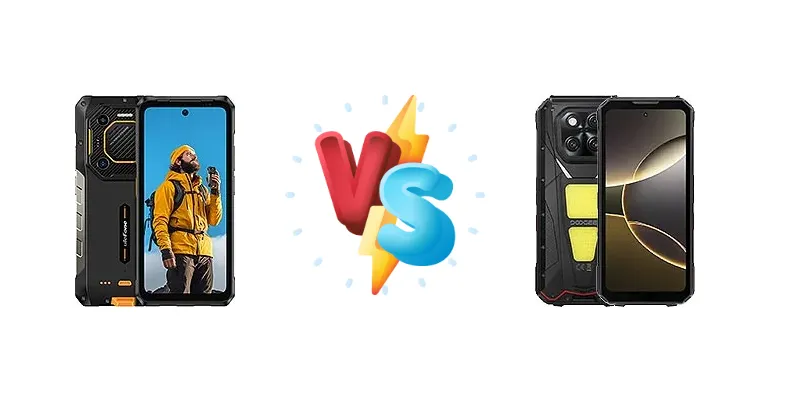
|
🏆 Quick Verdict
For users prioritizing raw performance and faster charging, the Ulefone Armor 26 Ultra is the clear winner. Its Dimensity 8020 chipset offers a performance edge, complemented by 120W charging. However, the Doogee V Max LR counters with significantly longer battery endurance, making it ideal for extended off-grid use.
| PHONES | ||
|---|---|---|
| Phone Names | Ulefone Armor 26 Ultra | Doogee V Max LR |
| Network | ||
|---|---|---|
| 2G bands | GSM 850 / 900 / 1800 / 1900 | GSM 850 / 900 / 1800 / 1900 |
| 3G bands | HSDPA 850 / 900 / 1700(AWS) / 1900 / 2100 | HSDPA 800 / 850 / 900 / 1700(AWS) / 1900 / 2100 |
| 4G bands | 1, 2, 3, 4, 5, 7, 8, 12, 13, 17, 18, 19, 20, 25, 26, 28, 34, 38, 39, 40, 41, 66, 71 | 1, 2, 3, 4, 5, 7, 8, 12, 17, 18, 19, 20, 25, 26, 28, 34, 38, 39, 40, 41, 66 |
| 5G bands | 1, 2, 3, 5, 7, 8, 20, 25, 28, 38, 40, 41, 66, 71, 77, 78, 79 SA/NSA/Sub6 | 1, 3, 7, 28, 38, 41, 77, 78, 79 SA/NSA |
| Speed | HSPA, LTE, 5G | HSPA, LTE, 5G |
| Technology | GSM / CDMA / HSPA / LTE / 5G | GSM / CDMA / HSPA / LTE / 5G |
| Launch | ||
|---|---|---|
| Announced | 2024, April | 2025, September |
| Status | Available. Released 2024, April | Available. Released 2025, October |
| Body | ||
|---|---|---|
| Dimensions | 179 x 83 x 25.5 mm (7.05 x 3.27 x 1.00 in) | 183.5 x 85.4 x 30.5 mm (7.22 x 3.36 x 1.20 in) |
| SIM | Nano-SIM + Nano-SIM | Nano-SIM + Nano-SIM |
| Weight | 609 g (1.34 lb) | 630 g (1.39 lb) |
| Display | ||
|---|---|---|
| Protection | Corning Gorilla Glass 5, Mohs level 4 | Mohs level 6 |
| Resolution | 1080 x 2460 pixels (~396 ppi density) | 1080 x 2460 pixels (~396 ppi density) |
| Size | 6.78 inches, 109.2 cm2 (~73.5% screen-to-body ratio) | 6.78 inches, 109.2 cm2 (~69.7% screen-to-body ratio) |
| Type | IPS LCD, 120Hz | IPS LCD, 120Hz, 500 nits |
| Platform | ||
|---|---|---|
| CPU | Octa-core (4x2.6 GHz Cortex-A78 & 4x2.0 GHz Cortex-A55) | Octa-core (2x2.6 GHz Cortex-A78 & 6x2.0 GHz Cortex-A55) |
| Chipset | Mediatek Dimensity 8020 (6 nm) | Mediatek Dimensity 7300 (4 nm) |
| GPU | Mali-G77 MC9 | Mali-G615 MC2 |
| OS | Android 13 | Android 15 |
| Memory | ||
|---|---|---|
| Card slot | microSDXC (dedicated slot) | microSDXC (dedicated slot) |
| Internal | 512GB 12GB RAM | 512GB 16GB RAM |
| Main Camera | ||
|---|---|---|
| Features | Quad-LED flash, HDR, panorama | Dual-LED flash, HDR, panorama |
| Quad | 200 MP, f/1.8, (wide), 1/1.4", 0.56µm, PDAF 8 MP, (telephoto), 3.2x optical zoom 50 MP, f/2.2, 117˚ (ultrawide) 64 MP, f/1.8, (night vision), 2 infrared night vision lights | - |
| Triple | - | 200 MP, f/2.0, (wide), 1/1.3", PDAF 20 MP, f/1.8, (night vision), 2 infrared night vision lights 8 MP, f/2.2, 119˚ (ultrawide) |
| Video | 4K@30fps, 1080p@30fps | 4K@30fps, 1080p@30fps |
| Selfie camera | ||
|---|---|---|
| Single | 50 MP, f/2.3, (wide), 1.0µm | 32 MP, f/2.3, (wide) |
| Video | 1080p@30fps | 1080p@30fps |
| Sound | ||
|---|---|---|
| 35mm jack | Yes | No |
| Loudspeaker | Yes | Yes (130 dB) |
| Comms | ||
|---|---|---|
| Bluetooth | 5.2, A2DP, LE | 5.4, A2DP, LE |
| Infrared port | Yes | Yes |
| NFC | Yes | Yes |
| Positioning | GPS (L1+L5), GLONASS, GALILEO, BDS, QZSS | GPS (L1+L5), GLONASS, GALILEO, BDS |
| Radio | Wireless FM radio, RDS, recording | FM radio |
| USB | USB Type-C 3.1, OTG | USB Type-C |
| WLAN | Wi-Fi 802.11 a/b/g/n/ac/6, dual-band | Wi-Fi 802.11 a/b/g/n/ac/6e, dual-band |
| Features | ||
|---|---|---|
| Sensors | Fingerprint (side-mounted), accelerometer, proximity, compass, gyro, barometer | Fingerprint (side-mounted), accelerometer, gyro, proximity, compass |
| Battery | ||
|---|---|---|
| Charging | 120W wired 33W wireless (via docking station with pins) Reverse wired | 45W wired 10W reverse wired |
| Type | Li-Po 15600 mAh | 20500 mAh |
| Misc | ||
|---|---|---|
| Colors | Black | Black, Tarnish |
| Price | € 442.99 / $ 371.99 | About 770 EUR |
| EU LABEL | ||
|---|---|---|
| Battery | 151:31h endurance, 1000 cycles | 192:26h endurance, 1100 cycles |
| Energy | Class B | Class B |
| Free fall | Class A (270 falls) | Class A (270 falls) |
| Repairability | Class B | Class C |
Ulefone Armor 26 Ultra
- Faster 120W charging for quick top-ups.
- More powerful Dimensity 8020 chipset for demanding tasks.
- Potentially better image processing due to the chipset's ISP.
- Shorter battery endurance compared to the Doogee V Max LR.
- Potentially more thermal throttling under sustained load.
Doogee V Max LR
- Exceptional battery life with 192:26h endurance.
- More power-efficient Dimensity 7300 chipset.
- Higher battery cycle count (1100 cycles) for longevity.
- Slower 45W charging.
- Less powerful chipset for intensive applications.
Display Comparison
Display specifications are not provided, so a direct comparison is limited. However, given the target market, both likely feature durable, high-brightness panels. The Armor 26 Ultra's potential for a higher refresh rate (based on the chipset's capabilities) could offer a smoother user experience, but this is speculative. Bezels are likely similar, prioritizing protection over minimal design.
Camera Comparison
Camera details are absent, but the rugged phone segment often focuses on practicality over cutting-edge imaging. Both devices likely feature a main sensor, ultrawide, and potentially a macro lens. The absence of specific sensor sizes prevents a definitive judgment. However, the Dimensity 8020's superior ISP (Image Signal Processor) in the Ulefone Armor 26 Ultra could translate to better image processing, particularly in challenging lighting conditions. The focus will be on durability and reliability of the camera module rather than pure image quality.
Performance
The Ulefone Armor 26 Ultra boasts the Mediatek Dimensity 8020 (6nm), featuring an octa-core configuration with 4x2.6 GHz Cortex-A78 and 4x2.0 GHz Cortex-A55 cores. The Doogee V Max LR utilizes the Dimensity 7300 (4nm) with 2x2.6 GHz Cortex-A78 and 6x2.0 GHz Cortex-A55 cores. While both have the same peak core speeds, the Dimensity 8020 generally offers higher overall performance. Crucially, the 4nm process of the Dimensity 7300 provides superior power efficiency, potentially leading to better sustained performance under load and reduced thermal throttling. The Armor 26 Ultra's advantage lies in peak performance, while the V Max LR prioritizes efficiency.
Battery Life
Battery life is a key differentiator. The Doogee V Max LR delivers an impressive 192:26h endurance, benefiting from the Dimensity 7300’s 4nm efficiency. The Ulefone Armor 26 Ultra offers 151:31h endurance. While the Armor 26 Ultra compensates with significantly faster 120W wired charging, allowing for a full charge in a fraction of the time compared to the V Max LR’s 45W charging. The V Max LR also offers 10W reverse wired charging, while the Armor 26 Ultra offers reverse wired charging, but the wattage is unspecified. The V Max LR’s 1100 charge cycles also suggest a longer lifespan for the battery itself.
Buying Guide
Buy the Ulefone Armor 26 Ultra if you need a rugged phone for demanding tasks like mobile gaming, video editing, or frequent multitasking, and value the convenience of incredibly fast charging. Buy the Doogee V Max LR if you prioritize maximum battery life for multi-day trips, fieldwork, or situations where access to power is limited, and are willing to trade some processing power for extended uptime.