
Ulefone Armor 26 Ultra vs. Blackview BL8800 Pro: A Deep Dive into Rugged Performance
| Phones Images | |||||
|---|---|---|---|---|---|
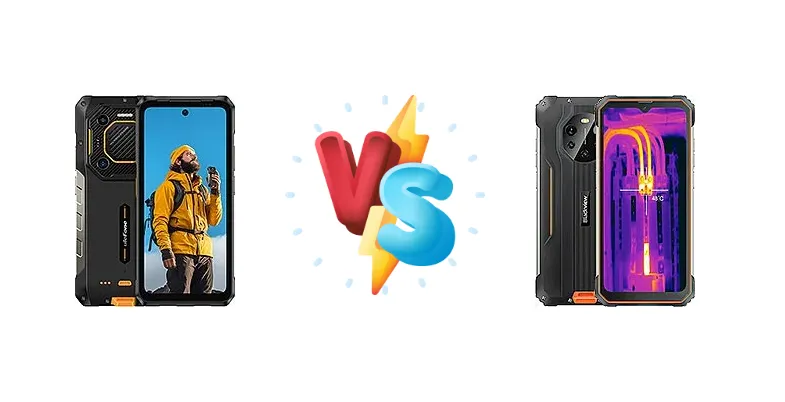
|
🏆 Quick Verdict
For users prioritizing performance and rapid charging, the Ulefone Armor 26 Ultra is the clear winner. Its Dimensity 8020 chipset offers a substantial leap in processing power over the Blackview BL8800 Pro’s Dimensity 700, and the 120W charging is a game-changer. However, the BL8800 Pro remains a viable option for budget-conscious buyers.
| PHONES | ||
|---|---|---|
| Phone Names | Ulefone Armor 26 Ultra | Blackview BL8800 Pro |
| Network | ||
|---|---|---|
| 2G bands | GSM 850 / 900 / 1800 / 1900 | GSM 850 / 900 / 1800 / 1900 |
| 3G bands | HSDPA 850 / 900 / 1700(AWS) / 1900 / 2100 | HSDPA 800 / 850 / 900 / 1700(AWS) / 1900 / 2100 |
| 4G bands | 1, 2, 3, 4, 5, 7, 8, 12, 13, 17, 18, 19, 20, 25, 26, 28, 34, 38, 39, 40, 41, 66, 71 | 1, 2, 3, 4, 5, 7, 8, 12, 13, 17, 18, 19, 20, 25, 26, 28, 30, 66 |
| 5G bands | 1, 2, 3, 5, 7, 8, 20, 25, 28, 38, 40, 41, 66, 71, 77, 78, 79 SA/NSA/Sub6 | 1, 3, 5, 7, 8, 20, 28, 38, 40, 41, 77, 78, 79 SA/NSA |
| Speed | HSPA, LTE, 5G | HSPA, LTE, 5G |
| Technology | GSM / CDMA / HSPA / LTE / 5G | GSM / CDMA / HSPA / CDMA2000 / LTE / 5G |
| - | CDMA2000 1x | |
| Launch | ||
|---|---|---|
| Announced | 2024, April | 2022, May 09 |
| Status | Available. Released 2024, April | Available. Released 2022, May 09 |
| Body | ||
|---|---|---|
| Dimensions | 179 x 83 x 25.5 mm (7.05 x 3.27 x 1.00 in) | 176.2 x 83.5 x 17.7 mm (6.94 x 3.29 x 0.70 in) |
| SIM | Nano-SIM + Nano-SIM | Nano-SIM + Nano-SIM |
| Weight | 609 g (1.34 lb) | 367 g (12.95 oz) |
| - | IP68/IP69K dust/water resistant (up to 1.5m for 30 min) Drop-to-concrete resistance from up to 1.5m MIL-STD-810H compliant | |
| Display | ||
|---|---|---|
| Protection | Corning Gorilla Glass 5, Mohs level 4 | - |
| Resolution | 1080 x 2460 pixels (~396 ppi density) | 1080 x 2408 pixels, 20:9 ratio (~401 ppi density) |
| Size | 6.78 inches, 109.2 cm2 (~73.5% screen-to-body ratio) | 6.58 inches, 104.3 cm2 (~70.9% screen-to-body ratio) |
| Type | IPS LCD, 120Hz | IPS LCD, 480 nits |
| Platform | ||
|---|---|---|
| CPU | Octa-core (4x2.6 GHz Cortex-A78 & 4x2.0 GHz Cortex-A55) | Octa-core (2x2.2 GHz Cortex-A76 & 6x2.0 GHz Cortex-A55) |
| Chipset | Mediatek Dimensity 8020 (6 nm) | Mediatek Dimensity 700 (7 nm) |
| GPU | Mali-G77 MC9 | Mali-G57 MC2 |
| OS | Android 13 | Android 11, Doke-OS 3.0 |
| Memory | ||
|---|---|---|
| Card slot | microSDXC (dedicated slot) | No |
| Internal | 512GB 12GB RAM | 128GB 8GB RAM |
| - | UFS 2.1 | |
| Main Camera | ||
|---|---|---|
| Features | Quad-LED flash, HDR, panorama | Thermal imaging, Dual-LED flash, HDR, panorama |
| Penta | - | 50 MP, f/1.8, (wide), PDAF 5 MP, thermal assisted camera FLIR thermal camera (Lepton module) 2x Auxiliary lens |
| Quad | 200 MP, f/1.8, (wide), 1/1.4", 0.56µm, PDAF 8 MP, (telephoto), 3.2x optical zoom 50 MP, f/2.2, 117˚ (ultrawide) 64 MP, f/1.8, (night vision), 2 infrared night vision lights | - |
| Single | - | 16 MP, f/2.0, (wide) |
| Video | 4K@30fps, 1080p@30fps | 1440p@30fps |
| Selfie camera | ||
|---|---|---|
| Single | 50 MP, f/2.3, (wide), 1.0µm | 16 MP, f/2.0, (wide) |
| Video | 1080p@30fps | 1080p@30fps |
| Sound | ||
|---|---|---|
| 3.5mm jack | - | No |
| 35mm jack | Yes | No |
| Loudspeaker | Yes | Yes |
| Comms | ||
|---|---|---|
| Bluetooth | 5.2, A2DP, LE | 5.1, A2DP, LE |
| Infrared port | Yes | - |
| NFC | Yes | Yes |
| Positioning | GPS (L1+L5), GLONASS, GALILEO, BDS, QZSS | GPS, GLONASS, GALILEO, BDS |
| Radio | Wireless FM radio, RDS, recording | FM radio |
| USB | USB Type-C 3.1, OTG | USB Type-C 2.0, OTG |
| WLAN | Wi-Fi 802.11 a/b/g/n/ac/6, dual-band | Wi-Fi 802.11 a/b/g/n/ac |
| Features | ||
|---|---|---|
| Sensors | Fingerprint (side-mounted), accelerometer, proximity, compass, gyro, barometer | Fingerprint (side-mounted), accelerometer, gyro, proximity, compass, barometer |
| Battery | ||
|---|---|---|
| Charging | 120W wired 33W wireless (via docking station with pins) Reverse wired | 33W wired, 31% in 30 min, 100% in 90 min Reverse wired |
| Type | Li-Po 15600 mAh | 8380 mAh |
| Misc | ||
|---|---|---|
| Colors | Black | Black, Orange, Green |
| Price | € 442.99 / $ 371.99 | About 300 EUR |
| EU LABEL | ||
|---|---|---|
| Battery | 151:31h endurance, 1000 cycles | - |
| Energy | Class B | - |
| Free fall | Class A (270 falls) | - |
| Repairability | Class B | - |
Ulefone Armor 26 Ultra
- Significantly faster 120W wired charging
- More powerful Dimensity 8020 processor for superior performance
- 33W wireless charging support
- Potentially better image processing due to the chipset
- Likely higher price point
- May be larger and heavier due to advanced features
Blackview BL8800 Pro
- More affordable price
- Solid build quality and rugged design
- Reliable performance for everyday tasks
- Reverse wired charging
- Slower 33W charging
- Less powerful Dimensity 700 processor
- Limited wireless charging options
Display Comparison
While both devices are rugged, display details are limited in the provided data. However, the chipset difference suggests the Ulefone Armor 26 Ultra likely benefits from a more capable display controller, potentially enabling higher refresh rates or improved color accuracy. The Blackview BL8800 Pro, with its older chipset, may have a more basic display panel. Expect both to prioritize durability over cutting-edge display technology.
Camera Comparison
Camera specifications are absent, but given the focus on ruggedness, both phones likely prioritize durable camera modules over high-end imaging features. The Ulefone, benefiting from the more powerful ISP within the Dimensity 8020, likely offers superior image processing capabilities, potentially resulting in better dynamic range and noise reduction. However, without sensor size or aperture information, a definitive camera comparison is impossible. Expect both to include basic camera functionality suitable for documenting outdoor adventures.
Performance
The Ulefone Armor 26 Ultra’s Mediatek Dimensity 8020 (6nm) represents a significant upgrade over the Blackview BL8800 Pro’s Dimensity 700 (7nm). The 8020’s octa-core configuration (4x2.6 GHz Cortex-A78 & 4x2.0 GHz Cortex-A55) delivers substantially higher CPU performance compared to the BL8800 Pro’s (2x2.2 GHz Cortex-A76 & 6x2.0 GHz Cortex-A55). The 6nm process node also contributes to improved power efficiency and reduced thermal throttling during sustained workloads. This translates to smoother multitasking, faster app loading times, and a better gaming experience on the Ulefone.
Battery Life
The Ulefone Armor 26 Ultra’s 120W wired charging is a standout feature, dwarfing the Blackview BL8800 Pro’s 33W charging. The Ulefone can likely achieve a full charge in under 40 minutes, while the Blackview takes approximately 90 minutes. The Ulefone also offers 33W wireless charging via a docking station, a feature absent on the Blackview. While battery capacity isn't specified, the Ulefone's 151:31h endurance suggests excellent battery optimization, potentially offsetting any capacity differences.
Buying Guide
Buy the Ulefone Armor 26 Ultra if you need uncompromising performance for demanding tasks like gaming or video editing, and value the convenience of incredibly fast charging. Buy the Blackview BL8800 Pro if you prioritize affordability and a reliable, rugged experience for everyday use, and aren't as concerned with having the absolute latest processing power.