
Ulefone Armor 26 Ultra vs. Samsung Galaxy XCover Pro: A Rugged Smartphone Showdown
| Phones Images | |||||
|---|---|---|---|---|---|
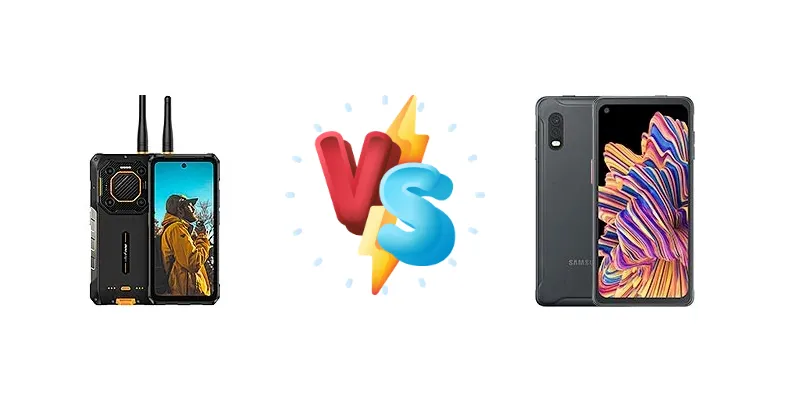
|
🏆 Quick Verdict
For users prioritizing raw performance and incredibly fast charging, the Ulefone Armor 26 Ultra is the clear winner. Its Dimensity 8020 chipset offers a substantial leap over the Exynos 9611 in the XCover Pro. However, the Galaxy XCover Pro remains a compelling choice for those deeply embedded in the Samsung ecosystem or requiring a more conservatively-powered, enterprise-focused device.
| PHONES | ||
|---|---|---|
| Phone Names | Ulefone Armor 26 Ultra Walkie-talkie | Samsung Galaxy XCover Pro |
| Network | ||
|---|---|---|
| 2G bands | GSM 850 / 900 / 1800 / 1900 | GSM 850 / 900 / 1800 / 1900 |
| 3G bands | HSDPA 850 / 900 / 1700(AWS) / 1900 / 2100 | HSDPA 850 / 900 / 1900 / 2100 - International |
| 4G bands | 1, 2, 3, 4, 5, 7, 8, 12, 13, 17, 18, 19, 20, 25, 26, 28, 34, 38, 39, 40, 41, 66, 71 | 1, 2, 3, 5, 7, 8, 20, 28, 38, 40, 41 - International |
| 5G bands | 1, 2, 3, 5, 7, 8, 20, 25, 28, 38, 40, 41, 66, 71, 77, 78, 79 SA/NSA/Sub6 | - |
| Speed | HSPA, LTE, 5G | HSPA 42.2/5.76 Mbps, LTE (3CA) Cat11 600/50 Mbps |
| Technology | GSM / CDMA / HSPA / LTE / 5G | GSM / HSPA / LTE |
| - | 1, 2, 3, 4, 5, 7, 12, 13, 14, 20, 29, 38, 40, 41, 66 - Canada | |
| Launch | ||
|---|---|---|
| Announced | 2024, April | 2020, January |
| Status | Available. Released 2024, April | Available. Released 2020, January |
| Body | ||
|---|---|---|
| Dimensions | 179 x 83 x 25.5 mm (7.05 x 3.27 x 1.00 in) | 159.9 x 76.7 x 10 mm (6.30 x 3.02 x 0.39 in) |
| SIM | Nano-SIM + Nano-SIM | · Nano-SIM· Nano-SIM + Nano-SIM |
| Weight | 609 g (1.34 lb) | 218 g (7.69 oz) |
| - | IP68 dust/water resistant (up to 1.5m for 35 min) Drop-to-concrete resistance from up to 1.5m MIL-STD-810G compliant* *does not guarantee ruggedness or use in extreme conditions | |
| Display | ||
|---|---|---|
| Protection | Corning Gorilla Glass 5 | Corning Gorilla Glass 5 |
| Resolution | 1080 x 2460 pixels (~396 ppi density) | 1080 x 2340 pixels, 19.5:9 ratio (~409 ppi density) |
| Size | 6.78 inches, 109.2 cm2 (~73.5% screen-to-body ratio) | 6.3 inches, 97.4 cm2 (~79.4% screen-to-body ratio) |
| Type | IPS LCD, 120Hz | IPS LCD |
| Platform | ||
|---|---|---|
| CPU | Octa-core (4x2.6 GHz Cortex-A78 & 4x2.0 GHz Cortex-A55) | Octa-core (4x2.3 GHz Cortex-A73 & 4x1.7 GHz Cortex-A53) |
| Chipset | Mediatek Dimensity 8020 (6 nm) | Exynos 9611 (10 nm) |
| GPU | Mali-G77 MC9 | Mali-G72 MP3 |
| OS | Android 13 | Android 10, upgradable to Android 13, One UI 5 |
| Memory | ||
|---|---|---|
| Card slot | microSDXC (dedicated slot) | microSDXC (dedicated slot) |
| Internal | 512GB 12GB RAM | 64GB 4GB RAM |
| Main Camera | ||
|---|---|---|
| Dual | - | 25 MP, f/1.7, 26mm (wide), PDAF 8 MP, f/2.2, 123˚ (ultrawide), 1/4.0", 1.12µm |
| Features | Quad-LED flash, HDR, panorama | Dual-LED flash, HDR, panorama |
| Quad | 200 MP, f/1.8, (wide), 1/1.4", 0.56µm, PDAF 8 MP, (telephoto), 3.2x optical zoom 50 MP, f/2.2, 117˚ (ultrawide) 64 MP, f/1.8, (night vision), 2 infrared night vision lights | - |
| Video | 4K@30fps, 1080p@30fps | 1080p@30fps |
| Selfie camera | ||
|---|---|---|
| Features | - | HDR |
| Single | 50 MP, f/2.3, (wide), 1.0µm | 13 MP, f/2.0, (wide), 1/3.1", 1.12µm |
| Video | 1080p@30fps | 1080p@30fps |
| Sound | ||
|---|---|---|
| 3.5mm jack | - | Yes |
| 35mm jack | Yes | Yes |
| Loudspeaker | Yes | Yes |
| Comms | ||
|---|---|---|
| Bluetooth | 5.2, A2DP, LE | 5.0, A2DP, LE |
| Infrared port | Yes | - |
| NFC | Yes | Yes |
| Positioning | GPS (L1+L5), GLONASS, GALILEO, BDS, QZSS | GPS, GLONASS, GALILEO, BDS |
| Radio | Wireless FM radio, RDS, recording | FM radio (market/region dependent) |
| USB | USB Type-C 3.1, OTG | USB Type-C 2.0 |
| WLAN | Wi-Fi 802.11 a/b/g/n/ac/6, dual-band | Wi-Fi 802.11 a/b/g/n/ac/k/v/r, dual-band, Wi-Fi Direct |
| Features | ||
|---|---|---|
| Sensors | Fingerprint (side-mounted), accelerometer, proximity, compass, gyro, barometer | Fingerprint (side-mounted), accelerometer, gyro, proximity, compass |
| - | ANT+ | |
| Battery | ||
|---|---|---|
| Charging | 120W wired 33W wireless (via docking station with pins) Reverse wired | 15W wired |
| Type | Li-Po 15600 mAh | Li-Po 4050 mAh, removable |
| Misc | ||
|---|---|---|
| Colors | Black | Black |
| Models | - | SM-G715FN/DS, SM-G715FN, SM-G715F, SM-G715W, SM-G715U, SM-G715U1 |
| Price | About 600 EUR | About 120 EUR |
| SAR EU | - | 0.47 W/kg (head) 1.23 W/kg (body) |
Ulefone Armor 26 Ultra Walkie-talkie
- Significantly faster processor (Dimensity 8020)
- Ultra-fast 120W wired charging
- 33W wireless charging support
- Likely superior camera performance
- Brand recognition is lower than Samsung
- Software update support may be less consistent
Samsung Galaxy XCover Pro
- Samsung’s established brand and software ecosystem
- Samsung Knox security platform for enterprise use
- Guaranteed software updates (typically)
- Replaceable battery (a significant advantage for long-term use)
- Outdated Exynos 9611 chipset
- Slow 15W charging
- Less powerful performance for demanding tasks
Display Comparison
Neither device boasts a cutting-edge display. While specific details like peak brightness and color accuracy are missing for the Ulefone, the XCover Pro’s display is known for being functional rather than visually stunning. The Armor 26 Ultra’s larger size likely allows for a higher resolution panel, but the XCover Pro benefits from Samsung’s display calibration expertise. Both are likely to prioritize visibility in direct sunlight over color accuracy, given their rugged focus.
Camera Comparison
Without detailed camera specs for the Ulefone, a direct comparison is limited. However, the Armor 26 Ultra’s positioning suggests a focus on modern camera technology. The XCover Pro’s camera is adequate for documentation but doesn’t excel in image quality. The Armor 26 Ultra likely features a larger main sensor and more advanced image processing, offering superior low-light performance and dynamic range. The inclusion of a 2MP macro camera on the XCover Pro is largely a marketing feature with limited practical benefit.
Performance
The performance gap is significant. The Ulefone Armor 26 Ultra’s Mediatek Dimensity 8020 (6nm) is a modern, high-performance chipset featuring an octa-core configuration with Cortex-A78 cores clocked at 2.6GHz. This contrasts sharply with the Samsung Galaxy XCover Pro’s Exynos 9611 (10nm), utilizing older Cortex-A73 cores at 2.3GHz. The 6nm process node of the Dimensity 8020 translates to improved power efficiency and thermal management, allowing for sustained performance under load. The Armor 26 Ultra will demonstrably outperform the XCover Pro in CPU-intensive tasks and gaming.
Battery Life
The Ulefone Armor 26 Ultra’s 120W wired charging is a game-changer. This allows for a full charge in a fraction of the time compared to the XCover Pro’s 15W charging. While battery capacity isn’t specified for the Ulefone, the faster charging mitigates concerns about a potentially smaller battery. The XCover Pro’s 15W charging is slow by modern standards, requiring several hours for a full charge. The Armor 26 Ultra also offers 33W wireless charging via a docking station, a feature absent on the XCover Pro.
Buying Guide
Buy the Ulefone Armor 26 Ultra if you need a rugged phone capable of demanding tasks like mobile gaming, video editing, or running complex field applications, and if minimizing downtime with ultra-fast charging is critical. Buy the Samsung Galaxy XCover Pro if you prefer a more established brand with guaranteed software updates, require compatibility with Samsung’s enterprise solutions like Knox, or prioritize a longer-term, less aggressively-priced ownership experience.