
Ulefone Armor 26 Ultra vs. Nokia XR20: A Deep Dive into Rugged Smartphone Performance
| Phones Images | |||||
|---|---|---|---|---|---|
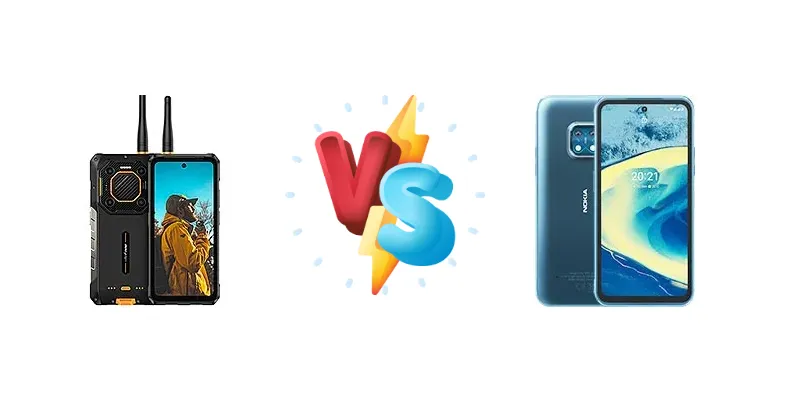
|
🏆 Quick Verdict
For users prioritizing raw performance and ultra-fast charging, the Ulefone Armor 26 Ultra is the clear winner. Its Dimensity 8020 chipset offers a substantial leap over the Snapdragon 480 in the Nokia XR20. However, the Nokia XR20 remains a compelling option for those seeking a reliable, durable phone with guaranteed software updates at a lower cost.
| PHONES | ||
|---|---|---|
| Phone Names | Ulefone Armor 26 Ultra Walkie-talkie | Nokia XR20 |
| Network | ||
|---|---|---|
| 2G bands | GSM 850 / 900 / 1800 / 1900 | GSM 850 / 900 / 1800 / 1900 |
| 3G bands | HSDPA 850 / 900 / 1700(AWS) / 1900 / 2100 | HSDPA 850 / 900 / 1700(AWS) / 1900 / 2100 |
| 4G bands | 1, 2, 3, 4, 5, 7, 8, 12, 13, 17, 18, 19, 20, 25, 26, 28, 34, 38, 39, 40, 41, 66, 71 | 1, 2, 3, 4, 5, 7, 8, 12, 13, 14, 20, 25, 26, 28, 30, 38, 40, 41, 48, 66, 71 |
| 5G bands | 1, 2, 3, 5, 7, 8, 20, 25, 28, 38, 40, 41, 66, 71, 77, 78, 79 SA/NSA/Sub6 | 2, 5, 25, 38, 41, 48, 66, 77, 78 SA/NSA |
| Speed | HSPA, LTE, 5G | HSPA, LTE, 5G |
| Technology | GSM / CDMA / HSPA / LTE / 5G | GSM / CDMA / HSPA / EVDO / LTE / 5G |
| - | CDMA2000 1xEV-DO | |
| Launch | ||
|---|---|---|
| Announced | 2024, April | 2021, July 27 |
| Status | Available. Released 2024, April | Available. Released 2021, August 04 |
| Body | ||
|---|---|---|
| Dimensions | 179 x 83 x 25.5 mm (7.05 x 3.27 x 1.00 in) | 171.6 x 81.5 x 10.6 mm (6.76 x 3.21 x 0.42 in) |
| SIM | Nano-SIM + Nano-SIM | · Nano-SIM· Nano-SIM + Nano-SIM |
| Weight | 609 g (1.34 lb) | 248 g (8.75 oz) |
| - | IP68 dust/water resistant (up to 1.5m for 60 min) Drop-to-concrete resistance from up to 1.8m MIL-STD-810H compliant | |
| Display | ||
|---|---|---|
| Protection | Corning Gorilla Glass 5 | Corning Gorilla Glass Victus |
| Resolution | 1080 x 2460 pixels (~396 ppi density) | 1080 x 2400 pixels, 20:9 ratio (~395 ppi density) |
| Size | 6.78 inches, 109.2 cm2 (~73.5% screen-to-body ratio) | 6.67 inches, 107.4 cm2 (~76.8% screen-to-body ratio) |
| Type | IPS LCD, 120Hz | IPS LCD, 550 nits |
| Platform | ||
|---|---|---|
| CPU | Octa-core (4x2.6 GHz Cortex-A78 & 4x2.0 GHz Cortex-A55) | Octa-core (2x2.0 GHz Kryo 460 & 6x1.8 GHz Kryo 460) |
| Chipset | Mediatek Dimensity 8020 (6 nm) | Qualcomm SM4350 Snapdragon 480 5G (8 nm) |
| GPU | Mali-G77 MC9 | Adreno 619 |
| OS | Android 13 | Android 11, upgradable to Android 13 |
| Memory | ||
|---|---|---|
| Card slot | microSDXC (dedicated slot) | microSDXC (uses shared SIM slot) |
| Internal | 512GB 12GB RAM | 64GB 4GB RAM, 128GB 6GB RAM |
| Main Camera | ||
|---|---|---|
| Dual | - | 48 MP, f/1.8, (wide), 1/2.25", 0.8µm, PDAF 13 MP, f/2.4, 123˚ (ultrawide), 1/3.0", 1.12µm |
| Features | Quad-LED flash, HDR, panorama | Zeiss optics, Dual-LED dual-tone flash, second LED flash, HDR, panorama |
| Quad | 200 MP, f/1.8, (wide), 1/1.4", 0.56µm, PDAF 8 MP, (telephoto), 3.2x optical zoom 50 MP, f/2.2, 117˚ (ultrawide) 64 MP, f/1.8, (night vision), 2 infrared night vision lights | - |
| Single | - | 8 MP, f/2.0 (wide), 1/4.0", 1.12µm |
| Video | 4K@30fps, 1080p@30fps | 1080p@30fps |
| Selfie camera | ||
|---|---|---|
| Single | 50 MP, f/2.3, (wide), 1.0µm | 8 MP, f/2.0 (wide), 1/4.0", 1.12µm |
| Video | 1080p@30fps | 1080p@30fps |
| Sound | ||
|---|---|---|
| 3.5mm jack | - | Yes |
| 35mm jack | Yes | Yes |
| Loudspeaker | Yes | Yes, with stereo speakers |
| Comms | ||
|---|---|---|
| Bluetooth | 5.2, A2DP, LE | 5.1, A2DP, LE, aptX Adaptive |
| Infrared port | Yes | - |
| NFC | Yes | Yes |
| Positioning | GPS (L1+L5), GLONASS, GALILEO, BDS, QZSS | GPS (L1+L5), GLONASS, BDS, GALILEO, QZSS, NavIC |
| Radio | Wireless FM radio, RDS, recording | Unspecified |
| USB | USB Type-C 3.1, OTG | USB Type-C 3.0 |
| WLAN | Wi-Fi 802.11 a/b/g/n/ac/6, dual-band | Wi-Fi 802.11 a/b/g/n/ac/6, dual-band, Wi-Fi Direct |
| Features | ||
|---|---|---|
| Sensors | Fingerprint (side-mounted), accelerometer, proximity, compass, gyro, barometer | Fingerprint (side-mounted), accelerometer, gyro, proximity, compass, barometer |
| Battery | ||
|---|---|---|
| Charging | 120W wired 33W wireless (via docking station with pins) Reverse wired | 18W wired 15W wireless |
| Type | Li-Po 15600 mAh | Li-Po 4630 mAh |
| Misc | ||
|---|---|---|
| Colors | Black | Ultra Blue, Granite Gray |
| Models | - | TA-1368, TA-1362 |
| Price | About 600 EUR | About 270 EUR |
| SAR EU | - | 1.13 W/kg (head) 1.43 W/kg (body) |
Ulefone Armor 26 Ultra Walkie-talkie
- Significantly faster processing power with the Dimensity 8020.
- Ultra-fast 120W wired charging.
- 33W wireless charging support.
- Potential for better camera performance due to a more powerful ISP.
- Likely higher price point.
- Potential for increased heat generation under sustained load.
Nokia XR20
- More affordable price.
- Guaranteed software updates from Nokia.
- Reliable durability and build quality.
- Efficient Snapdragon 480 chipset for good battery life.
- Significantly slower processing power.
- Slow 18W wired charging.
- Limited wireless charging capabilities.
Display Comparison
Neither device boasts a cutting-edge display. While specific display specs (resolution, panel type) are missing for both, the focus is clearly on ruggedness, not visual fidelity. However, the chipset difference impacts display capabilities; the Dimensity 8020 in the Ulefone Armor 26 Ultra can drive higher refresh rates and resolutions if the panel supports it, something the Snapdragon 480 in the Nokia XR20 would struggle with. The XR20's display is likely tuned for efficiency, prioritizing battery life over visual pop.
Camera Comparison
Without detailed camera specs, a direct comparison is limited. However, the chipset difference suggests the Ulefone Armor 26 Ultra will have a more powerful image signal processor (ISP), enabling faster image processing and potentially better low-light performance. The XR20 likely relies on Qualcomm’s ISP, which is competent but less advanced. Both phones likely prioritize practicality over photographic excellence, but the Ulefone has the potential for superior image quality due to its processing power.
Performance
The performance gap is significant. The Ulefone Armor 26 Ultra’s Mediatek Dimensity 8020 (6nm) features an octa-core configuration with 4x2.6 GHz Cortex-A78 cores and 4x2.0 GHz Cortex-A55 cores, offering a substantial advantage over the Nokia XR20’s Qualcomm SM4350 Snapdragon 480 5G (8nm). The Snapdragon 480’s 2x2.0 GHz Kryo 460 and 6x1.8 GHz Kryo 460 core setup is geared towards efficiency, not peak performance. The 6nm process node of the Dimensity 8020 also contributes to better power efficiency at comparable workloads. This translates to faster app loading, smoother multitasking, and a more responsive user experience on the Ulefone.
Battery Life
The Ulefone Armor 26 Ultra dominates in charging speed with its 120W wired charging capability, drastically reducing charge times compared to the Nokia XR20’s 18W wired charging. While battery capacity isn’t specified, the Ulefone also offers 33W wireless charging via a docking station, a feature absent on the XR20. The faster charging of the Ulefone mitigates any potential disadvantage from a smaller battery capacity, offering more convenient top-ups throughout the day. The XR20’s slower charging necessitates longer periods tethered to a power outlet.
Buying Guide
Buy the Ulefone Armor 26 Ultra if you need a rugged phone capable of demanding tasks like mobile gaming, video editing, or running specialized field applications, and if 120W charging is a priority. Buy the Nokia XR20 if you prefer a more balanced experience focused on long-term software support, reliable durability, and a lower upfront investment, accepting a trade-off in processing power.