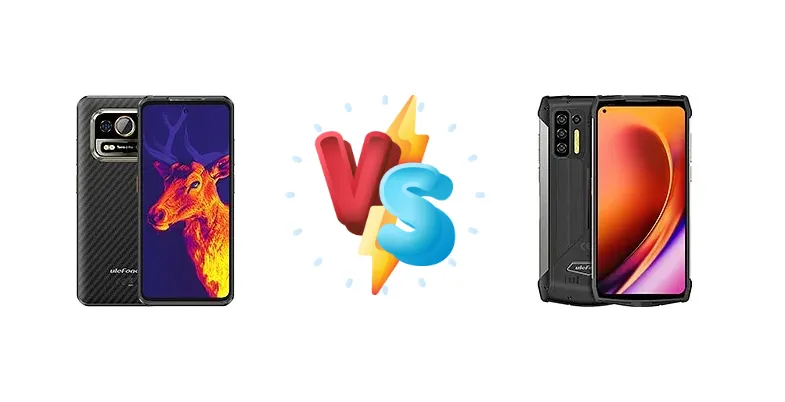
Ulefone dominates the rugged smartphone space, offering durable devices at competitive prices. The Armor 25T and Power Armor 13 represent two compelling options, but cater to slightly different priorities. The 25T brings a newer chipset and faster wireless charging, while the 13 boasts a proven endurance rating. This comparison dissects the key differences to help you choose the best Ulefone for your needs.
🏆 Quick Verdict
For most users, the Ulefone Armor 25T is the better choice. Its Mediatek Helio G99 chipset, built on a 6nm process, offers a performance advantage over the Power Armor 13’s 12nm Helio G95. The faster 30W wireless charging and slightly improved efficiency make it a more modern and versatile device.
| Network |
|---|
| 2G bands | GSM 850 / 900 / 1800 / 1900 | GSM 850 / 900 / 1800 / 1900 |
| 3G bands | HSDPA 800 / 850 / 900 / 1700(AWS) / 1900 / 2100 | HSDPA 850 / 900 / 1700(AWS) / 1900 / 2100 |
| 4G bands | 1/2/3/4/5/7/8/12/13/17/18/19/20/25/26/28/34/38/39/40/41/66/71 | 1, 2, 3, 4, 5, 7, 8, 12, 13, 17, 18, 19, 20, 25, 26, 28, 38, 40, 66 |
| Speed | HSPA, LTE, 5G | HSPA 42.2/11.5 Mbps, LTE Cat12 600/150 Mbps |
| Technology | GSM / HSPA / LTE | GSM / HSPA / LTE |
| Launch |
|---|
| Announced | 2024, July 11 | 2021, July 22 |
| Status | Available. Released 2024, July | Available. Released 2021, July 26 |
| Body |
|---|
| Dimensions | 177.4 x 81.4 x 12.5 mm (6.98 x 3.20 x 0.49 in) | 183.7 x 85.4 x 20.8 mm (7.23 x 3.36 x 0.82 in) |
| SIM | Nano-SIM + Nano-SIM | Nano-SIM + Nano-SIM |
| Weight | 326 g (11.50 oz) | 492 g (1.08 lb) |
| | - | IP68 dust/water resistant (up to 1.5m for 30 min)
Drop-to-concrete resistance from up to 1.2m
MIL-STD-810G compliant |
| Display |
|---|
| Protection | Corning Gorilla Glass Victus | Corning Gorilla Glass 3 |
| Resolution | 1080 x 2460 pixels (~396 ppi density) | 1080 x 2400 pixels, 20:9 ratio (~386 ppi density) |
| Size | 6.78 inches, 109.2 cm2 (~75.6% screen-to-body ratio) | 6.81 inches, 112.0 cm2 (~71.4% screen-to-body ratio) |
| Type | IPS LCD, 120Hz | IPS LCD |
| Platform |
|---|
| CPU | Octa-core (2x2.2 GHz Cortex-A76 & 6x2.0 GHz Cortex-A55) | Octa-core (2x2.05 GHz Cortex-A76 & 6x2.0 GHz Cortex-A55) |
| Chipset | Mediatek Helio G99 (6 nm) | Mediatek MT6785V/CD Helio G95 (12 nm) |
| GPU | Mali-G57 MC2 | Mali-G76 MC4 |
| OS | Android 14 | Android 11 |
| Memory |
|---|
| Card slot | microSDXC (dedicated slot) | microSDXC (uses shared SIM slot) |
| Internal | 256GB 6GB RAM | 256GB 8GB RAM |
| Main Camera |
|---|
| Features | Dual-LED flash, HDR, panorama | Quad-LED flash, HDR, panorama |
| Penta | - | 48 MP, f/1.8, 26mm (wide), 1/2.0", 0.8µm, PDAF
8 MP, f/2.2, (ultrawide)
2 MP (macro)
Auxiliary lens |
| Triple | 50 MP, f/2.0, (wide), 1/1.31", 1.2µm, PDAF
64 MP, f/1.8, (night vision), 2 infrared night vision lights
Thermal camera by ThermoVue, 160x120 px, 25Hz, 12μm | - |
| Video | 1440p@30fps, 1080p@30fps | 4K@30fps, 1080p@30fps |
| Selfie camera |
|---|
| Features | - | HDR, panorama |
| Single | 32 MP, f/2.5, (wide), 0.8µm | 16 MP, f/2.2 |
| Video | Yes | 1080p@30fps |
| Sound |
|---|
| 3.5mm jack | - | Yes |
| 35mm jack | Yes | Yes |
| Loudspeaker | Yes | Yes |
| Comms |
|---|
| Bluetooth | 5.2, A2DP, LE | 5.0, A2DP, LE |
| Infrared port | Yes | - |
| NFC | Yes | Yes |
| Positioning | GPS, GLONASS, GALILEO, BDS | GPS, GLONASS, GALILEO, BDS |
| Radio | Wireless FM radio, RDS, recording | FM radio, RDS, recording |
| USB | USB Type-C 2.0, OTG | - |
| WLAN | Wi-Fi 802.11 a/b/g/n/ac, dual-band | Wi-Fi 802.11 a/b/g/n/ac, dual-band |
| Features |
|---|
| Sensors | Fingerprint (side-mounted), accelerometer, gyro, proximity, compass, barometer | Fingerprint (side-mounted), accelerometer, gyro, proximity, compass, baroceptor, coulombmeter |
| | - | Infrared distance measure (error range: 1~20m, ±10mm; 20~40m, ±25mm) |
| Battery |
|---|
| Charging | 33W wired
30W wireless
Reverse wireless | 33W wired
15W wireless
5W reverse wireless |
| Type | Li-Po 6500 mAh | Li-Po 13200 mAh |
| Misc |
|---|
| Colors | Black | Black |
| Price | About 370 EUR | About 300 EUR |
| Tests |
|---|
| Battery life | - |
Endurance rating 296h
|
| Camera | - |
Photo / Video |
| Display | - |
Contrast ratio: 1306:1 (nominal) |
| Loudspeaker | - |
-28.3 LUFS (Average)
|
| Performance | - |
AnTuTu: 294194 (v8), 351678 (v9)
GeekBench: 1610 (v5.1)
GFXBench: 18fps (ES 3.1 onscreen) |
Ulefone Armor 25T
- More efficient and powerful Helio G99 chipset
- Faster 30W wireless charging
- Reverse wireless charging capability
- Display specifications are less detailed
- Camera details are lacking
Ulefone Power Armor 13
- Proven 296-hour endurance rating
- Measured display brightness available (401 nits)
- Established reliability within the Ulefone lineup
- Older, less efficient Helio G95 chipset
- Slower 15W wireless charging
- Limited reverse wireless charging (5W)
Display Comparison
Both the Armor 25T and Power Armor 13 share a 1306:1 contrast ratio, suggesting similar visual pop. The Power Armor 13’s measured peak brightness of 401 nits is a useful data point, but the Armor 25T’s display specifications are not provided. Given Ulefone’s recent trends, we can expect similar brightness levels. The lack of high refresh rate panels on either device suggests a focus on battery conservation rather than fluid scrolling. Both displays prioritize readability in direct sunlight, a crucial feature for rugged phones.
Camera Comparison
Both phones list 'Photo / Video' capabilities, but lack specific details regarding sensor size, aperture, or image processing. This suggests a similar level of camera performance geared towards casual photography. The absence of details implies neither phone is targeting photography enthusiasts. Without further information, it’s difficult to differentiate their camera capabilities beyond the basic functionality.
Performance
The Ulefone Armor 25T’s Mediatek Helio G99 (6nm) represents a significant architectural leap over the Power Armor 13’s Helio G95 (12nm). The 6nm process inherently offers better power efficiency and thermal characteristics, meaning the 25T is likely to sustain peak performance for longer periods without throttling. While both CPUs feature the same core configuration (2x2.2 GHz Cortex-A76 & 6x2.0 GHz Cortex-A55), the G99’s improved architecture translates to a noticeable performance boost in benchmarks and real-world applications. This benefits gamers and users running demanding apps.
Battery Life
Both the Ulefone Armor 25T and Power Armor 13 boast an endurance rating of 296 hours, indicating comparable battery life under similar usage conditions. However, the Armor 25T offers a more versatile charging solution with 33W wired, 30W wireless, and reverse wireless charging. The Power Armor 13 is limited to 33W wired, 15W wireless, and 5W reverse wireless. The faster wireless charging on the 25T significantly reduces charging times, making it more convenient for users who rely on wireless power.
Buying Guide
Buy the Ulefone Armor 25T if you prioritize performance for gaming or demanding applications, and value faster wireless charging speeds. It’s ideal for users who frequently use their phone outdoors and need a responsive experience. Buy the Ulefone Power Armor 13 if you prioritize a proven battery endurance record and are less concerned with having the absolute latest chipset. It’s a solid choice for users who need a reliable, long-lasting phone for essential tasks and occasional use.
Frequently Asked Questions
❓ Does the Helio G99 in the Armor 25T get noticeably warmer than the Helio G95 during extended gaming sessions?
While the Helio G99 is more powerful, the 6nm process is more efficient, meaning it generates less heat for the same level of performance. This should translate to lower temperatures and less thermal throttling during prolonged gaming compared to the Power Armor 13’s Helio G95.
❓ How much faster is the 30W wireless charging on the Armor 25T compared to the 15W on the Power Armor 13 in real-world use?
Expect roughly a 50-70% reduction in wireless charging time with the Armor 25T. A full wireless charge on the Power Armor 13 could take upwards of 4-5 hours, while the 25T should achieve a full charge in around 2.5-3 hours, depending on the wireless charger used.
❓ Is the reverse wireless charging on either phone powerful enough to reliably charge earbuds or a smartwatch?
The Armor 25T’s 30W reverse wireless charging is significantly more capable than the Power Armor 13’s 5W. The 25T can comfortably charge earbuds and smartwatches, while the 13 may only provide a very slow trickle charge, primarily useful for maintaining a minimal charge.