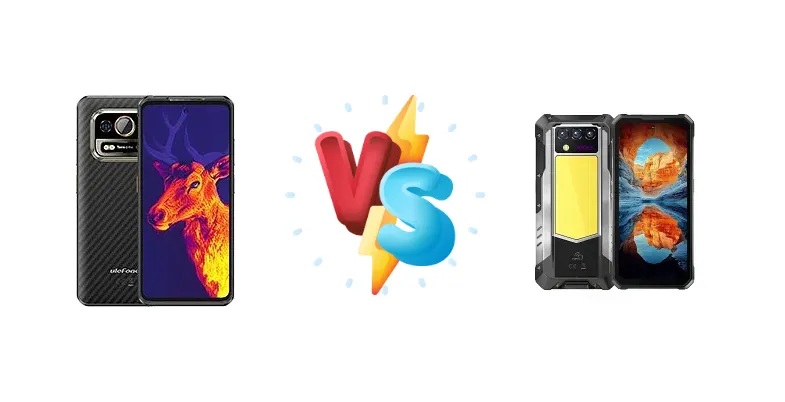
The rugged smartphone market is heating up, with both Ulefone and Oukitel offering compelling options. We're pitting the Ulefone Armor 25T, powered by the Mediatek Helio G99, against the Oukitel WP100 Titan, boasting the more powerful Dimensity 7300. This comparison dives deep into the core differences, focusing on performance, battery endurance, and charging capabilities to determine which device delivers the best value for demanding users.
🏆 Quick Verdict
For the average user prioritizing raw performance and faster charging, the Oukitel WP100 Titan is the clear winner. Its Dimensity 7300 chipset offers a significant leap in processing power, and the 66W wired charging drastically reduces downtime. However, the Ulefone Armor 25T remains a viable option for those on a tighter budget.
| Network |
|---|
| 2G bands | GSM 850 / 900 / 1800 / 1900 | GSM 850 / 900 / 1800 / 1900 |
| 3G bands | HSDPA 800 / 850 / 900 / 1700(AWS) / 1900 / 2100 | HSDPA 800 / 850 / 900 / 1700(AWS) / 1900 / 2100 |
| 4G bands | 1/2/3/4/5/7/8/12/13/17/18/19/20/25/26/28/34/38/39/40/41/66/71 | 1, 2, 3, 4, 5, 7, 8, 12, 13, 17, 18, 19, 20, 25, 26, 28, 34, 38, 40, 41, 66 LTE |
| 5G bands | - | 1, 2, 3, 5, 7, 8, 12, 20, 28, 38, 40, 41, 66, 71, 77, 78, 79 |
| Speed | HSPA, LTE, 5G | HSPA, LTE |
| Technology | GSM / HSPA / LTE | GSM / HSPA / EVDO / LTE / 5G |
| Launch |
|---|
| Announced | 2024, July 11 | 2025, February 18 |
| Status | Available. Released 2024, July | Available. Released 2025, February 18 |
| Body |
|---|
| Build | - | Glass front, aluminum with plastic frame and back |
| Dimensions | 177.4 x 81.4 x 12.5 mm (6.98 x 3.20 x 0.49 in) | 178.3 x 84.3 x 35.6 mm (7.02 x 3.32 x 1.40 in) |
| SIM | Nano-SIM + Nano-SIM | Nano-SIM + Nano-SIM |
| Weight | 326 g (11.50 oz) | 876.6 g (1.93 lb) |
| Display |
|---|
| Protection | Corning Gorilla Glass Victus | Corning Gorilla Glass 5, Mohs level 5 |
| Resolution | 1080 x 2460 pixels (~396 ppi density) | 1080 x 2460 pixels (~395 ppi density) |
| Size | 6.78 inches, 109.2 cm2 (~75.6% screen-to-body ratio) | 6.8 inches, 109.8 cm2 (~73.1% screen-to-body ratio) |
| Type | IPS LCD, 120Hz | IPS LCD, 120Hz, 450 nits |
| Platform |
|---|
| CPU | Octa-core (2x2.2 GHz Cortex-A76 & 6x2.0 GHz Cortex-A55) | Octa-core (4x2.5 GHz Cortex-A78 & 4x2.0 GHz Cortex-A55) |
| Chipset | Mediatek Helio G99 (6 nm) | Mediatek Dimensity 7300 (4 nm) |
| GPU | Mali-G57 MC2 | Mali-G615 MP2 |
| OS | Android 14 | Android 14 |
| Memory |
|---|
| Card slot | microSDXC (dedicated slot) | microSDXC (uses shared SIM slot) |
| Internal | 256GB 6GB RAM | 512GB 16GB RAM |
| Main Camera |
|---|
| Features | Dual-LED flash, HDR, panorama | LED flash, HDR, portrait, panorama |
| Triple | 50 MP, f/2.0, (wide), 1/1.31", 1.2µm, PDAF
64 MP, f/1.8, (night vision), 2 infrared night vision lights
Thermal camera by ThermoVue, 160x120 px, 25Hz, 12μm | 200 MP (wide), 1/1.4", PDAF, LED
20 MP (Night Vision), 1/2.78", AF
2 MP (macro) |
| Video | 1440p@30fps, 1080p@30fps | 4K@30fps |
| Selfie camera |
|---|
| Single | 32 MP, f/2.5, (wide), 0.8µm | 32MP, 1/2.74" |
| Video | Yes | 1080p@30fps |
| Sound |
|---|
| 35mm jack | Yes | No |
| Loudspeaker | Yes | Yes |
| Comms |
|---|
| Bluetooth | 5.2, A2DP, LE | 5.4, A2DP, LE |
| Infrared port | Yes | - |
| NFC | Yes | Yes |
| Positioning | GPS, GLONASS, GALILEO, BDS | GPS, GLONASS, GALILEO, BDS |
| Radio | Wireless FM radio, RDS, recording | FM radio, FM recording |
| USB | USB Type-C 2.0, OTG | USB Type-C 2.0, OTG |
| WLAN | Wi-Fi 802.11 a/b/g/n/ac, dual-band | Wi-Fi 802.11 a/b/g/n/ac/6e, dual-band |
| Features |
|---|
| Sensors | Fingerprint (side-mounted), accelerometer, gyro, proximity, compass, barometer | Fingerprint (side-mounted), accelerometer, gyro, proximity, compass |
| Battery |
|---|
| Charging | 33W wired
30W wireless
Reverse wireless | 66W wired
18W reverse wired |
| Type | Li-Po 6500 mAh | Li-Po 33000 mAh |
| Misc |
|---|
| Colors | Black | Black |
| Price | About 370 EUR | About 780 EUR |
| EU LABEL |
|---|
| Battery | - | 166:39h endurance, 1400 cycles |
| Energy | - | Class B |
| Free fall | - | Class A (270 falls) |
| Repairability | - | Class C |
Ulefone Armor 25T
- More affordable price point
- Wireless charging support
- Reverse wireless charging capability
- Less powerful processor
- Slower charging speeds
- Potentially lower image quality
Oukitel WP100 Titan
- Significantly faster processor
- Much faster wired charging
- Potentially longer battery lifespan (1400 cycles)
- Higher price
- No wireless charging
- May run hotter under sustained load
Display Comparison
Neither device's display specifications are provided, so a direct comparison is limited. However, given the WP100 Titan's focus on performance, it's reasonable to expect a higher-quality panel with potentially higher brightness and refresh rate. Rugged phones often prioritize durability over display fidelity, so expect both to feature robust glass protection, but color accuracy and viewing angles may be compromised compared to mainstream smartphones.
Camera Comparison
Without detailed camera specifications, a precise comparison is difficult. However, the chipset difference suggests the WP100 Titan will have a more powerful image signal processor (ISP), enabling better noise reduction, dynamic range, and overall image quality. The Titan’s processing power will also allow for faster image processing and potentially more advanced computational photography features. The Ulefone Armor 25T will likely focus on providing a functional camera experience, but may struggle in low-light conditions or with complex scenes.
Performance
The Oukitel WP100 Titan’s Dimensity 7300 (4nm) represents a substantial upgrade over the Ulefone Armor 25T’s Helio G99 (6nm). The Dimensity 7300 utilizes Cortex-A78 cores clocked at 2.5 GHz, offering significantly higher single-core performance than the G99’s Cortex-A76 cores at 2.2 GHz. This translates to snappier app launches, smoother multitasking, and a more responsive user experience. The 4nm process node of the Dimensity 7300 also contributes to improved thermal efficiency, reducing the likelihood of performance throttling during sustained workloads. While the G99 is still capable, the Titan is geared towards users who demand more from their device.
Battery Life
The Oukitel WP100 Titan boasts a significant advantage in charging speed with its 66W wired charging capability, compared to the Ulefone Armor 25T’s 33W. This means a substantially faster 0-100% charge time for the Titan. While the Ulefone offers 30W wireless charging and reverse wireless charging, the Titan’s faster wired charging is more practical for daily use. The WP100 Titan also claims 166:39h endurance and 1400 cycles, suggesting a focus on long-term battery health and longevity, though real-world results will vary based on usage.
Buying Guide
Buy the Ulefone Armor 25T if you need a dependable, affordable rugged phone for basic tasks, occasional gaming, and appreciate the convenience of wireless charging. Buy the Oukitel WP100 Titan if you prioritize demanding applications, extended gaming sessions, and require the fastest possible charging speeds, even if it means a higher upfront cost.
Frequently Asked Questions
❓ Does the Dimensity 7300 in the Oukitel WP100 Titan generate excessive heat during prolonged gaming sessions?
While the Dimensity 7300 is a powerful chip, its 4nm process node is designed for improved thermal efficiency. However, sustained gaming will inevitably generate heat. The WP100 Titan’s rugged design may limit passive cooling, so expect some throttling after extended play, but likely less than the Helio G99 in the Armor 25T.
❓ How does the 30W wireless charging on the Ulefone Armor 25T compare to the 66W wired charging of the Oukitel WP100 Titan in terms of convenience and speed?
Wireless charging offers convenience, eliminating the need for cables, but it's significantly slower than wired charging. The Ulefone Armor 25T’s 30W wireless charging will take considerably longer to fully charge the battery compared to the Oukitel WP100 Titan’s 66W wired charging. For users prioritizing speed, the Titan is the clear winner.
❓ What is the practical benefit of the 1400 battery cycles claimed by Oukitel for the WP100 Titan?
The 1400 battery cycle claim suggests the WP100 Titan’s battery is designed to retain a higher percentage of its original capacity after numerous charge cycles compared to a standard battery. This means the battery will remain usable for a longer period before needing replacement, offering better long-term value.