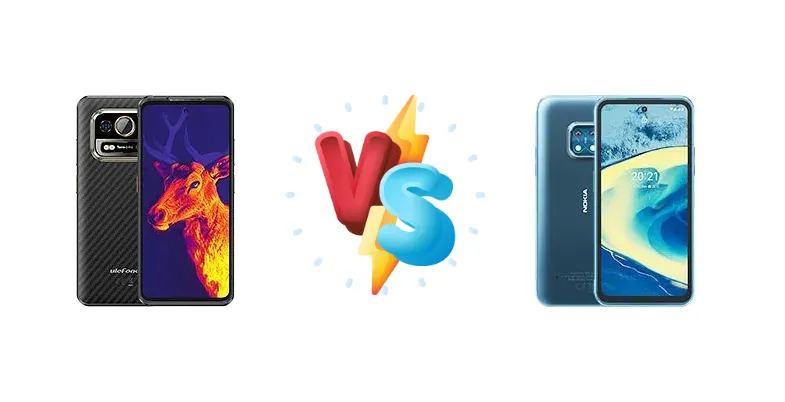
The rugged smartphone market caters to a specific need: durability. Both the Ulefone Armor 25T and Nokia XR20 aim to deliver on that promise, but they diverge significantly in their approach to internal hardware. The Ulefone prioritizes processing power with a newer Mediatek chipset, while the Nokia opts for Qualcomm’s 5G connectivity and a focus on software support. This comparison will dissect these differences to determine which phone best suits your needs.
🏆 Quick Verdict
For users prioritizing raw performance and faster charging, the Ulefone Armor 25T is the clear winner. Its Mediatek Helio G99 chipset offers a noticeable performance advantage over the Snapdragon 480 in the Nokia XR20. However, the Nokia XR20’s 5G connectivity and potentially longer software support make it a compelling choice for those needing reliable mobile data and a trusted brand.
| Network |
|---|
| 2G bands | GSM 850 / 900 / 1800 / 1900 | GSM 850 / 900 / 1800 / 1900 |
| 3G bands | HSDPA 800 / 850 / 900 / 1700(AWS) / 1900 / 2100 | HSDPA 850 / 900 / 1700(AWS) / 1900 / 2100 |
| 4G bands | 1/2/3/4/5/7/8/12/13/17/18/19/20/25/26/28/34/38/39/40/41/66/71 | 1, 2, 3, 4, 5, 7, 8, 12, 13, 14, 20, 25, 26, 28, 30, 38, 40, 41, 48, 66, 71 |
| 5G bands | - | 2, 5, 25, 38, 41, 48, 66, 77, 78 SA/NSA |
| Speed | HSPA, LTE, 5G | HSPA, LTE, 5G |
| Technology | GSM / HSPA / LTE | GSM / CDMA / HSPA / EVDO / LTE / 5G |
| | - | CDMA2000 1xEV-DO |
| Launch |
|---|
| Announced | 2024, July 11 | 2021, July 27 |
| Status | Available. Released 2024, July | Available. Released 2021, August 04 |
| Body |
|---|
| Dimensions | 177.4 x 81.4 x 12.5 mm (6.98 x 3.20 x 0.49 in) | 171.6 x 81.5 x 10.6 mm (6.76 x 3.21 x 0.42 in) |
| SIM | Nano-SIM + Nano-SIM | · Nano-SIM· Nano-SIM + Nano-SIM |
| Weight | 326 g (11.50 oz) | 248 g (8.75 oz) |
| | - | IP68 dust/water resistant (up to 1.5m for 60 min)
Drop-to-concrete resistance from up to 1.8m
MIL-STD-810H compliant |
| Display |
|---|
| Protection | Corning Gorilla Glass Victus | Corning Gorilla Glass Victus |
| Resolution | 1080 x 2460 pixels (~396 ppi density) | 1080 x 2400 pixels, 20:9 ratio (~395 ppi density) |
| Size | 6.78 inches, 109.2 cm2 (~75.6% screen-to-body ratio) | 6.67 inches, 107.4 cm2 (~76.8% screen-to-body ratio) |
| Type | IPS LCD, 120Hz | IPS LCD, 550 nits |
| Platform |
|---|
| CPU | Octa-core (2x2.2 GHz Cortex-A76 & 6x2.0 GHz Cortex-A55) | Octa-core (2x2.0 GHz Kryo 460 & 6x1.8 GHz Kryo 460) |
| Chipset | Mediatek Helio G99 (6 nm) | Qualcomm SM4350 Snapdragon 480 5G (8 nm) |
| GPU | Mali-G57 MC2 | Adreno 619 |
| OS | Android 14 | Android 11, upgradable to Android 13 |
| Memory |
|---|
| Card slot | microSDXC (dedicated slot) | microSDXC (uses shared SIM slot) |
| Internal | 256GB 6GB RAM | 64GB 4GB RAM, 128GB 6GB RAM |
| Main Camera |
|---|
| Dual | - | 48 MP, f/1.8, (wide), 1/2.25", 0.8µm, PDAF
13 MP, f/2.4, 123˚ (ultrawide), 1/3.0", 1.12µm |
| Features | Dual-LED flash, HDR, panorama | Zeiss optics, Dual-LED dual-tone flash, second LED flash, HDR, panorama |
| Single | - | 8 MP, f/2.0 (wide), 1/4.0", 1.12µm |
| Triple | 50 MP, f/2.0, (wide), 1/1.31", 1.2µm, PDAF
64 MP, f/1.8, (night vision), 2 infrared night vision lights
Thermal camera by ThermoVue, 160x120 px, 25Hz, 12μm | - |
| Video | 1440p@30fps, 1080p@30fps | 1080p@30fps |
| Selfie camera |
|---|
| Single | 32 MP, f/2.5, (wide), 0.8µm | 8 MP, f/2.0 (wide), 1/4.0", 1.12µm |
| Video | Yes | 1080p@30fps |
| Sound |
|---|
| 3.5mm jack | - | Yes |
| 35mm jack | Yes | Yes |
| Loudspeaker | Yes | Yes, with stereo speakers |
| Comms |
|---|
| Bluetooth | 5.2, A2DP, LE | 5.1, A2DP, LE, aptX Adaptive |
| Infrared port | Yes | - |
| NFC | Yes | Yes |
| Positioning | GPS, GLONASS, GALILEO, BDS | GPS (L1+L5), GLONASS, BDS, GALILEO, QZSS, NavIC |
| Radio | Wireless FM radio, RDS, recording | Unspecified |
| USB | USB Type-C 2.0, OTG | USB Type-C 3.0 |
| WLAN | Wi-Fi 802.11 a/b/g/n/ac, dual-band | Wi-Fi 802.11 a/b/g/n/ac/6, dual-band, Wi-Fi Direct |
| Features |
|---|
| Sensors | Fingerprint (side-mounted), accelerometer, gyro, proximity, compass, barometer | Fingerprint (side-mounted), accelerometer, gyro, proximity, compass, barometer |
| Battery |
|---|
| Charging | 33W wired
30W wireless
Reverse wireless | 18W wired
15W wireless |
| Type | Li-Po 6500 mAh | Li-Po 4630 mAh |
| Misc |
|---|
| Colors | Black | Ultra Blue, Granite Gray |
| Models | - | TA-1368, TA-1362 |
| Price | About 370 EUR | About 270 EUR |
| SAR EU | - | 1.13 W/kg (head) 1.43 W/kg (body) |
Ulefone Armor 25T
- Faster processor for smoother performance
- Significantly faster charging speeds (wired and wireless)
- Potentially better power efficiency with 6nm process
- Lacks 5G connectivity
- Software update support may be less consistent
Nokia XR20
- 5G connectivity for faster mobile data
- Trusted brand with potentially longer software support
- Clean software experience
- Slower processor resulting in less responsive performance
- Significantly slower charging speeds
- Less efficient 8nm chipset
Display Comparison
Neither device boasts a cutting-edge display. While specific display specs (resolution, panel type) are missing, the focus here is on durability. Both will likely feature toughened glass, but the real comparison lies elsewhere. The absence of high refresh rates suggests neither is geared towards visually intensive experiences. The Armor 25T’s potential for higher peak brightness, given the more modern chipset, could improve outdoor visibility, a crucial factor for a rugged device.
Camera Comparison
Without detailed camera specifications, a direct comparison is difficult. However, the chipset difference hints at processing advantages for the Ulefone. The G99’s ISP (Image Signal Processor) is likely more capable than the Snapdragon 480’s, potentially leading to better image quality, especially in low-light conditions. The absence of information regarding sensor sizes and optical image stabilization (OIS) makes it impossible to definitively declare a winner, but the Armor 25T’s processing power gives it an edge. We can assume both will include basic camera functionality, but neither is likely to compete with flagship smartphone cameras.
Performance
The Ulefone Armor 25T’s Mediatek Helio G99 (6nm) represents a significant leap over the Nokia XR20’s Qualcomm Snapdragon 480 5G (8nm). The G99’s Cortex-A76 cores, clocked at 2.2 GHz, offer substantially more processing power than the XR20’s 2.0 GHz Kryo 460 cores. This translates to faster app loading times, smoother multitasking, and a more responsive user experience. The 6nm process node of the G99 also implies better power efficiency, potentially mitigating the impact of the higher performance on battery life. While the XR20 has 5G, the G99’s raw CPU and GPU power will likely provide a more fluid experience for most tasks.
Battery Life
The Ulefone Armor 25T’s charging capabilities are a clear advantage. 33W wired charging and 30W wireless charging significantly outperform the Nokia XR20’s 18W wired and 15W wireless options. This means the Armor 25T will replenish its battery much faster, a critical feature for users who rely on their phone throughout the day and need minimal downtime. While battery capacity isn’t specified, the G99’s 6nm efficiency could offset any capacity difference, and the faster charging speeds are a major benefit.
Buying Guide
Buy the Ulefone Armor 25T if you need a rugged phone for demanding tasks like mobile gaming, running resource-intensive apps, or frequent use in challenging environments where quick charging is essential. Buy the Nokia XR20 if you prioritize 5G connectivity, a cleaner software experience with guaranteed updates, and a brand known for its reliability, even if it means sacrificing some processing power.
Frequently Asked Questions
❓ Will the Ulefone Armor 25T struggle with graphically demanding games?
While the Helio G99 is a capable chipset, it's not a flagship gaming processor. Expect to play most games at medium settings. The Armor 25T will outperform the XR20 in gaming due to the G99’s superior GPU, but don’t expect a high-end gaming experience.
❓ How important is 5G on the Nokia XR20 for a rugged phone user?
5G is most beneficial if you frequently operate in areas with strong 5G coverage and require fast data speeds for tasks like streaming or large file downloads. If you primarily use Wi-Fi or operate in areas with limited 5G, the benefit is diminished. The XR20’s 5G capability is a key differentiator, but its value depends on your usage scenario.
❓ Does the Ulefone Armor 25T's faster charging generate excessive heat?
The 33W charging on the Armor 25T is relatively fast, but the 6nm process of the Helio G99 should help mitigate heat generation. Ulefone likely incorporates thermal management features to prevent overheating during charging. However, some heat is expected with fast charging.