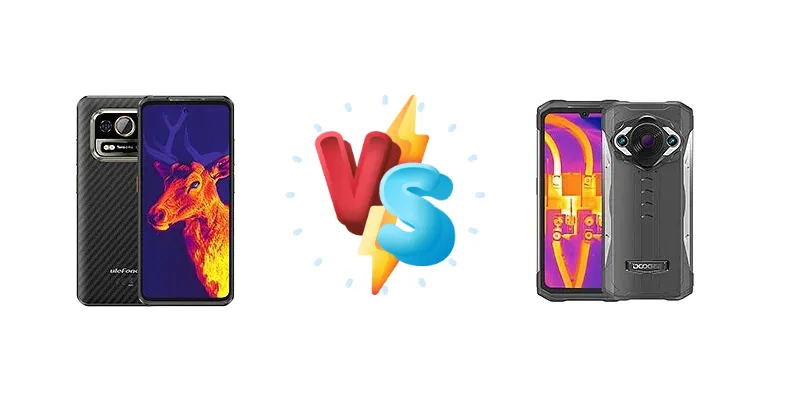
The rugged smartphone market is heating up, offering increasingly capable devices for outdoor enthusiasts and demanding professionals. The Ulefone Armor 25T and Doogee S98 Pro both aim to deliver durability and performance, but key differences in their chipsets and charging capabilities create distinct user experiences. This comparison dissects those differences to help you choose the right tool for the job.
🏆 Quick Verdict
For the average user prioritizing sustained performance and faster charging, the Ulefone Armor 25T is the better choice. Its Mediatek Helio G99, built on a 6nm process, offers a noticeable efficiency advantage over the Doogee S98 Pro’s 12nm Helio G96, translating to less throttling and potentially longer battery life under load.
| Network |
|---|
| 2G bands | GSM 850 / 900 / 1800 / 1900 | GSM 850 / 900 / 1800 / 1900 |
| 3G bands | HSDPA 800 / 850 / 900 / 1700(AWS) / 1900 / 2100 | HSDPA 800 / 850 / 900 / 1700(AWS) / 1900 / 2100 |
| 4G bands | 1/2/3/4/5/7/8/12/13/17/18/19/20/25/26/28/34/38/39/40/41/66/71 | 1, 2, 3, 4, 5, 7, 8, 12, 13, 17, 18, 19, 20, 25, 26, 28, 34, 38, 39, 40, 41, 66 |
| Speed | HSPA, LTE, 5G | HSPA, LTE |
| Technology | GSM / HSPA / LTE | GSM / CDMA / HSPA / LTE |
| Launch |
|---|
| Announced | 2024, July 11 | 2022, May 27 |
| Status | Available. Released 2024, July | Available. Released 2022, June 06 |
| Body |
|---|
| Dimensions | 177.4 x 81.4 x 12.5 mm (6.98 x 3.20 x 0.49 in) | 172 x 82 x 15.5 mm (6.77 x 3.23 x 0.61 in) |
| SIM | Nano-SIM + Nano-SIM | Nano-SIM + Nano-SIM |
| Weight | 326 g (11.50 oz) | 320 g (11.29 oz) |
| Display |
|---|
| Protection | Corning Gorilla Glass Victus | Corning Gorilla Glass |
| Resolution | 1080 x 2460 pixels (~396 ppi density) | 1080 x 2340 pixels, 19.5:9 ratio (~409 ppi density) |
| Size | 6.78 inches, 109.2 cm2 (~75.6% screen-to-body ratio) | 6.3 inches, 97.4 cm2 (~69.1% screen-to-body ratio) |
| Type | IPS LCD, 120Hz | IPS LCD, 500 nits (peak) |
| Platform |
|---|
| CPU | Octa-core (2x2.2 GHz Cortex-A76 & 6x2.0 GHz Cortex-A55) | Octa-core (2x2.05 GHz Cortex-A76 & 6x2.0 GHz Cortex-A55) |
| Chipset | Mediatek Helio G99 (6 nm) | Mediatek MT6781 Helio G96 (12 nm) |
| GPU | Mali-G57 MC2 | Mali-G57 MC2 |
| OS | Android 14 | Android 12 |
| Memory |
|---|
| Card slot | microSDXC (dedicated slot) | microSDXC (dedicated slot) |
| Internal | 256GB 6GB RAM | 256GB 8GB RAM |
| Main Camera |
|---|
| Features | Dual-LED flash, HDR, panorama | Dual-LED flash, HDR, panorama |
| Triple | 50 MP, f/2.0, (wide), 1/1.31", 1.2µm, PDAF
64 MP, f/1.8, (night vision), 2 infrared night vision lights
Thermal camera by ThermoVue, 160x120 px, 25Hz, 12μm | 48 MP, f/1.8, (wide), PDAF
20 MP, f/1.8, (night vision), 2 infrared night vision lights
Thermal imaging camera |
| Video | 1440p@30fps, 1080p@30fps | 1440p, 1080p |
| Selfie camera |
|---|
| Single | 32 MP, f/2.5, (wide), 0.8µm | 16 MP, f/2.0, (wide) |
| Video | Yes | 1080p |
| Sound |
|---|
| 35mm jack | Yes | Unspecified |
| Loudspeaker | Yes | Yes |
| Comms |
|---|
| Bluetooth | 5.2, A2DP, LE | 5.1, A2DP, LE |
| Infrared port | Yes | - |
| NFC | Yes | Yes |
| Positioning | GPS, GLONASS, GALILEO, BDS | GPS, GLONASS, BDS, GALILEO |
| Radio | Wireless FM radio, RDS, recording | FM radio |
| USB | USB Type-C 2.0, OTG | USB Type-C 2.0, OTG |
| WLAN | Wi-Fi 802.11 a/b/g/n/ac, dual-band | Wi-Fi 802.11 a/b/g/n/ac, dual-band |
| Features |
|---|
| Sensors | Fingerprint (side-mounted), accelerometer, gyro, proximity, compass, barometer | Fingerprint (side-mounted), accelerometer, gyro, proximity, compass |
| Battery |
|---|
| Charging | 33W wired
30W wireless
Reverse wireless | 33W wired
15W wireless |
| Type | Li-Po 6500 mAh | 6000 mAh |
| Misc |
|---|
| Colors | Black | Black |
| Price | About 370 EUR | About 470 EUR |
Ulefone Armor 25T
- More efficient Mediatek Helio G99 processor
- Faster 30W wireless charging
- Potentially better sustained performance
- Less established brand recognition
- Display specs unknown, potentially average
Doogee S98 Pro
- Established brand in the rugged phone market
- 33W wired charging
- Likely durable build quality
- Less efficient Mediatek Helio G96 processor
- Slower 15W wireless charging
Display Comparison
Neither Ulefone nor Doogee provide detailed display specifications in the provided data. However, given the price point and rugged focus, we can expect both devices to utilize IPS LCD panels prioritizing durability and visibility in direct sunlight over color accuracy. The absence of LTPO or high refresh rate technology is typical for this segment. Bezels are likely to be substantial on both to provide impact protection.
Camera Comparison
Without detailed sensor information, a direct camera comparison is difficult. However, the rugged phone market often prioritizes megapixel count over sensor size and image quality. We can assume both phones feature a multi-camera setup, but the quality will heavily depend on the primary sensor and image processing algorithms. The absence of information suggests neither phone will challenge flagship camera performance. Any 2MP macro or depth sensors are likely to offer limited practical benefit.
Performance
The core difference lies in the chipsets. The Ulefone Armor 25T’s Mediatek Helio G99 (6nm) is a significant upgrade over the Doogee S98 Pro’s Helio G96 (12nm). The smaller 6nm node allows for greater transistor density and improved power efficiency. While both CPUs feature the same core configuration – 2x2.2 GHz Cortex-A76 and 6x2.0 GHz Cortex-A55 – the G99’s architecture benefits from optimizations resulting in better sustained performance. This means the 25T will likely exhibit less thermal throttling during prolonged gaming or heavy multitasking. The G96, while capable, will struggle to maintain peak performance for extended periods.
Battery Life
Both devices offer 33W wired charging, providing a reasonable charging speed for their likely battery capacities (typically 5000-6000mAh in this segment). However, the Ulefone Armor 25T’s 30W wireless charging significantly surpasses the Doogee S98 Pro’s 15W wireless charging. This is a substantial advantage for users who frequently utilize wireless charging, reducing charging times considerably. The G99’s efficiency also contributes to potentially longer battery life between charges, even with similar battery capacities.
Buying Guide
Buy the Ulefone Armor 25T if you need a rugged phone for demanding tasks like extended GPS navigation, mobile gaming, or running resource-intensive apps in the field. Its more efficient processor and faster wireless charging are ideal for users who push their devices. Buy the Doogee S98 Pro if you prioritize a slightly more established brand reputation within the rugged phone space and are less concerned with maximizing sustained performance or wireless charging speed.
Frequently Asked Questions
❓ Will the Ulefone Armor 25T’s Helio G99 handle demanding games like PUBG Mobile at high settings?
The Helio G99 is capable of running PUBG Mobile at high settings, but expect some frame rate drops during intense firefights. The 6nm process and improved efficiency will help mitigate throttling compared to the G96, allowing for longer gaming sessions before performance degrades significantly. Optimizing in-game settings may be necessary for a consistently smooth experience.
❓ How long does it realistically take to fully charge the Doogee S98 Pro wirelessly?
With 15W wireless charging, a full charge from 0% on the Doogee S98 Pro will likely take between 3-4 hours, depending on ambient temperature and charging pad efficiency. This is considerably slower than the Ulefone Armor 25T’s 30W wireless charging, which could potentially cut that time in half.
❓ Are the rugged certifications (IP68, MIL-STD-810H) comparable between these two devices?
Both phones likely adhere to similar rugged certifications (IP68 for water/dust resistance and MIL-STD-810H for shock/drop resistance). However, the *implementation* of these standards can vary. The quality of seals, materials used, and internal bracing all contribute to real-world durability. Without independent testing, it’s difficult to definitively say which phone is more robust.