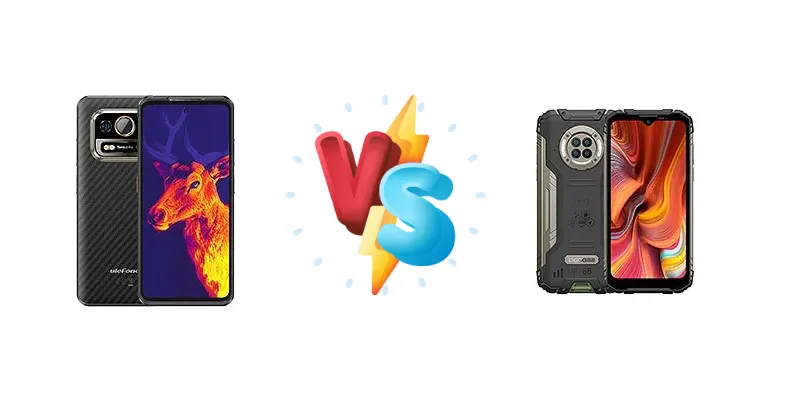
The rugged smartphone market is heating up, offering increasingly capable devices for outdoor enthusiasts and demanding work environments. The Ulefone Armor 25T and Doogee S96 Pro represent compelling options, but differ significantly in their core processing power and charging capabilities. This comparison dissects these differences to determine which phone delivers the best value for your needs.
🏆 Quick Verdict
For most users, the Ulefone Armor 25T is the superior choice. Its newer Mediatek Helio G99 chipset, built on a more efficient 6nm process, provides a performance advantage and potentially better thermal management over the Doogee S96 Pro’s older 12nm Helio G90. The faster 33W wired and 30W wireless charging further solidify its lead.
| Network |
|---|
| 2G bands | GSM 850 / 900 / 1800 / 1900 | GSM 850 / 900 / 1800 / 1900 |
| 3G bands | HSDPA 800 / 850 / 900 / 1700(AWS) / 1900 / 2100 | HSDPA 800 / 850 / 900 / 1700(AWS) / 1900 / 2100 |
| 4G bands | 1/2/3/4/5/7/8/12/13/17/18/19/20/25/26/28/34/38/39/40/41/66/71 | 1, 2, 3, 4, 5, 7, 8, 12, 13, 17, 18, 19, 20, 25, 26, 28, 38, 40, 66 |
| Speed | HSPA, LTE, 5G | HSPA, LTE |
| Technology | GSM / HSPA / LTE | GSM / CDMA / HSPA / LTE |
| Launch |
|---|
| Announced | 2024, July 11 | 2020, October 26. Released 2020, November |
| Status | Available. Released 2024, July | Discontinued |
| Body |
|---|
| Dimensions | 177.4 x 81.4 x 12.5 mm (6.98 x 3.20 x 0.49 in) | 167 x 81.4 x 15.5 mm (6.57 x 3.20 x 0.61 in) |
| SIM | Nano-SIM + Nano-SIM | Nano-SIM + Nano-SIM |
| Weight | 326 g (11.50 oz) | 310 g (10.93 oz) |
| Display |
|---|
| Protection | Corning Gorilla Glass Victus | Corning Gorilla Glass |
| Resolution | 1080 x 2460 pixels (~396 ppi density) | 720 x 1520 pixels, 19:9 ratio (~270 ppi density) |
| Size | 6.78 inches, 109.2 cm2 (~75.6% screen-to-body ratio) | 6.22 inches, 96.6 cm2 (~71.0% screen-to-body ratio) |
| Type | IPS LCD, 120Hz | IPS LCD |
| Platform |
|---|
| CPU | Octa-core (2x2.2 GHz Cortex-A76 & 6x2.0 GHz Cortex-A55) | Octa-core (2x2.0 GHz Cortex-A76 & 6x2.0 GHz Cortex-A55) |
| Chipset | Mediatek Helio G99 (6 nm) | Mediatek MT6785 Helio G90 (12 nm) |
| GPU | Mali-G57 MC2 | Mali-G76 MC4 |
| OS | Android 14 | Android 10 |
| Memory |
|---|
| Card slot | microSDXC (dedicated slot) | microSDXC (dedicated slot) |
| Internal | 256GB 6GB RAM | 128GB 8GB RAM |
| Main Camera |
|---|
| Features | Dual-LED flash, HDR, panorama | Quad-LED flash, HDR, panorama |
| Quad | - | 48 MP, f/1.8, (wide), PDAF
8 MP, f/2.2, 130˚, (ultrawide)
20 MP, f/2.8, (night vision), 4 infrared night vision lights
2 MP (macro) |
| Triple | 50 MP, f/2.0, (wide), 1/1.31", 1.2µm, PDAF
64 MP, f/1.8, (night vision), 2 infrared night vision lights
Thermal camera by ThermoVue, 160x120 px, 25Hz, 12μm | - |
| Video | 1440p@30fps, 1080p@30fps | 1080p |
| Selfie camera |
|---|
| Single | 32 MP, f/2.5, (wide), 0.8µm | 16 MP, f/2.0, (wide) |
| Video | Yes | 1080p |
| Sound |
|---|
| 35mm jack | Yes | Yes |
| Loudspeaker | Yes | Yes |
| Comms |
|---|
| Bluetooth | 5.2, A2DP, LE | 5.0, A2DP, LE |
| Infrared port | Yes | - |
| NFC | Yes | Yes |
| Positioning | GPS, GLONASS, GALILEO, BDS | GPS, GLONASS, BDS, GALILEO |
| Radio | Wireless FM radio, RDS, recording | FM radio |
| USB | USB Type-C 2.0, OTG | USB Type-C 2.0, OTG |
| WLAN | Wi-Fi 802.11 a/b/g/n/ac, dual-band | Wi-Fi 802.11 a/b/g/n/ac, dual-band |
| Features |
|---|
| Sensors | Fingerprint (side-mounted), accelerometer, gyro, proximity, compass, barometer | Fingerprint (side-mounted), accelerometer, gyro, proximity, compass |
| Battery |
|---|
| Charging | 33W wired
30W wireless
Reverse wireless | 24W wired
10W wireless |
| Type | Li-Po 6500 mAh | 6350 mAh |
| Misc |
|---|
| Colors | Black | Black, Orange, Green |
| Price | About 370 EUR | About 280 EUR |
Ulefone Armor 25T
- More powerful and efficient Mediatek Helio G99 chipset
- Faster 33W wired charging
- 30W wireless charging and reverse wireless charging capability
- Potentially higher price point
- No detailed display specifications available
Doogee S96 Pro
- Potentially lower price point
- Rugged design and build quality
- Acceptable performance for basic tasks
- Older and less efficient Mediatek Helio G90 chipset
- Slower 24W wired charging
- Slower 10W wireless charging
Display Comparison
Neither Ulefone nor Doogee provide detailed display specifications in the provided data. However, given the market segment, both likely utilize IPS LCD panels. The absence of information regarding refresh rates or resolution suggests both are targeting the mid-range in terms of display quality. The focus here is clearly on durability, not visual fidelity.
Camera Comparison
Without detailed sensor information, a direct camera comparison is difficult. However, rugged phones often prioritize durability over camera quality. It’s reasonable to assume both phones feature a multi-camera setup, but the image processing capabilities and sensor sizes will be key differentiators. The absence of information suggests neither phone is targeting photography enthusiasts. Users should manage expectations accordingly.
Performance
The core difference lies in the chipsets. The Ulefone Armor 25T’s Mediatek Helio G99 (6nm) represents a significant architectural leap over the Doogee S96 Pro’s Helio G90 (12nm). The 6nm process allows for greater transistor density and improved power efficiency, translating to potentially higher sustained performance and reduced heat generation. While both CPUs feature the same core configuration (2x2.2 GHz Cortex-A76 & 6x2.0 GHz Cortex-A55), the G99’s higher clock speed and more efficient node give it an edge in CPU-bound tasks. The GPU within the G99 also benefits from the process node improvement, offering better graphics performance for gaming. The G90, while capable, will likely exhibit more throttling under prolonged load.
Battery Life
While battery capacity isn't specified, the charging capabilities are a clear win for the Ulefone Armor 25T. Its 33W wired charging and 30W wireless charging significantly outpace the Doogee S96 Pro’s 24W wired and 10W wireless. This translates to substantially faster top-up times, a crucial benefit for users who rely on their phones throughout the day. Even with a similar battery capacity, the faster charging of the 25T reduces downtime.
Buying Guide
Buy the Ulefone Armor 25T if you prioritize sustained performance for gaming or demanding applications, and value faster charging speeds – both wired and wireless. Buy the Doogee S96 Pro if you are on a tighter budget and your usage primarily consists of basic tasks like communication, navigation, and light media consumption, and aren't concerned about the latest chipset.
Frequently Asked Questions
❓ Will the Ulefone Armor 25T’s Helio G99 handle demanding games like PUBG or Genshin Impact at high settings?
The Helio G99 is a capable chipset for gaming, and should handle PUBG at high settings with reasonable frame rates. Genshin Impact may require some settings adjustments to maintain smooth gameplay, but the G99’s improved efficiency should minimize throttling compared to the G90 in the Doogee S96 Pro.
❓ How long does it realistically take to fully charge the Ulefone Armor 25T with the 33W charger?
While a precise time requires testing, a 33W charger should bring the Ulefone Armor 25T from 0% to 100% in approximately 1.5 to 2 hours, assuming a typical battery capacity for a rugged phone. This is significantly faster than the Doogee S96 Pro’s 24W charging.
❓ Is the wireless charging on either phone useful for topping up the battery quickly, or is it primarily for convenience?
The Ulefone Armor 25T’s 30W wireless charging is fast enough to provide a meaningful charge boost, making it useful for more than just convenience. The Doogee S96 Pro’s 10W wireless charging is considerably slower and best suited for overnight or occasional top-ups.