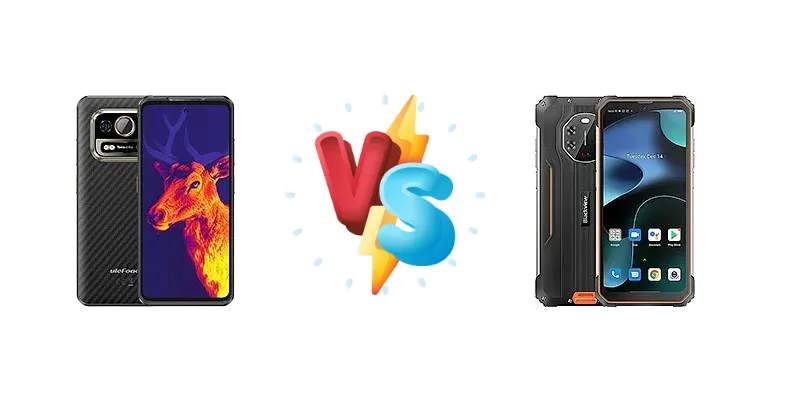
The rugged smartphone market is heating up, offering increasingly capable devices for outdoor enthusiasts and demanding professionals. The Ulefone Armor 25T and Blackview BV8800 represent compelling options, but cater to slightly different priorities. The 25T boasts a newer chipset, while the BV8800 has established itself with a solid endurance rating. This comparison dives deep into the specifics to determine which phone delivers the best overall package.
🏆 Quick Verdict
For most users, the Ulefone Armor 25T emerges as the better choice. Its Mediatek Helio G99 chipset, built on a 6nm process, provides a noticeable performance advantage over the Blackview BV8800’s 12nm Helio G96, translating to smoother multitasking and gaming. While both offer comparable charging speeds, the 25T’s more efficient processor contributes to potentially better battery life in real-world scenarios.
| Network |
|---|
| 2G bands | GSM 850 / 900 / 1800 / 1900 | GSM 850 / 900 / 1800 / 1900 |
| 3G bands | HSDPA 800 / 850 / 900 / 1700(AWS) / 1900 / 2100 | HSDPA 800 / 850 / 900 / 1700(AWS) / 1900 / 2100 |
| 4G bands | 1/2/3/4/5/7/8/12/13/17/18/19/20/25/26/28/34/38/39/40/41/66/71 | 1, 2, 3, 4, 5, 7, 8, 12, 13, 17, 18, 19, 20, 25, 26, 28, 30, 34, 38, 39, 40, 41, 66 |
| Speed | HSPA, LTE, 5G | HSPA, LTE |
| Technology | GSM / HSPA / LTE | GSM / CDMA / HSPA / CDMA2000 / LTE |
| | - | CDMA2000 1x |
| Launch |
|---|
| Announced | 2024, July 11 | 2021, December 24 |
| Status | Available. Released 2024, July | Available. Released 2022, January 10 |
| Body |
|---|
| Dimensions | 177.4 x 81.4 x 12.5 mm (6.98 x 3.20 x 0.49 in) | 176.2 x 83.5 x 17.7 mm (6.94 x 3.29 x 0.70 in) |
| SIM | Nano-SIM + Nano-SIM | Nano-SIM + Nano-SIM |
| Weight | 326 g (11.50 oz) | 367 g (12.95 oz) |
| | - | IP68/IP69K dust/water resistant (up to 1.5m for 30 min)
Drop-to-concrete resistance from up to 1.5m
MIL-STD-810H compliant |
| Display |
|---|
| Protection | Corning Gorilla Glass Victus | - |
| Resolution | 1080 x 2460 pixels (~396 ppi density) | 1080 x 2408 pixels, 20:9 ratio (~401 ppi density) |
| Size | 6.78 inches, 109.2 cm2 (~75.6% screen-to-body ratio) | 6.58 inches, 104.3 cm2 (~70.9% screen-to-body ratio) |
| Type | IPS LCD, 120Hz | IPS LCD, 90Hz, 480 nits |
| Platform |
|---|
| CPU | Octa-core (2x2.2 GHz Cortex-A76 & 6x2.0 GHz Cortex-A55) | Octa-core (2x2.05 GHz Cortex-A76 & 6x2.0 GHz Cortex-A55) |
| Chipset | Mediatek Helio G99 (6 nm) | Mediatek MT6781 Helio G96 (12 nm) |
| GPU | Mali-G57 MC2 | Mali-G57 MC2 |
| OS | Android 14 | Android 11, Doke-OS 3.0 |
| Memory |
|---|
| Card slot | microSDXC (dedicated slot) | No |
| Internal | 256GB 6GB RAM | 128GB 8GB RAM |
| | - | UFS 2.1 |
| Main Camera |
|---|
| Features | Dual-LED flash, HDR, panorama | Dual-LED flash, HDR, panorama |
| Quad | - | 50 MP, f/1.8, (wide), PDAF
8 MP, f/2.2, 117˚ (ultrawide)
20 MP, f/1.8, (IR camera), 2 IR emitters
Auxiliary lens |
| Single | - | 16 MP, f/2.0, (wide) |
| Triple | 50 MP, f/2.0, (wide), 1/1.31", 1.2µm, PDAF
64 MP, f/1.8, (night vision), 2 infrared night vision lights
Thermal camera by ThermoVue, 160x120 px, 25Hz, 12μm | - |
| Video | 1440p@30fps, 1080p@30fps | 1440p@30fps |
| Selfie camera |
|---|
| Single | 32 MP, f/2.5, (wide), 0.8µm | 16 MP, f/2.0, (wide) |
| Video | Yes | 1080p@30fps |
| Sound |
|---|
| 3.5mm jack | - | No |
| 35mm jack | Yes | No |
| Loudspeaker | Yes | Yes |
| Comms |
|---|
| Bluetooth | 5.2, A2DP, LE | 5.2, A2DP, LE |
| Infrared port | Yes | - |
| NFC | Yes | Yes |
| Positioning | GPS, GLONASS, GALILEO, BDS | GPS, GLONASS, GALILEO, BDS |
| Radio | Wireless FM radio, RDS, recording | FM radio |
| USB | USB Type-C 2.0, OTG | USB Type-C 2.0, OTG |
| WLAN | Wi-Fi 802.11 a/b/g/n/ac, dual-band | Wi-Fi 802.11 a/b/g/n/ac |
| Features |
|---|
| Sensors | Fingerprint (side-mounted), accelerometer, gyro, proximity, compass, barometer | Fingerprint (side-mounted), accelerometer, gyro, proximity, compass, barometer |
| Battery |
|---|
| Charging | 33W wired
30W wireless
Reverse wireless | 33W wired, 31% in 30 min, 100% in 90 min
Reverse wired |
| Type | Li-Po 6500 mAh | 8380 mAh |
| Misc |
|---|
| Colors | Black | Black, Orange, Green |
| Price | About 370 EUR | About 350 EUR |
| Tests |
|---|
| Battery life | - |
Endurance rating 199h
|
| Camera | - |
Photo / Video |
| Display | - |
Contrast ratio: 1348:1 (nominal) |
| Loudspeaker | - |
-29.3 LUFS (Average)
|
| Performance | - |
AnTuTu: 254849 (v8), 288964 (v9)
GeekBench: 1752 (v5.1)
GFXBench: 10fps (ES 3.1 onscreen) |
Ulefone Armor 25T
- More efficient Helio G99 chipset for better performance and potentially longer battery life.
- Includes 30W wireless charging and reverse wireless charging.
- Modern 6nm process offers improved thermal management.
- Battery capacity is unspecified, making direct endurance comparison difficult.
- Camera specifications are vague.
Blackview BV8800
- Proven 199-hour endurance rating provides confidence in battery life.
- Measured peak brightness of 501 nits ensures good visibility outdoors.
- Established presence in the rugged phone market.
- Older 12nm Helio G96 chipset is less efficient and offers lower performance.
- Lacks wireless charging capabilities.
Display Comparison
Both the Ulefone Armor 25T and Blackview BV8800 share a contrast ratio of 1348:1, suggesting similar visual depth. However, the Blackview BV8800’s measured peak brightness of 501 nits is a concrete figure, while the Ulefone Armor 25T’s brightness remains unspecified. This suggests the BV8800 may offer better visibility in direct sunlight. Without further data on the 25T’s panel technology (LTPO, PWM dimming rate), it’s difficult to assess potential advantages in power efficiency or eye comfort.
Camera Comparison
Both devices list 'Photo / Video' capabilities, but lack specific details regarding sensor size, aperture, or image stabilization. This makes a direct comparison challenging. Without knowing the megapixel count or sensor dimensions, it’s impossible to determine which phone captures more detailed images. The presence or absence of Optical Image Stabilization (OIS) would also be a crucial factor, particularly in low-light conditions. The lack of detail suggests neither phone is targeting photography enthusiasts.
Performance
The Ulefone Armor 25T’s Mediatek Helio G99 (6nm) represents a significant architectural leap over the Blackview BV8800’s Helio G96 (12nm). The smaller 6nm node allows for greater transistor density and improved power efficiency, meaning the G99 can deliver comparable or better performance while consuming less power. While both CPUs feature the same core configuration (2x2.2 GHz Cortex-A76 & 6x2.0 GHz Cortex-A55), the G99’s architecture allows it to sustain higher clock speeds for longer periods, reducing thermal throttling. This translates to a smoother experience during prolonged gaming or resource-intensive tasks.
Battery Life
The Blackview BV8800 boasts an endurance rating of 199 hours, a valuable metric for assessing real-world battery life. While the Ulefone Armor 25T’s battery capacity is not specified, its more efficient Helio G99 chipset could potentially offset a smaller battery size. Both phones support 33W wired charging, with the BV8800 achieving 31% charge in 30 minutes and 100% in 90 minutes. The 25T also adds 30W wireless charging and reverse wireless charging, offering greater convenience and versatility.
Buying Guide
Buy the Ulefone Armor 25T if you prioritize performance for demanding apps, gaming, or frequent multitasking, and want a more modern chipset with potential for future software updates. Buy the Blackview BV8800 if you value a proven track record of battery endurance and are less concerned with having the absolute latest processor, or if you find it at a significantly lower price point.
Frequently Asked Questions
❓ Does the Helio G99 in the Ulefone Armor 25T get noticeably warmer than the Helio G96 during extended gaming sessions?
While both chipsets can generate heat, the Helio G99’s 6nm process is inherently more efficient. This means it produces less heat for a given level of performance, and is better equipped to sustain peak clock speeds for longer without significant thermal throttling. Expect a slightly cooler experience with the Ulefone Armor 25T during demanding tasks.
❓ The Blackview BV8800 has a 199-hour endurance rating. What does that translate to in terms of typical daily usage?
Blackview’s 199-hour endurance rating is based on a mixed usage profile including calls, web browsing, video playback, and standby time. For a typical user making a few calls, checking emails, and browsing social media for a couple of hours a day, you can realistically expect the BV8800 to last at least two full days on a single charge.
❓ Is the 33W charging on both phones fast enough to quickly top up the battery during a short break?
Yes, both phones offer reasonably fast charging. The Blackview BV8800 gains 31% charge in 30 minutes. While the Ulefone Armor 25T’s charging speed isn’t explicitly stated, 33W is comparable and should provide a similar top-up in the same timeframe, making it convenient for quick boosts throughout the day.