
Ulefone Armor 25T Pro vs. Oukitel WP210: A Deep Dive into Rugged Smartphone Performance
| Phones Images | |||||
|---|---|---|---|---|---|
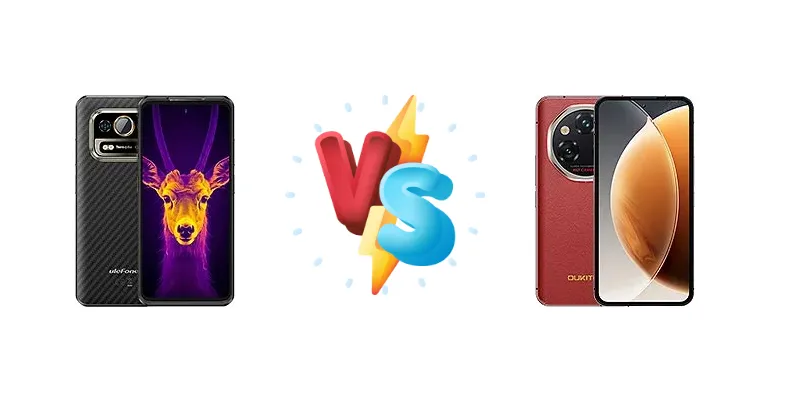
|
🏆 Quick Verdict
For users prioritizing raw processing power and demanding tasks, the Oukitel WP210 is the clear winner thanks to its Dimensity 8200 chipset. However, the Ulefone Armor 25T Pro offers a compelling package with wireless charging and a potentially more efficient processor for everyday use, making it a strong contender for those seeking balanced performance.
| PHONES | ||
|---|---|---|
| Phone Names | Ulefone Armor 25T Pro | Oukitel WP210 |
| Network | ||
|---|---|---|
| 2G bands | GSM 850 / 900 / 1800 / 1900 | GSM 850 / 900 / 1800 / 1900 |
| 3G bands | HSDPA 800 / 850 / 900 / 1700(AWS) / 1900 / 2100 | HSDPA 800 / 850 / 900 / 1700(AWS) / 1900 / 2100 |
| 4G bands | 1, 2, 3, 4, 5, 7, 8, 12, 13, 17, 18, 19, 20, 25, 26, 28, 34, 38, 39, 40, 41, 66, 71 | 1, 2, 3, 4, 5, 7, 8, 12, 13, 17, 18, 19, 20, 25, 26, 28, 34, 38, 39, 40, 41, 66, 71 |
| 5G bands | 1, 3, 5, 8, 20, 28, 38, 41, 71, 77, 78, 79 SA/NSA/Sub6 | 1, 2, 3, 5, 7, 8, 12, 20, 25, 28, 34, 38, 39, 40, 41, 48, 66, 71, 77, 78 SA/NSA |
| Speed | HSPA, LTE, 5G | HSPA, LTE, 5G |
| Technology | GSM / HSPA / LTE / 5G | GSM / HSPA / LTE / 5G |
| Launch | ||
|---|---|---|
| Announced | 2024, May | 2025, July |
| Status | Available. Released 2024, May | Available. Released 2025, July 15 |
| Body | ||
|---|---|---|
| Dimensions | 177.4 x 81.4 x 12.5 mm (6.98 x 3.20 x 0.49 in) | 163.6 x 77.9 x 13.7 mm (6.44 x 3.07 x 0.54 in) |
| SIM | Nano-SIM + Nano-SIM | Nano-SIM + Nano-SIM |
| Weight | 326 g (11.50 oz) | 311 g (10.97 oz) |
| Display | ||
|---|---|---|
| Protection | Corning Gorilla Glass Victus | Corning Gorilla Glass 5, Mohs level 5 |
| Resolution | 1080 x 2460 pixels (~396 ppi density) | 1080 x 2408 pixels, 20:9 ratio (~394 ppi density) |
| Size | 6.78 inches, 109.2 cm2 (~75.6% screen-to-body ratio) | 6.7 inches, 108.1 cm2 (~84.9% screen-to-body ratio) |
| Type | IPS LCD, 120Hz | IPS LCD, 120Hz, 500 nits |
| Platform | ||
|---|---|---|
| CPU | Octa-core (2x2.4 GHz Cortex-A76 & 6x2.0 GHz Cortex-A55) | Octa-core (1x3.1 GHz Cortex-A78 & 3x3.0 GHz Cortex-A78 & 4x2.0 GHz Cortex-A55) |
| Chipset | Mediatek Dimensity 6300 (6 nm) | Mediatek Dimensity 8200 (4 nm) |
| GPU | Mali-G57 MC2 | Mali-G610 MC6 |
| OS | Android 14 | Android 15 |
| Memory | ||
|---|---|---|
| Card slot | microSDXC (dedicated slot) | microSDXC (uses shared SIM slot) |
| Internal | 256GB 6GB RAM | 512GB 12GB RAM |
| Main Camera | ||
|---|---|---|
| Features | Dual-LED flash, HDR, panorama | LED flash, HDR, panorama |
| Triple | 50 MP, f/1.7, (wide), 1/1.31", 1.2µm, PDAF 64 MP, f/1.8, (night vision), 2 infrared night vision lights Thermal camera by ThermoVue, 160x120 px, 25Hz, 12μm | 108 MP, f/1.9, (wide), 1/1.8", PDAF 2 MP (macro) Auxiliary lens |
| Video | 1440p@30fps, 1080p@30fps | 4K@30fps |
| Selfie camera | ||
|---|---|---|
| Single | 32 MP, f/2.5, (wide), 0.8µm | 32 MP, f/2.2, (wide), 1/2.74" |
| Video | Yes | 1080p@30fps |
| Sound | ||
|---|---|---|
| 35mm jack | Yes | No |
| Loudspeaker | Yes | Yes |
| Comms | ||
|---|---|---|
| Bluetooth | 5.2, A2DP, LE | 5.3, A2DP, LE |
| Infrared port | Yes | - |
| NFC | Yes | Yes |
| Positioning | GPS, GLONASS, GALILEO, BDS | GPS (L1+L5), GLONASS, GALILEO, BDS |
| Radio | Wireless FM radio, RDS, recording | FM radio |
| USB | USB Type-C 2.0, OTG | USB Type-C 2.0 |
| WLAN | Wi-Fi 802.11 a/b/g/n/ac, dual-band | Wi-Fi 802.11 a/b/g/n/ac/6, dual-band |
| Features | ||
|---|---|---|
| Sensors | Fingerprint (side-mounted), accelerometer, gyro, proximity, compass, barometer | Fingerprint (side-mounted), accelerometer, gyro, proximity, compass |
| Battery | ||
|---|---|---|
| Charging | 33W wired 30W wireless Reverse wireless | 45W wired |
| Type | Li-Po 6500 mAh | Li-Po 8800 mAh |
| Misc | ||
|---|---|---|
| Colors | Black | Gray, Black, Red |
| Price | About 420 EUR | - |
| EU LABEL | ||
|---|---|---|
| Battery | - | 86:17h endurance, 1000 cycles |
| Energy | - | Class B |
| Free fall | - | Class A (270 falls) |
| Repairability | - | Class C |
Ulefone Armor 25T Pro
- Wireless charging offers added convenience.
- Reverse wireless charging can top up accessories.
- Potentially better power efficiency with the Dimensity 6300.
- Significantly less powerful processor than the WP210.
- Slower wired charging speed.
- Lacks the WP210's claimed battery endurance.
Oukitel WP210
- Superior processing power with the Dimensity 8200.
- Faster 45W wired charging.
- Impressive claimed battery endurance and cycle life.
- No wireless charging support.
- Potentially higher power consumption.
- May run hotter under sustained load.
Display Comparison
Neither device's display specifications are provided, so a direct comparison is limited. However, given the Armor 25T Pro's positioning, it likely utilizes an IPS LCD panel, prioritizing durability over advanced features like LTPO. The WP210, being a higher-tier device, may incorporate a more advanced panel with higher peak brightness and potentially better color accuracy. Bezels are likely similar across both devices, focusing on maximizing screen real estate within a ruggedized frame.
Camera Comparison
Without detailed camera specifications, a precise comparison is difficult. However, the WP210’s higher overall processing power suggests a more sophisticated image signal processor (ISP), potentially leading to better image quality and faster processing times. The Armor 25T Pro may focus on practical camera features for documentation in rugged environments, while the WP210 could offer more advanced computational photography capabilities. The absence of information regarding sensor sizes and OIS makes a definitive judgment impossible.
Performance
The Oukitel WP210’s Dimensity 8200 (4nm) represents a significant leap in performance over the Ulefone Armor 25T Pro’s Dimensity 6300 (6nm). The 8200 boasts a prime Cortex-A78 core clocked at 3.1 GHz, alongside three additional A78 cores at 3.0 GHz, offering substantially greater single-core and multi-core performance. The 6300’s configuration of 2x2.4 GHz Cortex-A76 and 6x2.0 GHz Cortex-A55 cores, while capable, is geared towards efficiency rather than outright speed. This translates to smoother multitasking, faster app loading times, and superior gaming performance on the WP210. The 4nm process node of the Dimensity 8200 also contributes to better thermal efficiency, potentially reducing throttling during sustained workloads.
Battery Life
The Oukitel WP210 features 45W wired charging, enabling significantly faster charging speeds compared to the Ulefone Armor 25T Pro’s 33W wired charging. While the Armor 25T Pro adds the convenience of 30W wireless charging and reverse wireless charging, the WP210’s faster wired charging is more practical for quickly replenishing the battery. Oukitel claims 86:17h endurance and 1000 cycles, suggesting a focus on long-term battery health and longevity, a key consideration for users needing reliable power in remote locations. The actual battery capacity of both devices is unknown, but the WP210’s charging speed and endurance claim position it as the superior option for power users.
Buying Guide
Buy the Ulefone Armor 25T Pro if you need a rugged phone with the convenience of wireless charging and prioritize a balance between performance and efficiency for typical daily tasks. Buy the Oukitel WP210 if you demand maximum processing power for gaming, video editing, or other resource-intensive applications, and are willing to forgo wireless charging for faster wired charging and superior performance.