
Ulefone Armor 25T Pro vs. Doogee V30 Pro: A Deep Dive into Rugged Smartphone Performance
| Phones Images | |||||
|---|---|---|---|---|---|
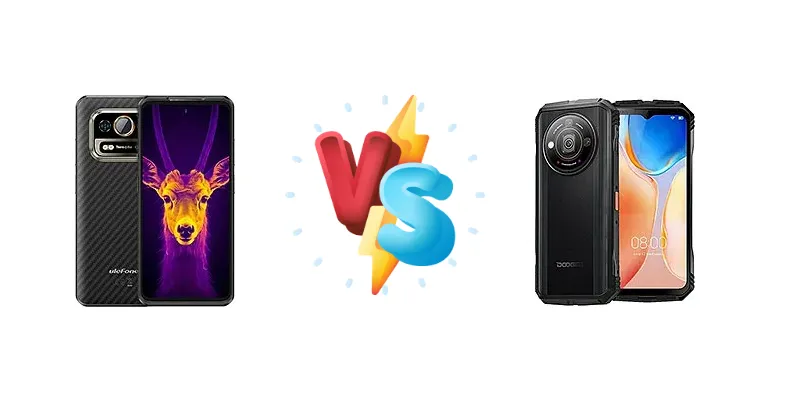
|
🏆 Quick Verdict
For the average user prioritizing raw processing power and slightly faster performance, the Doogee V30 Pro edges out the Ulefone Armor 25T Pro thanks to its Dimensity 7050. However, the 25T Pro’s inclusion of 30W wireless charging and reverse wireless charging provides added convenience that the V30 Pro lacks, making it a compelling choice for those valuing versatility.
| PHONES | ||
|---|---|---|
| Phone Names | Ulefone Armor 25T Pro | Doogee V30 Pro |
| Network | ||
|---|---|---|
| 2G bands | GSM 850 / 900 / 1800 / 1900 | GSM 850 / 900 / 1800 / 1900 |
| 3G bands | HSDPA 800 / 850 / 900 / 1700(AWS) / 1900 / 2100 | HSDPA 800 / 850 / 900 / 1700(AWS) / 1900 / 2100 |
| 4G bands | 1, 2, 3, 4, 5, 7, 8, 12, 13, 17, 18, 19, 20, 25, 26, 28, 34, 38, 39, 40, 41, 66, 71 | 1, 2, 3, 4, 5, 7, 8, 12, 17, 18, 19, 20, 25, 26, 28, 34, 38, 39, 40, 41, 66 |
| 5G bands | 1, 3, 5, 8, 20, 28, 38, 41, 71, 77, 78, 79 SA/NSA/Sub6 | 1, 3, 7, 28, 38, 41, 77, 78, 79 SA/NSA |
| Speed | HSPA, LTE, 5G | HSPA, LTE, 5G |
| Technology | GSM / HSPA / LTE / 5G | GSM / CDMA / HSPA / LTE / 5G |
| Launch | ||
|---|---|---|
| Announced | 2024, May | 2023, October 24 |
| Status | Available. Released 2024, May | Available. Released 2023, November 01 |
| Body | ||
|---|---|---|
| Dimensions | 177.4 x 81.4 x 12.5 mm (6.98 x 3.20 x 0.49 in) | 178.5 x 83.1 x 17.9 mm (7.03 x 3.27 x 0.70 in) |
| SIM | Nano-SIM + Nano-SIM | Nano-SIM + Nano-SIM |
| Weight | 326 g (11.50 oz) | - |
| Display | ||
|---|---|---|
| Protection | Corning Gorilla Glass Victus | Corning Gorilla Glass 5 |
| Resolution | 1080 x 2460 pixels (~396 ppi density) | 1080 x 2408 pixels, 20:9 ratio (~401 ppi density) |
| Size | 6.78 inches, 109.2 cm2 (~75.6% screen-to-body ratio) | 6.58 inches, 104.3 cm2 (~70.3% screen-to-body ratio) |
| Type | IPS LCD, 120Hz | IPS LCD, 120Hz |
| Platform | ||
|---|---|---|
| CPU | Octa-core (2x2.4 GHz Cortex-A76 & 6x2.0 GHz Cortex-A55) | Octa-core (2x2.6 GHz Cortex-A78 & 6x2.0 GHz Cortex-A55) |
| Chipset | Mediatek Dimensity 6300 (6 nm) | Mediatek Dimensity 7050 (6 nm) |
| GPU | Mali-G57 MC2 | Mali-G68 MC4 |
| OS | Android 14 | Android 13 |
| Memory | ||
|---|---|---|
| Card slot | microSDXC (dedicated slot) | microSDXC (uses shared SIM slot) |
| Internal | 256GB 6GB RAM | 512GB 12GB RAM |
| Main Camera | ||
|---|---|---|
| Features | Dual-LED flash, HDR, panorama | Dual-LED flash, HDR, panorama |
| Triple | 50 MP, f/1.7, (wide), 1/1.31", 1.2µm, PDAF 64 MP, f/1.8, (night vision), 2 infrared night vision lights Thermal camera by ThermoVue, 160x120 px, 25Hz, 12μm | 200 MP, f/1.7, (wide), 1/1.4", PDAF 24 MP, f/1.8, (night vision), 2 infrared night vision lights 16 MP, f/2.2, 125˚ (ultrawide) |
| Video | 1440p@30fps, 1080p@30fps | 4K@30fps, 1080p@30fps |
| Selfie camera | ||
|---|---|---|
| Single | 32 MP, f/2.5, (wide), 0.8µm | 32 MP, f/1.8, (wide), 1/2.7" |
| Video | Yes | 1080p@30fps |
| Sound | ||
|---|---|---|
| 35mm jack | Yes | Unspecified |
| Loudspeaker | Yes | Yes, with stereo speakers |
| Comms | ||
|---|---|---|
| Bluetooth | 5.2, A2DP, LE | 5.2, A2DP, LE |
| Infrared port | Yes | - |
| NFC | Yes | Yes (market/region dependent) |
| Positioning | GPS, GLONASS, GALILEO, BDS | GPS (L1+L5), GLONASS, GALILEO, BDS |
| Radio | Wireless FM radio, RDS, recording | FM radio |
| USB | USB Type-C 2.0, OTG | USB Type-C 2.0, OTG |
| WLAN | Wi-Fi 802.11 a/b/g/n/ac, dual-band | Wi-Fi 802.11 a/b/g/n/ac/6, dual-band |
| Features | ||
|---|---|---|
| Sensors | Fingerprint (side-mounted), accelerometer, gyro, proximity, compass, barometer | Fingerprint (side-mounted), accelerometer, gyro, proximity, compass |
| Battery | ||
|---|---|---|
| Charging | 33W wired 30W wireless Reverse wireless | 33W wired Reverse wired |
| Type | Li-Po 6500 mAh | 10800 mAh |
| Misc | ||
|---|---|---|
| Colors | Black | Black, Orange, Silver |
| Price | About 420 EUR | About 440 EUR |
Ulefone Armor 25T Pro
- Includes 30W wireless charging for added convenience.
- Offers reverse wireless charging for accessories.
- Potentially more affordable price point.
- Dimensity 6300 chipset offers slightly lower CPU performance.
- Lacks the latest LPDDR5X RAM for faster memory speeds.
Doogee V30 Pro
- Dimensity 7050 chipset delivers superior CPU and GPU performance.
- Faster CPU cores (Cortex-A78) for smoother multitasking.
- Potentially better gaming experience.
- Lacks wireless charging capabilities.
- Only offers reverse wired charging.
Display Comparison
Neither Ulefone nor Doogee provide display specifications in the provided data. However, given the price point and rugged focus, we can anticipate both devices utilize IPS LCD panels prioritizing durability over cutting-edge features like LTPO. Bezels are likely to be substantial to reinforce the screen's protection. Color accuracy will likely be adequate for outdoor visibility, but not geared towards professional content creation.
Camera Comparison
Without detailed camera specs, a direct comparison is limited. However, the market trend suggests both phones will feature a multi-camera setup with a primary sensor likely around 50MP or higher. The absence of information regarding OIS (Optical Image Stabilization) suggests it may not be present on either device, relying instead on digital stabilization. Lens apertures will be crucial for low-light performance, but without that data, it’s difficult to assess. The inclusion of a 2MP macro camera on either device is largely a marketing tactic, offering minimal practical benefit due to its low resolution and fixed focus.
Performance
The core difference lies in the chipsets: the Ulefone Armor 25T Pro features the Mediatek Dimensity 6300, while the Doogee V30 Pro boasts the Dimensity 7050. Both are 6nm chips, but the 7050 utilizes Cortex-A78 cores (2x2.6 GHz) compared to the 25T Pro’s Cortex-A76 cores (2x2.4 GHz). This architectural difference translates to a noticeable performance advantage for the V30 Pro in CPU-intensive tasks. While both share the same Cortex-A55 efficiency cores (6x2.0 GHz), the 7050’s superior CPU architecture will result in faster application loading and smoother multitasking. The GPU performance will also favor the V30 Pro, offering a better gaming experience. Both devices likely utilize LPDDR4X RAM, as is common in this segment, limiting memory bandwidth.
Battery Life
Battery capacity isn't specified, but rugged phones typically prioritize large batteries. The charging capabilities are a key differentiator. The Ulefone Armor 25T Pro supports both 33W wired charging, 30W wireless charging, *and* reverse wireless charging. The Doogee V30 Pro only offers 33W wired charging and reverse *wired* charging. This gives the 25T Pro a significant advantage for users who value the convenience of wireless charging or the ability to top up accessories like earbuds or smartwatches without a cable. While the V30 Pro’s wired charging is comparable, the lack of wireless options is a notable omission.
Buying Guide
Buy the Ulefone Armor 25T Pro if you need a rugged phone with the added convenience of wireless and reverse wireless charging, and are comfortable with slightly less peak CPU performance. Buy the Doogee V30 Pro if you prioritize maximum processing power for demanding tasks like gaming or video editing, and don't require wireless charging capabilities. Both excel in durability, making them ideal for outdoor enthusiasts and professionals in demanding environments.