
Ulefone Armor 24 vs. Doogee V30T: A Deep Dive into Rugged Smartphone Performance
| Phones Images | |||||
|---|---|---|---|---|---|
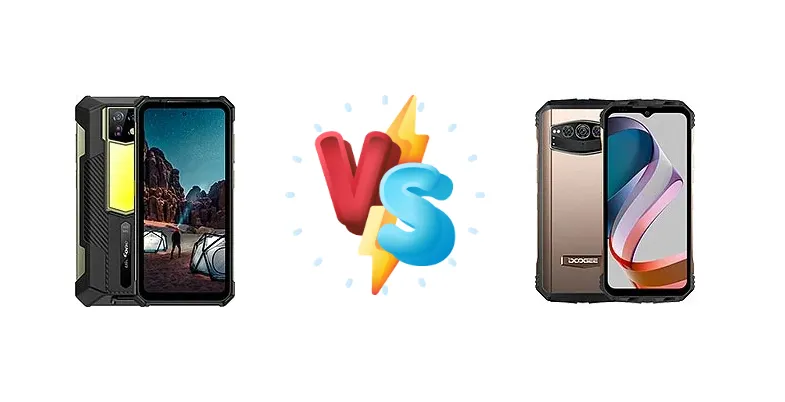
|
🏆 Quick Verdict
For the average user prioritizing sustained performance and future-proofing, the Doogee V30T is the clear winner. Its Dimensity 1080 chipset delivers a substantial performance leap over the Armor 24’s Helio G96. However, users who absolutely require maximum battery life and 1000 charge cycles will find the Ulefone Armor 24 a more suitable choice.
| PHONES | ||
|---|---|---|
| Phone Names | Ulefone Armor 24 | Doogee V30T |
| Network | ||
|---|---|---|
| 2G bands | GSM 850 / 900 / 1800 / 1900 | GSM 850 / 900 / 1800 / 1900 |
| 3G bands | HSDPA 850 / 900 / 1700(AWS) / 1900 / 2100 | HSDPA 800 / 850 / 900 / 1700(AWS) / 1900 / 2100 |
| 4G bands | 1, 2, 3, 4, 5, 7, 8, 12, 17, 19, 20, 28, 34, 38, 39, 40, 41, 66 | 1, 2, 3, 4, 5, 7, 8, 12, 17, 18, 19, 20, 25, 26, 28, 34, 38, 39, 40, 41, 66 |
| 5G bands | - | 1, 3, 7, 28, 38, 41, 77, 78, 79 SA/NSA |
| Speed | HSPA, LTE | HSPA, LTE, 5G |
| Technology | GSM / HSPA / LTE | GSM / CDMA / HSPA / LTE / 5G |
| Launch | ||
|---|---|---|
| Announced | 2023, September | 2023, April 16 |
| Status | Available. Released 2023, September | Available. Released 2023, May |
| Body | ||
|---|---|---|
| Dimensions | 181.2 x 87 x 27.5 mm (7.13 x 3.43 x 1.08 in) | 178.4 x 83.1 x 17.8 mm (7.02 x 3.27 x 0.70 in) |
| SIM | Nano-SIM + Nano-SIM | Nano-SIM + Nano-SIM |
| Weight | 647 g (1.43 lb) | 376 g (13.26 oz) |
| Display | ||
|---|---|---|
| Protection | Corning Gorilla Glass 5, Mohs level 4 | Corning Gorilla Glass 5 |
| Resolution | 1080 x 2460 pixels (~396 ppi density) | 1080 x 2408 pixels, 20:9 ratio (~401 ppi density) |
| Size | 6.78 inches, 109.2 cm2 (~69.2% screen-to-body ratio) | 6.58 inches, 104.3 cm2 (~70.4% screen-to-body ratio) |
| Type | IPS LCD, 120Hz | IPS LCD, 120Hz |
| Platform | ||
|---|---|---|
| CPU | Octa-core (2x2.05 GHz Cortex-A76 & 6x2.0 GHz Cortex-A55) | Octa-core (2x2.6 GHz Cortex-A78 & 6x2.0 GHz Cortex-A55) |
| Chipset | Mediatek MT6781 Helio G96 (12 nm) | Mediatek Dimensity 1080 (6 nm) |
| GPU | Mali-G57 MC2 | Mali-G68 MC4 |
| OS | Android 13 | Android 12 |
| Memory | ||
|---|---|---|
| Card slot | microSDXC (dedicated slot) | microSDXC (uses shared SIM slot) |
| Internal | 256GB 12GB RAM | 256GB 12GB RAM |
| Main Camera | ||
|---|---|---|
| Dual | 64 MP, f/1.9, (wide), 1/1.7", 0.8µm, PDAF 64 MP, f/1.8, (night vision), 2 infrared night vision lights | - |
| Features | LED flash, HDR, panorama | Dual-LED flash, HDR, panorama |
| Triple | - | 108 MP, f/1.8, (wide), 1/1.52", 0.7µm, PDAF, OIS 20 MP, f/1.8, (night vision), 2 infrared night vision lights 16 MP, f/2.2, 130˚ (ultrawide), AF |
| Video | 1440p@30fps, 1080p@30fps | 4K@30fps, 1080p@30fps |
| Selfie camera | ||
|---|---|---|
| Single | 16 MP, f/2.2, (wide), 1.0µm | 32 MP, f/1.8, (wide), 1/2.8", 0.8µm |
| Video | 1080p@30fps | 4K@30fps, 1080p@30fps |
| Sound | ||
|---|---|---|
| 35mm jack | Yes | No |
| Loudspeaker | Yes | Yes, with stereo speakers |
| Comms | ||
|---|---|---|
| Bluetooth | 5.2, A2DP, LE | 5.2, A2DP, LE |
| Infrared port | Yes | - |
| NFC | Yes | Yes (market/region dependent) |
| Positioning | GPS, GLONASS, GALILEO, BDS | GPS (L1+L5), GLONASS, GALILEO, BDS |
| Radio | Wireless FM radio, RDS, recording | FM radio |
| USB | USB Type-C 2.0, OTG | USB Type-C 2.0, OTG |
| WLAN | Wi-Fi 802.11 a/b/g/n/ac, dual-band | Wi-Fi 802.11 a/b/g/n/ac/6, dual-band |
| Features | ||
|---|---|---|
| Sensors | Fingerprint (side-mounted), accelerometer, proximity, compass, gyro | Fingerprint (side-mounted), accelerometer, gyro, proximity, compass |
| Battery | ||
|---|---|---|
| Charging | 66W wired 10W reverse wired | 66W wired, 55% in 30 min 15W wireless Reverse wired |
| Type | Li-Po 22000 mAh | 10800 mAh |
| Misc | ||
|---|---|---|
| Colors | Black | Marble Black, Rose Gold, Galaxy Gray |
| Price | About 370 EUR | About 420 EUR |
| EU LABEL | ||
|---|---|---|
| Battery | 166:39h endurance, 1000 cycles | - |
| Energy | Class A | - |
| Free fall | Class A (270 falls) | - |
| Repairability | Class B | - |
Ulefone Armor 24
- Exceptional battery endurance (166:39h)
- Industry-leading 1000 battery charge cycles
- Rugged design built for extreme conditions
- Less powerful Helio G96 chipset
- Slower charging speeds compared to the V30T
- Potentially less refined camera experience
Doogee V30T
- Significantly faster Dimensity 1080 chipset
- Faster 66W wired and 15W wireless charging
- Potentially better camera performance due to ISP
- Lower battery charge cycle lifespan
- Battery endurance likely lower than the Armor 24
- May be more prone to thermal throttling under heavy load
Display Comparison
Neither device’s display specifications are provided, so a direct comparison is limited. However, given the V30T’s positioning, it likely features a higher resolution and potentially a smoother refresh rate. The Armor 24, focusing on practicality, may prioritize durability over display finesse. The absence of LTPO technology in either device suggests standard refresh rate implementations.
Camera Comparison
Without detailed camera specifications, a comprehensive comparison is difficult. However, the chipset difference suggests the Doogee V30T will benefit from a more powerful image signal processor (ISP), enabling faster image processing and potentially better low-light performance. The Armor 24 will likely focus on providing a functional camera experience, while the V30T aims for a more refined photographic output. The absence of information regarding sensor sizes and optical image stabilization (OIS) makes a definitive judgment impossible.
Performance
The Doogee V30T’s Mediatek Dimensity 1080 (6nm) represents a significant architectural advantage over the Ulefone Armor 24’s Helio G96 (12nm). The Dimensity 1080 utilizes Cortex-A78 cores clocked at 2.6 GHz, offering substantially higher single-core performance compared to the Armor 24’s 2.05 GHz Cortex-A76 cores. This translates to snappier app launches, smoother multitasking, and a more responsive gaming experience. The 6nm process node also contributes to improved thermal efficiency, reducing the likelihood of throttling under sustained load. While both phones share Cortex-A55 efficiency cores, the V30T’s superior chipset architecture provides a clear performance advantage.
Battery Life
The Ulefone Armor 24 boasts a remarkable 166:39h endurance rating and a 1000-cycle battery lifespan, indicating a focus on long-term battery health. While the Doogee V30T’s battery capacity is unknown, its 66W wired charging (55% in 30 minutes) and 15W wireless charging offer faster replenishment. The Armor 24’s 66W wired and 10W reverse wired charging are slower. The 1000 charge cycle claim on the Armor 24 is a significant differentiator, suggesting the battery will retain a higher capacity over years of use, even if initial capacity is lower.
Buying Guide
Buy the Ulefone Armor 24 if you need a phone that can withstand extreme conditions and offers exceptional battery endurance, even if it means sacrificing some processing power. This is ideal for outdoor professionals or those frequently away from power outlets. Buy the Doogee V30T if you prioritize a smoother, faster user experience, enjoy mobile gaming, and appreciate the convenience of wireless charging, accepting a slightly shorter battery lifespan and fewer charge cycles.