
Ulefone Armor 24 vs. Blackview BL8800 Pro: A Rugged Showdown
| Phones Images | |||||
|---|---|---|---|---|---|
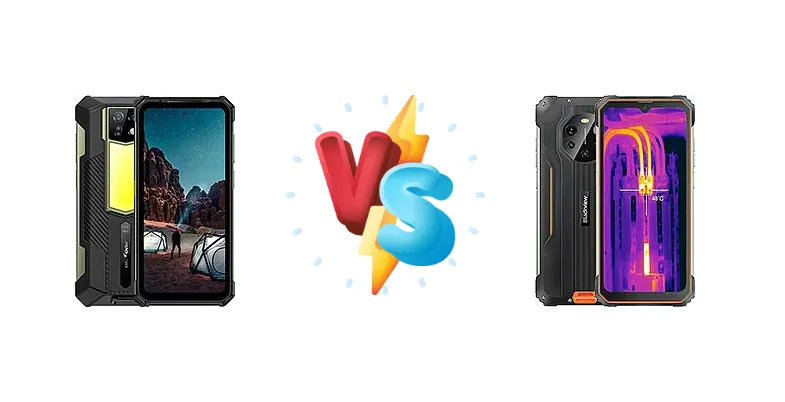
|
🏆 Quick Verdict
For users prioritizing maximum uptime and longevity, the Ulefone Armor 24 is the clear winner. Its exceptional 166:39h battery endurance and 1000 charge cycles outweigh the BL8800 Pro’s 5G capabilities for those who need a phone that simply *lasts*. However, the BL8800 Pro is a strong contender for users needing 5G and faster processing.
| PHONES | ||
|---|---|---|
| Phone Names | Ulefone Armor 24 | Blackview BL8800 Pro |
| Network | ||
|---|---|---|
| 2G bands | GSM 850 / 900 / 1800 / 1900 | GSM 850 / 900 / 1800 / 1900 |
| 3G bands | HSDPA 850 / 900 / 1700(AWS) / 1900 / 2100 | HSDPA 800 / 850 / 900 / 1700(AWS) / 1900 / 2100 |
| 4G bands | 1, 2, 3, 4, 5, 7, 8, 12, 17, 19, 20, 28, 34, 38, 39, 40, 41, 66 | 1, 2, 3, 4, 5, 7, 8, 12, 13, 17, 18, 19, 20, 25, 26, 28, 30, 66 |
| 5G bands | - | 1, 3, 5, 7, 8, 20, 28, 38, 40, 41, 77, 78, 79 SA/NSA |
| Speed | HSPA, LTE | HSPA, LTE, 5G |
| Technology | GSM / HSPA / LTE | GSM / CDMA / HSPA / CDMA2000 / LTE / 5G |
| - | CDMA2000 1x | |
| Launch | ||
|---|---|---|
| Announced | 2023, September | 2022, May 09 |
| Status | Available. Released 2023, September | Available. Released 2022, May 09 |
| Body | ||
|---|---|---|
| Dimensions | 181.2 x 87 x 27.5 mm (7.13 x 3.43 x 1.08 in) | 176.2 x 83.5 x 17.7 mm (6.94 x 3.29 x 0.70 in) |
| SIM | Nano-SIM + Nano-SIM | Nano-SIM + Nano-SIM |
| Weight | 647 g (1.43 lb) | 367 g (12.95 oz) |
| - | IP68/IP69K dust/water resistant (up to 1.5m for 30 min) Drop-to-concrete resistance from up to 1.5m MIL-STD-810H compliant | |
| Display | ||
|---|---|---|
| Protection | Corning Gorilla Glass 5, Mohs level 4 | - |
| Resolution | 1080 x 2460 pixels (~396 ppi density) | 1080 x 2408 pixels, 20:9 ratio (~401 ppi density) |
| Size | 6.78 inches, 109.2 cm2 (~69.2% screen-to-body ratio) | 6.58 inches, 104.3 cm2 (~70.9% screen-to-body ratio) |
| Type | IPS LCD, 120Hz | IPS LCD, 480 nits |
| Platform | ||
|---|---|---|
| CPU | Octa-core (2x2.05 GHz Cortex-A76 & 6x2.0 GHz Cortex-A55) | Octa-core (2x2.2 GHz Cortex-A76 & 6x2.0 GHz Cortex-A55) |
| Chipset | Mediatek MT6781 Helio G96 (12 nm) | Mediatek Dimensity 700 (7 nm) |
| GPU | Mali-G57 MC2 | Mali-G57 MC2 |
| OS | Android 13 | Android 11, Doke-OS 3.0 |
| Memory | ||
|---|---|---|
| Card slot | microSDXC (dedicated slot) | No |
| Internal | 256GB 12GB RAM | 128GB 8GB RAM |
| - | UFS 2.1 | |
| Main Camera | ||
|---|---|---|
| Dual | 64 MP, f/1.9, (wide), 1/1.7", 0.8µm, PDAF 64 MP, f/1.8, (night vision), 2 infrared night vision lights | - |
| Features | LED flash, HDR, panorama | Thermal imaging, Dual-LED flash, HDR, panorama |
| Penta | - | 50 MP, f/1.8, (wide), PDAF 5 MP, thermal assisted camera FLIR thermal camera (Lepton module) 2x Auxiliary lens |
| Single | - | 16 MP, f/2.0, (wide) |
| Video | 1440p@30fps, 1080p@30fps | 1440p@30fps |
| Selfie camera | ||
|---|---|---|
| Single | 16 MP, f/2.2, (wide), 1.0µm | 16 MP, f/2.0, (wide) |
| Video | 1080p@30fps | 1080p@30fps |
| Sound | ||
|---|---|---|
| 3.5mm jack | - | No |
| 35mm jack | Yes | No |
| Loudspeaker | Yes | Yes |
| Comms | ||
|---|---|---|
| Bluetooth | 5.2, A2DP, LE | 5.1, A2DP, LE |
| Infrared port | Yes | - |
| NFC | Yes | Yes |
| Positioning | GPS, GLONASS, GALILEO, BDS | GPS, GLONASS, GALILEO, BDS |
| Radio | Wireless FM radio, RDS, recording | FM radio |
| USB | USB Type-C 2.0, OTG | USB Type-C 2.0, OTG |
| WLAN | Wi-Fi 802.11 a/b/g/n/ac, dual-band | Wi-Fi 802.11 a/b/g/n/ac |
| Features | ||
|---|---|---|
| Sensors | Fingerprint (side-mounted), accelerometer, proximity, compass, gyro | Fingerprint (side-mounted), accelerometer, gyro, proximity, compass, barometer |
| Battery | ||
|---|---|---|
| Charging | 66W wired 10W reverse wired | 33W wired, 31% in 30 min, 100% in 90 min Reverse wired |
| Type | Li-Po 22000 mAh | 8380 mAh |
| Misc | ||
|---|---|---|
| Colors | Black | Black, Orange, Green |
| Price | About 370 EUR | About 300 EUR |
| EU LABEL | ||
|---|---|---|
| Battery | 166:39h endurance, 1000 cycles | - |
| Energy | Class A | - |
| Free fall | Class A (270 falls) | - |
| Repairability | Class B | - |
Ulefone Armor 24
- Exceptional battery life (166:39h endurance)
- High charge cycle count (1000 cycles)
- Rugged design for durability
- Older chipset (Helio G96)
- No 5G connectivity
Blackview BL8800 Pro
- 5G connectivity for faster data speeds
- More modern chipset (Dimensity 700)
- Faster charging (33W)
- Likely shorter battery life
- Potentially lower long-term battery health
Display Comparison
Neither device provides display specifications in the provided data. However, given the rugged focus, expect both to utilize durable, potentially IPS-based panels. The lack of LTPO or high refresh rate information suggests a focus on power efficiency and durability over visual fidelity. Bezels are likely to be substantial on both to protect the screen.
Camera Comparison
The provided data lacks camera details beyond the chipsets. Given the market segment, expect both phones to prioritize practicality over photographic excellence. The image signal processor (ISP) within the Dimensity 700 may offer slightly better image processing capabilities, but the real-world difference will depend heavily on software optimization. The absence of information regarding sensor size and aperture makes a definitive comparison impossible, but a larger sensor would generally improve low-light performance.
Performance
The Blackview BL8800 Pro’s Mediatek Dimensity 700 (7nm) holds a clear architectural advantage over the Ulefone Armor 24’s Helio G96 (12nm). The 7nm process allows for greater transistor density and improved power efficiency, translating to potentially better sustained performance and less thermal throttling. While both CPUs feature the same Cortex-A76 (2x2.2 GHz vs 2x2.05 GHz) and Cortex-A55 core configuration, the Dimensity 700’s more efficient architecture gives it an edge in demanding tasks. This benefits users who frequently game or run resource-intensive applications.
Battery Life
The Ulefone Armor 24’s battery endurance of 166:39h is a standout feature, significantly exceeding what most smartphones offer. This is coupled with a claimed 1000 charge cycles, suggesting exceptional long-term battery health. While the Blackview BL8800 Pro’s battery capacity is unknown, its 33W charging (100% in 90 minutes, 31% in 30 minutes) is faster than the Armor 24’s 66W, but the Armor 24's endurance is far more significant. The Armor 24’s 10W reverse wired charging is a useful, albeit slow, feature for topping up accessories.
Buying Guide
Buy the Ulefone Armor 24 if you need a phone for extended fieldwork, travel in areas with limited power access, or simply demand multi-day battery life. It’s ideal for construction workers, outdoor enthusiasts, and anyone who values reliability above all else. Buy the Blackview BL8800 Pro if you prioritize 5G connectivity for faster data speeds, require a more responsive user experience for multitasking, and appreciate a more modern chipset for future software updates.