
Ulefone Armor 2 vs Oukitel WP100 Titan: A Deep Dive into Rugged Performance
| Phones Images | |||||
|---|---|---|---|---|---|
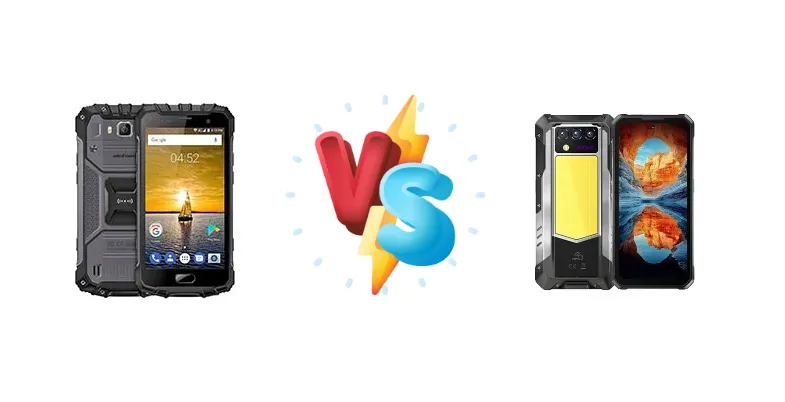
|
🏆 Quick Verdict
For the average user prioritizing performance and future-proofing, the Oukitel WP100 Titan is the clear winner. Its Dimensity 7300 chipset offers a substantial leap in processing power and efficiency compared to the Ulefone Armor 2’s Helio P25. While the Armor 2 remains a viable option for basic tasks, the Titan’s faster charging and superior CPU make it the better long-term investment.
| PHONES | ||
|---|---|---|
| Phone Names | Ulefone Armor 2 | Oukitel WP100 Titan |
| Network | ||
|---|---|---|
| 2G bands | GSM 850 / 900 / 1800 / 1900 | GSM 850 / 900 / 1800 / 1900 |
| 3G bands | HSDPA 850 / 900 / 1700(AWS) / 1900 / 2100 | HSDPA 800 / 850 / 900 / 1700(AWS) / 1900 / 2100 |
| 4G bands | 1, 2, 3, 4, 5, 7, 8, 12, 17, 19, 20, 38, 39, 40, 41 | 1, 2, 3, 4, 5, 7, 8, 12, 13, 17, 18, 19, 20, 25, 26, 28, 34, 38, 40, 41, 66 LTE |
| 5G bands | - | 1, 2, 3, 5, 7, 8, 12, 20, 28, 38, 40, 41, 66, 71, 77, 78, 79 |
| Speed | HSPA 21.1/5.76 Mbps, LTE Cat6 300/50 Mbps | HSPA, LTE |
| Technology | GSM / CDMA / HSPA / LTE | GSM / HSPA / EVDO / LTE / 5G |
| CDMA 800 / 1900 | - | |
| Launch | ||
|---|---|---|
| Announced | 2017, August. Released 2017, August | 2025, February 18 |
| Status | Discontinued | Available. Released 2025, February 18 |
| Body | ||
|---|---|---|
| Build | - | Glass front, aluminum with plastic frame and back |
| Dimensions | 159 x 78.3 x 14.5 mm (6.26 x 3.08 x 0.57 in) | 178.3 x 84.3 x 35.6 mm (7.02 x 3.32 x 1.40 in) |
| SIM | Nano-SIM + Nano-SIM | Nano-SIM + Nano-SIM |
| Weight | 270 g (9.52 oz) | 876.6 g (1.93 lb) |
| IP68 dust/water resistant (up to 1.5m for 30 mins) Drop-to-concrete resistance from up to 1.2 m MIL-STD-810G compliant | - | |
| Display | ||
|---|---|---|
| Protection | - | Corning Gorilla Glass 5, Mohs level 5 |
| Resolution | 1080 x 1920 pixels, 16:9 ratio (~441 ppi density) | 1080 x 2460 pixels (~395 ppi density) |
| Size | 5.0 inches, 68.9 cm2 (~55.4% screen-to-body ratio) | 6.8 inches, 109.8 cm2 (~73.1% screen-to-body ratio) |
| Type | IPS LCD | IPS LCD, 120Hz, 450 nits |
| Platform | ||
|---|---|---|
| CPU | Octa-core (4x2.6 GHz Cortex-A53 & 4x1.6 GHz Cortex-A53) | Octa-core (4x2.5 GHz Cortex-A78 & 4x2.0 GHz Cortex-A55) |
| Chipset | Mediatek MT6757 Helio P25 (16 nm) | Mediatek Dimensity 7300 (4 nm) |
| GPU | Mali-T880MP2 | Mali-G615 MP2 |
| OS | Android 7.0 (Nougat) | Android 14 |
| Memory | ||
|---|---|---|
| Card slot | microSDXC (uses shared SIM slot) | microSDXC (uses shared SIM slot) |
| Internal | 64GB 6GB RAM | 512GB 16GB RAM |
| eMMC 5.1 | - | |
| Main Camera | ||
|---|---|---|
| Features | Dual-LED dual-tone flash, HDR | LED flash, HDR, portrait, panorama |
| Single | 16 MP, f/2.0, (wide), AF | - |
| Triple | - | 200 MP (wide), 1/1.4", PDAF, LED 20 MP (Night Vision), 1/2.78", AF 2 MP (macro) |
| Video | 1080p@30fps | 4K@30fps |
| Selfie camera | ||
|---|---|---|
| Single | 8 MP | 32MP, 1/2.74" |
| Video | 1080p@30fps | 1080p@30fps |
| Sound | ||
|---|---|---|
| 3.5mm jack | No | - |
| 35mm jack | No | No |
| Loudspeaker | Yes | Yes |
| Comms | ||
|---|---|---|
| Bluetooth | 4.1, A2DP | 5.4, A2DP, LE |
| NFC | Yes | Yes |
| Positioning | GPS, GLONASS | GPS, GLONASS, GALILEO, BDS |
| Radio | Stereo FM radio, RDS, recording | FM radio, FM recording |
| USB | USB Type-C 2.0, OTG | USB Type-C 2.0, OTG |
| WLAN | Wi-Fi 802.11 a/b/g/n, dual-band | Wi-Fi 802.11 a/b/g/n/ac/6e, dual-band |
| Features | ||
|---|---|---|
| Sensors | Fingerprint (front-mounted), accelerometer, proximity, gyro, compass, barometer | Fingerprint (side-mounted), accelerometer, gyro, proximity, compass |
| Battery | ||
|---|---|---|
| Charging | 18W wired | 66W wired 18W reverse wired |
| Type | Li-Po 4700 mAh | Li-Po 33000 mAh |
| Misc | ||
|---|---|---|
| Colors | Gray, Gold | Black |
| Price | - | About 780 EUR |
| EU LABEL | ||
|---|---|---|
| Battery | - | 166:39h endurance, 1400 cycles |
| Energy | - | Class B |
| Free fall | - | Class A (270 falls) |
| Repairability | - | Class C |
Ulefone Armor 2
- Potentially lower price point (due to age)
- Rugged design for durability
- Simple and straightforward user experience
- Outdated Helio P25 chipset
- Slow 18W charging
- Likely inferior camera performance
Oukitel WP100 Titan
- Powerful Mediatek Dimensity 7300 chipset
- Ultra-fast 66W wired charging
- 18W reverse wired charging
- Long battery life and 1400 charge cycles
- Potentially higher price
- May be larger and heavier due to larger battery
Display Comparison
Neither device’s display specifications are provided, so a direct comparison is limited. However, given the Armor 2’s age, it likely utilizes an older IPS LCD panel. The WP100 Titan, being a newer device, may incorporate a more advanced panel technology, potentially with higher brightness and improved color accuracy. The lack of information on refresh rates is also a key omission; a higher refresh rate on the Titan would contribute to a smoother user experience.
Camera Comparison
Without detailed camera specifications, a precise comparison is difficult. However, the age difference suggests the WP100 Titan likely benefits from more advanced image processing algorithms and potentially larger sensor sizes. While both phones may feature multiple cameras, the quality of the main sensor and the inclusion of Optical Image Stabilization (OIS) are critical factors. The Armor 2 likely relies on older sensor technology, while the Titan has the potential for improved low-light performance and dynamic range.
Performance
The performance gap between these two devices is substantial. The Ulefone Armor 2’s Mediatek Helio P25, built on a 16nm process, features an octa-core CPU with a mix of Cortex-A53 cores clocked at 2.6GHz and 1.6GHz. This is a mid-range chipset from 2017. In contrast, the Oukitel WP100 Titan utilizes the Mediatek Dimensity 7300, fabricated on a far more efficient 4nm process. Its CPU configuration – Cortex-A78 cores at 2.5GHz and Cortex-A55 cores at 2.0GHz – represents a significant architectural improvement. The Dimensity 7300’s newer cores and smaller node translate to dramatically better performance and thermal efficiency, meaning sustained performance under load will be far superior on the Titan.
Battery Life
The Oukitel WP100 Titan boasts a claimed endurance of 166:39h and 1400 charge cycles, indicating a focus on long-term battery health. While the Armor 2’s battery capacity isn’t specified, its 18W wired charging is significantly slower than the Titan’s 66W charging. This means the Titan can replenish its battery much faster, reducing downtime. The 18W reverse wired charging on the Titan is also a valuable feature for topping up other devices in the field, a capability the Armor 2 lacks.
Buying Guide
Buy the Ulefone Armor 2 if you need a basic, affordable rugged phone for essential communication and light tasks, and are less concerned with demanding applications or long-term performance. Buy the Oukitel WP100 Titan if you prioritize speed, responsiveness, and the ability to handle demanding apps, gaming, and benefit from significantly faster 66W charging, making it ideal for professionals or outdoor enthusiasts who rely on their phone throughout the day.