
Ulefone Armor 2 vs Blackview BV9900E: A Deep Dive into Rugged Smartphone Performance
| Phones Images | |||||
|---|---|---|---|---|---|
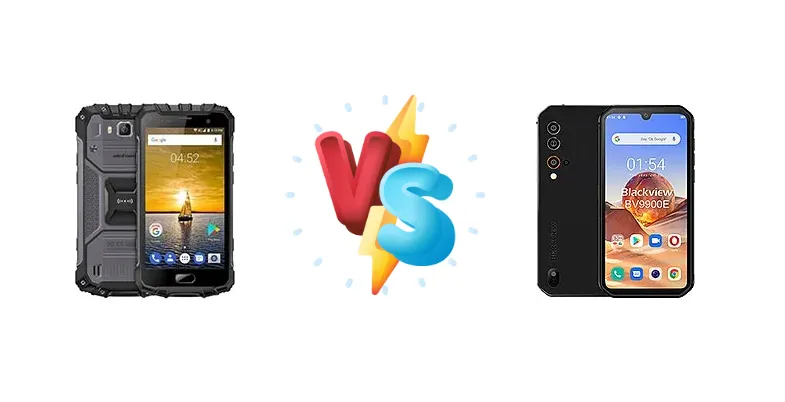
|
🏆 Quick Verdict
For the average user prioritizing performance and future-proofing, the Blackview BV9900E is the clear winner. Its Helio P90 chipset, built on a more efficient 12nm process, delivers significantly better CPU and GPU performance. While the Armor 2 offers a more basic experience, the BV9900E’s wireless charging and superior processing power justify the price difference.
| PHONES | ||
|---|---|---|
| Phone Names | Ulefone Armor 2 | Blackview BV9900E |
| Network | ||
|---|---|---|
| 2G bands | GSM 850 / 900 / 1800 / 1900 | GSM 850 / 900 / 1800 / 1900 |
| 3G bands | HSDPA 850 / 900 / 1700(AWS) / 1900 / 2100 | HSDPA 800 / 850 / 900 / 1700(AWS) / 1900 / 2100 |
| 4G bands | 1, 2, 3, 4, 5, 7, 8, 12, 17, 19, 20, 38, 39, 40, 41 | 1, 2, 3, 4, 5, 7, 8, 12, 13, 17, 18, 19, 20, 25, 26, 28, 34, 38, 39, 40, 41, 66 |
| Speed | HSPA 21.1/5.76 Mbps, LTE Cat6 300/50 Mbps | HSPA, LTE |
| Technology | GSM / CDMA / HSPA / LTE | GSM / CDMA / HSPA / CDMA2000 / LTE |
| CDMA 800 / 1900 | - | |
| Launch | ||
|---|---|---|
| Announced | 2017, August. Released 2017, August | 2020, September 10. Released 2020, September |
| Status | Discontinued | Discontinued |
| Body | ||
|---|---|---|
| Dimensions | 159 x 78.3 x 14.5 mm (6.26 x 3.08 x 0.57 in) | 156.5 x 78.3 x 14.2 mm (6.16 x 3.08 x 0.56 in) |
| SIM | Nano-SIM + Nano-SIM | Nano-SIM + Nano-SIM |
| Weight | 270 g (9.52 oz) | 273 g (9.63 oz) |
| IP68 dust/water resistant (up to 1.5m for 30 mins) Drop-to-concrete resistance from up to 1.2 m MIL-STD-810G compliant | - | |
| Display | ||
|---|---|---|
| Protection | - | Corning Gorilla Glass 5 |
| Resolution | 1080 x 1920 pixels, 16:9 ratio (~441 ppi density) | 1080 x 2280 pixels, 19:9 ratio (~432 ppi density) |
| Size | 5.0 inches, 68.9 cm2 (~55.4% screen-to-body ratio) | 5.84 inches, 85.1 cm2 (~69.5% screen-to-body ratio) |
| Type | IPS LCD | IPS LCD |
| Platform | ||
|---|---|---|
| CPU | Octa-core (4x2.6 GHz Cortex-A53 & 4x1.6 GHz Cortex-A53) | Octa-core (2x2.2 GHz Cortex-A75 & 6x2.0 GHz Cortex-A55) |
| Chipset | Mediatek MT6757 Helio P25 (16 nm) | Mediatek MT6779V/CE Helio P90 (12 nm) |
| GPU | Mali-T880MP2 | PowerVR GM9446 |
| OS | Android 7.0 (Nougat) | Android 10 |
| Memory | ||
|---|---|---|
| Card slot | microSDXC (uses shared SIM slot) | microSDXC |
| Internal | 64GB 6GB RAM | 128GB 6GB RAM |
| eMMC 5.1 | - | |
| Main Camera | ||
|---|---|---|
| Features | Dual-LED dual-tone flash, HDR | LED flash, HDR, panorama |
| Quad | - | 48 MP, f/1.8, (wide), PDAF 16 MP, 120˚ (ultrawide) 2 MP (macro) Auxiliary lens |
| Single | 16 MP, f/2.0, (wide), AF | - |
| Video | 1080p@30fps | 4K@30fps, 1080p@60fps |
| Selfie camera | ||
|---|---|---|
| Single | 8 MP | 16 MP, f/2.0, (wide) |
| Video | 1080p@30fps | 1080p@30fps |
| Sound | ||
|---|---|---|
| 3.5mm jack | No | - |
| 35mm jack | No | No |
| Loudspeaker | Yes | Yes |
| Comms | ||
|---|---|---|
| Bluetooth | 4.1, A2DP | 5.0, A2DP, LE |
| NFC | Yes | Yes |
| Positioning | GPS, GLONASS | GPS, GLONASS, GALILEO, BDS |
| Radio | Stereo FM radio, RDS, recording | FM radio |
| USB | USB Type-C 2.0, OTG | USB Type-C 2.0, OTG |
| WLAN | Wi-Fi 802.11 a/b/g/n, dual-band | Wi-Fi 802.11 a/b/g/n/ac |
| Features | ||
|---|---|---|
| Sensors | Fingerprint (front-mounted), accelerometer, proximity, gyro, compass, barometer | Fingerprint (side-mounted), accelerometer, gyro, proximity, compass, barometer |
| Battery | ||
|---|---|---|
| Charging | 18W wired | 15W wired 18W wireless |
| Type | Li-Po 4700 mAh | 4380 mAh |
| Misc | ||
|---|---|---|
| Colors | Gray, Gold | Black, Silver |
| Price | - | About 260 EUR |
Ulefone Armor 2
- More affordable price point
- Rugged design for durability
- Simple and straightforward user experience
- Outdated Helio P25 chipset
- Limited performance for demanding tasks
- No wireless charging
Blackview BV9900E
- Powerful Helio P90 chipset
- Wireless charging capability
- Improved power efficiency
- Higher price compared to the Armor 2
- May be slightly bulkier due to larger battery/components
- Rugged design may not appeal to all users
Display Comparison
Neither device’s display specifications are provided, so a direct comparison is limited. However, given the Armor 2’s older chipset and likely lower price point, it likely features a lower-resolution panel with narrower viewing angles. The BV9900E, positioned as a more premium device, likely benefits from a higher-quality display, potentially with better color accuracy and brightness. Rugged phones often prioritize durability over display quality, so expect both to have robust glass protection.
Camera Comparison
Without specific camera sensor details, a detailed comparison is challenging. However, the BV9900E’s positioning suggests a more advanced camera system. The inclusion of a more modern chipset often correlates with improved image signal processing (ISP) capabilities, leading to better image quality, especially in low-light conditions. While both phones likely feature multiple rear cameras, the Armor 2 may rely on lower-resolution sensors for auxiliary functions. The BV9900E is more likely to offer features like HDR and potentially even 4K video recording.
Performance
The Blackview BV9900E’s Helio P90 chipset represents a substantial upgrade over the Ulefone Armor 2’s Helio P25. The P90, fabricated on a 12nm process versus the P25’s 16nm, offers improved power efficiency and thermal performance. More importantly, the CPU architecture is significantly different: the P90 utilizes two Cortex-A75 cores for peak performance alongside six Cortex-A55 cores for efficiency, while the P25 relies solely on Cortex-A53 cores. This translates to a noticeable performance boost in multitasking, gaming, and demanding applications for the BV9900E. The P90’s GPU also provides a more capable graphics experience.
Battery Life
Both devices offer respectable battery life given their rugged nature. The BV9900E’s 15W wired and 18W wireless charging provides greater flexibility. While the Armor 2’s 18W wired charging is competitive, the lack of wireless charging is a significant drawback for users who value convenience. The more efficient Helio P90 in the BV9900E will also contribute to longer battery life under heavy use, offsetting any potential capacity differences not specified in the provided data.
Buying Guide
Buy the Ulefone Armor 2 if you need a highly affordable, basic rugged phone for essential communication and light tasks. It’s ideal for users who prioritize cost above all else and don’t require demanding applications. Buy the Blackview BV9900E if you prefer a more powerful and versatile rugged phone capable of handling demanding apps, gaming, and benefiting from the convenience of wireless charging. It’s suited for users who need a reliable workhorse in harsh conditions.