
Ulefone Armor 2 vs Blackview BV9800 Pro: Which Rugged Phone Reigns Supreme?
| Phones Images | |||||
|---|---|---|---|---|---|
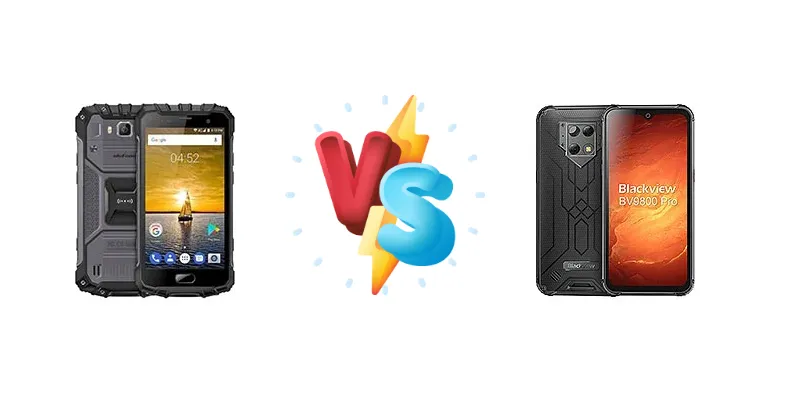
|
🏆 Quick Verdict
For the average user prioritizing performance and future-proofing, the Blackview BV9800 Pro is the better choice. Its Helio P70 chipset, built on a more efficient 12nm process, offers a noticeable performance uplift over the Ulefone Armor 2’s Helio P25, despite both featuring 18W charging. While both are rugged, the BV9800 Pro delivers a smoother experience.
| PHONES | ||
|---|---|---|
| Phone Names | Ulefone Armor 2 | Blackview BV9800 Pro |
| Network | ||
|---|---|---|
| 2G bands | GSM 850 / 900 / 1800 / 1900 | GSM 850 / 900 / 1800 / 1900 |
| 3G bands | HSDPA 850 / 900 / 1700(AWS) / 1900 / 2100 | HSDPA 800 / 850 / 900 / 1700(AWS) / 1900 / 2100 |
| 4G bands | 1, 2, 3, 4, 5, 7, 8, 12, 17, 19, 20, 38, 39, 40, 41 | 1, 2, 3, 4, 5, 6, 7, 8, 12, 13, 17, 18, 19, 20, 25, 26, 28, 34, 38, 39, 40, 41, 66 |
| Speed | HSPA 21.1/5.76 Mbps, LTE Cat6 300/50 Mbps | HSPA, LTE |
| Technology | GSM / CDMA / HSPA / LTE | GSM / CDMA / HSPA / CDMA2000 / LTE |
| CDMA 800 / 1900 | - | |
| Launch | ||
|---|---|---|
| Announced | 2017, August. Released 2017, August | 2019, October 28. Released 2019, November |
| Status | Discontinued | Discontinued |
| Body | ||
|---|---|---|
| Dimensions | 159 x 78.3 x 14.5 mm (6.26 x 3.08 x 0.57 in) | 168.5 x 81 x 14.8 mm (6.63 x 3.19 x 0.58 in) |
| SIM | Nano-SIM + Nano-SIM | Nano-SIM + Nano-SIM |
| Weight | 270 g (9.52 oz) | 322 g (11.36 oz) |
| IP68 dust/water resistant (up to 1.5m for 30 mins) Drop-to-concrete resistance from up to 1.2 m MIL-STD-810G compliant | - | |
| Display | ||
|---|---|---|
| Resolution | 1080 x 1920 pixels, 16:9 ratio (~441 ppi density) | 1080 x 2340 pixels, 19.5:9 ratio (~409 ppi density) |
| Size | 5.0 inches, 68.9 cm2 (~55.4% screen-to-body ratio) | 6.3 inches, 97.4 cm2 (~71.4% screen-to-body ratio) |
| Type | IPS LCD | IPS LCD |
| Platform | ||
|---|---|---|
| CPU | Octa-core (4x2.6 GHz Cortex-A53 & 4x1.6 GHz Cortex-A53) | Octa-core (4x2.1 GHz Cortex-A73 & 4x2.0 GHz Cortex-A53) |
| Chipset | Mediatek MT6757 Helio P25 (16 nm) | Mediatek MT6771V/CT Helio P70 (12 nm) |
| GPU | Mali-T880MP2 | Mali-G72 MP3 |
| OS | Android 7.0 (Nougat) | Android 9.0 (Pie) |
| Memory | ||
|---|---|---|
| Card slot | microSDXC (uses shared SIM slot) | microSDXC |
| Internal | 64GB 6GB RAM | 128GB 6GB RAM |
| eMMC 5.1 | - | |
| Main Camera | ||
|---|---|---|
| Features | Dual-LED dual-tone flash, HDR | Thermal imaging, LED flash |
| Single | 16 MP, f/2.0, (wide), AF | - |
| Triple | - | 48 MP, (wide), PDAF 5 MP, thermal assisted camera FLIR thermal camera (Lepton module) |
| Video | 1080p@30fps | 1080p@30fps |
| Selfie camera | ||
|---|---|---|
| Single | 8 MP | 16 MP, f/2.0, (wide) |
| Video | 1080p@30fps | 1080p@30fps |
| Sound | ||
|---|---|---|
| 3.5mm jack | No | - |
| 35mm jack | No | Yes |
| Loudspeaker | Yes | Yes |
| Comms | ||
|---|---|---|
| Bluetooth | 4.1, A2DP | 4.1, A2DP |
| NFC | Yes | Yes |
| Positioning | GPS, GLONASS | GPS, GLONASS, GALILEO |
| Radio | Stereo FM radio, RDS, recording | FM radio |
| USB | USB Type-C 2.0, OTG | USB Type-C 2.0, OTG |
| WLAN | Wi-Fi 802.11 a/b/g/n, dual-band | Wi-Fi 802.11 a/b/g/n/ac |
| Features | ||
|---|---|---|
| Sensors | Fingerprint (front-mounted), accelerometer, proximity, gyro, compass, barometer | Fingerprint (side-mounted), accelerometer, gyro, proximity, compass, barometer |
| Battery | ||
|---|---|---|
| Charging | 18W wired | 18W wired |
| Type | Li-Po 4700 mAh | 6580 mAh |
| Misc | ||
|---|---|---|
| Colors | Gray, Gold | Black, Orange |
| Price | - | About 340 EUR |
Ulefone Armor 2
- Potentially lower price point
- Rugged design for durability
- Basic functionality for essential tasks
- Older, less efficient chipset
- Slower performance compared to the BV9800 Pro
- Likely limited software support
Blackview BV9800 Pro
- More powerful and efficient Helio P70 chipset
- Improved performance for multitasking and gaming
- Potentially better camera image processing
- May be more expensive than the Armor 2
- Rugged design may add bulk
- 18W charging isn't the fastest available
Display Comparison
Neither device’s display specifications are provided, so a direct comparison is limited. However, given the Armor 2’s older chipset, it’s likely to feature a less advanced panel. The BV9800 Pro, benefiting from a newer platform, may incorporate features like higher peak brightness or improved color accuracy. Rugged phones often prioritize durability over display quality, so expect both to have practical, rather than exceptional, screens.
Camera Comparison
Without specific camera sensor details, a detailed comparison is difficult. However, the BV9800 Pro’s more powerful processor allows for more sophisticated image processing algorithms. This could result in better dynamic range, noise reduction, and overall image quality, even with similar sensors. The P70’s ISP (Image Signal Processor) is more capable than the P25’s, enabling faster processing and potentially better low-light performance. It’s reasonable to assume the BV9800 Pro will offer a more refined camera experience.
Performance
The core difference lies in the chipsets. The Blackview BV9800 Pro’s MediaTek Helio P70 (12nm) represents a significant architectural upgrade over the Ulefone Armor 2’s Helio P25 (16nm). The P70 utilizes Cortex-A73 cores (2.1 GHz) in its big cluster, offering substantially better single-core performance than the P25’s Cortex-A53 cores (2.6 GHz). While the P25 has a higher clock speed on its primary cores, the A73 architecture is more efficient and delivers more instructions per clock cycle. This translates to snappier app launches, smoother multitasking, and a more responsive user interface on the BV9800 Pro. The 12nm process further enhances efficiency, potentially leading to better thermal management under sustained load.
Battery Life
Both phones feature 18W wired charging, suggesting similar charging speeds. The actual 0-100% charge time will depend on battery capacity, which isn’t specified. However, the Helio P70’s improved power efficiency in the BV9800 Pro could translate to longer battery life, even with a similar capacity battery. The more efficient processor consumes less power during everyday tasks, extending the time between charges.
Buying Guide
Buy the Ulefone Armor 2 if you need a highly affordable, basic rugged phone for essential communication and light tasks. It’s ideal for users who prioritize cost above all else and don’t require demanding app performance. Buy the Blackview BV9800 Pro if you prefer a more responsive and capable device for everyday use, including moderate gaming and multitasking. Its more modern chipset provides a better long-term user experience and handles demanding applications with greater ease.