
Ulefone Armor 12 5G vs Xiaomi 11T: A Clash of Titans
| Phones Images | |||||
|---|---|---|---|---|---|
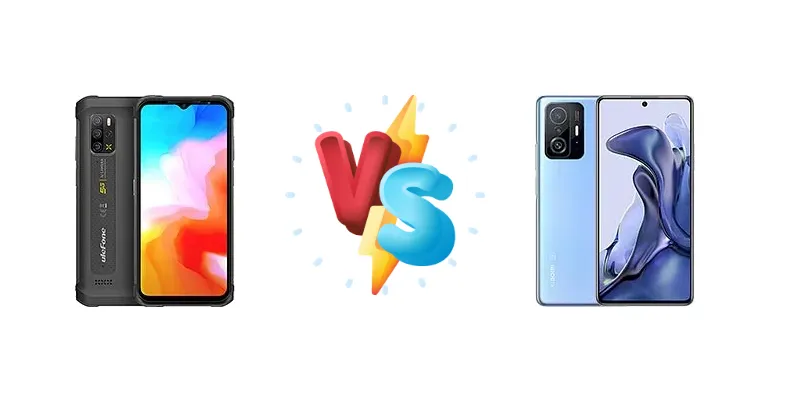
|
🏆 Quick Verdict
The Xiaomi 11T is the clear winner for most users, offering superior performance, a brighter display, and significantly faster charging. However, the Ulefone Armor 12 5G excels in durability and ruggedness, making it ideal for those working in harsh environments or seeking a truly worry-free device.
| PHONES | ||
|---|---|---|
| Phone Names | Ulefone Armor 12 5G | Xiaomi 11T |
| Network | ||
|---|---|---|
| 2G bands | GSM 850 / 900 / 1800 / 1900 | GSM 850 / 900 / 1800 / 1900 |
| 3G bands | HSDPA 850 / 900 / 1700(AWS) / 1900 / 2100 | HSDPA 850 / 900 / 1700(AWS) / 1900 / 2100 |
| 4G bands | 1, 2, 3, 4, 5, 7, 8, 12, 13, 17, 18, 19, 20, 25, 26, 28, 34, 38, 39, 40, 41, 66 | 1, 2, 3, 4, 5, 7, 8, 12, 13, 17, 18, 19, 20, 26, 28, 32, 38, 40, 41, 42, 66 |
| 5G bands | 1, 3, 28, 38, 41, 77, 78 SA/NSA | 1, 3, 5, 7, 8, 20, 28, 38, 40, 41, 66, 77, 78 SA/NSA |
| Speed | HSPA, LTE, 5G | HSPA, LTE, 5G |
| Technology | GSM / CDMA / HSPA / EVDO / LTE / 5G | GSM / HSPA / LTE / 5G |
| CDMA2000 1xEV-DO | - | |
| Launch | ||
|---|---|---|
| Announced | 2021, August 14 | 2021, September 15 |
| Status | Available. Released 2021, August 23 | Available. Released 2021, October 05 |
| Body | ||
|---|---|---|
| Build | Front glass, aluminum back with rubber, aluminum frame | Glass front (Gorilla Glass Victus), aluminum frame, glass back |
| Dimensions | 175.9 x 82.5 x 14.3 mm (6.93 x 3.25 x 0.56 in) | 164.1 x 76.9 x 8.8 mm (6.46 x 3.03 x 0.35 in) |
| SIM | Nano-SIM + Nano-SIM | Nano-SIM + Nano-SIM |
| Weight | 296 g (10.44 oz) | 203 g (7.16 oz) |
| IP68 dust/water resistant (up to 1.5m for 30 min) Drop-to-concrete resistance from up to 1.2m MIL-STD-810G compliant | IP53, dust and splash resistant | |
| Display | ||
|---|---|---|
| Protection | - | Corning Gorilla Glass Victus |
| Resolution | 720 x 1560 pixels, 19.5:9 ratio (~264 ppi density) | 1080 x 2400 pixels, 20:9 ratio (~395 ppi density) |
| Size | 6.52 inches, 104.4 cm2 (~71.9% screen-to-body ratio) | 6.67 inches, 107.4 cm2 (~85.1% screen-to-body ratio) |
| Type | IPS LCD | AMOLED, 1B colors, 120Hz, HDR10+, 800 nits (typ), 1000 nits (peak) |
| Platform | ||
|---|---|---|
| CPU | Octa-core (2x2.2 GHz Cortex-A76 & 6x2.0 GHz Cortex-A55) | Octa-core (1x3.0 GHz Cortex-A78 & 3x2.6 GHz Cortex-A78 & 4x2.0 GHz Cortex-A55) |
| Chipset | Mediatek Dimensity 700 (7 nm) | Mediatek Dimensity 1200 (6 nm) |
| GPU | Mali-G57 MC2 | Mali-G77 MC9 |
| OS | Android 11 | Android 11, upgradable to Android 13, MIUI 14 |
| Memory | ||
|---|---|---|
| Card slot | microSDXC | No |
| Internal | 128GB 8GB RAM | 128GB 8GB RAM, 256GB 8GB RAM |
| - | UFS 3.1 | |
| Main Camera | ||
|---|---|---|
| Features | Dual-LED flash, HDR, panorama | Dual-LED dual-tone flash, HDR, panorama |
| Quad | 48 MP, f/1.8, 26mm (wide), 1/2.0", 0.8µm, PDAF 8 MP, f/2.2, (ultrawide) 2 MP (macro) Auxiliary lens | - |
| Single | 16 MP, f/2.2 | 16 MP, f/2.5, (wide), 1/3.06", 1.0µm |
| Triple | - | 108 MP, f/1.8, 26mm (wide), 1/1.52", 0.7µm, PDAF 8 MP, f/2.2, 120˚ (ultrawide), 1/4.0", 1.12µm 5 MP, f/2.4, 50mm (telephoto macro), 1/5.0", 1.12µm, AF |
| Video | 1440p@30fps | 4K@30fps, 1080p@30/60/120, gyro-EIS |
| Selfie camera | ||
|---|---|---|
| Features | HDR, panorama | - |
| Single | 16 MP, f/2.2 | 16 MP, f/2.5, (wide), 1/3.06", 1.0µm |
| Video | 1080p@30fps | 1080p@30fps |
| Sound | ||
|---|---|---|
| 3.5mm jack | No | No |
| 35mm jack | No | No |
| Loudspeaker | Yes, with dual speakers | Yes, with stereo speakers |
| Comms | ||
|---|---|---|
| Bluetooth | 5.1, A2DP, LE | 5.2, A2DP, LE, aptX HD, aptX Adaptive |
| Infrared port | - | Yes |
| NFC | Yes | Yes |
| Positioning | GPS, GLONASS, GALILEO, BDS | GPS (L1+L5), GLONASS (G1), BDS (B1), GALILEO (E1+E5a), QZSS (L1+L5) |
| Radio | Wireless FM radio, RDS | No |
| USB | USB Type-C 2.0, OTG | USB Type-C 2.0, OTG |
| WLAN | Wi-Fi 802.11 a/b/g/n/ac, Wi-Fi Direct | Wi-Fi 802.11 a/b/g/n/ac/6, dual-band, Wi-Fi Direct |
| Features | ||
|---|---|---|
| Sensors | Fingerprint (side-mounted), accelerometer, gyro, proximity, compass, coulombmeter | Fingerprint (side-mounted), accelerometer, gyro, proximity, compass |
| Battery | ||
|---|---|---|
| Charging | 18W wired 15W wireless | 67W wired, 100% in 36 min |
| Type | Li-Po 5180 mAh | Li-Po 5000 mAh |
| Misc | ||
|---|---|---|
| Colors | Black/Orange, Gray/Black | Meteorite Gray, Moonlight White, Celestial Blue |
| Models | - | 21081111RG |
| Price | About 370 EUR | € 119.00 / £ 275.00 |
| SAR | - | 1.09 W/kg (head) 0.83 W/kg (body) |
| SAR EU | - | 0.55 W/kg (head) 0.95 W/kg (body) |
| Tests | ||
|---|---|---|
| Battery life | - | Endurance rating 98h |
| Camera | - | Photo / Video |
| Display | - | Contrast ratio: Infinite (nominal) |
| Loudspeaker | - | -27.6 LUFS (Good) |
| Performance | - | AnTuTu: 590837 (v9) GeekBench: 2834 (v5.1) GFXBench: 40fps (ES 3.1 onscreen) |
Ulefone Armor 12 5G
- Extremely durable and rugged
- Water and dust resistant
- 5G connectivity
- Wireless charging
- Lower performance than Xiaomi 11T
- Less vibrant display
- Slower charging
- Potentially bulkier design
Xiaomi 11T
- Powerful Dimensity 1200 chipset
- Bright and vibrant display
- Ultra-fast 67W charging
- Sleek and stylish design
- Likely superior camera
- Less durable than Ulefone Armor 12 5G
- No IP rating for ruggedness
- Potentially less battery life under heavy use
Display Comparison
The Xiaomi 11T boasts a significantly brighter display (798 nits) compared to the Ulefone Armor 12 5G, offering better visibility in sunlight. While the Armor 12 5G's display is functional, the 11T's contrast ratio (infinite nominal) provides a more immersive viewing experience. The 11T likely has a higher resolution as well, though this is not explicitly stated.
Camera Comparison
While both phones offer 'Photo / Video' capabilities, the Xiaomi 11T is expected to have a superior camera system. Xiaomi typically delivers excellent camera performance in this price range, with better image processing and more features. The Armor 12 5G's camera is likely adequate but won't match the 11T's quality.
Performance
The Xiaomi 11T's Dimensity 1200 chipset is considerably more powerful than the Armor 12 5G's Dimensity 700. Expect smoother multitasking, faster app loading times, and better gaming performance on the 11T. The 11T's CPU architecture also contributes to its performance advantage.
Battery Life
Both phones claim impressive endurance ratings (98h). However, the Xiaomi 11T's 67W wired charging is a game-changer, fully charging the phone in just 36 minutes. The Armor 12 5G's 18W wired charging is significantly slower, and its 15W wireless charging is a nice addition but not a replacement for fast wired charging.
Buying Guide
Buy the Ulefone Armor 12 5G if you need a phone that can withstand drops, water, and dust. It's perfect for construction workers, outdoor enthusiasts, or anyone prone to accidents. Buy the Xiaomi 11T if you want a sleek design, powerful performance, a vibrant display, and fast charging, and don't require extreme durability.