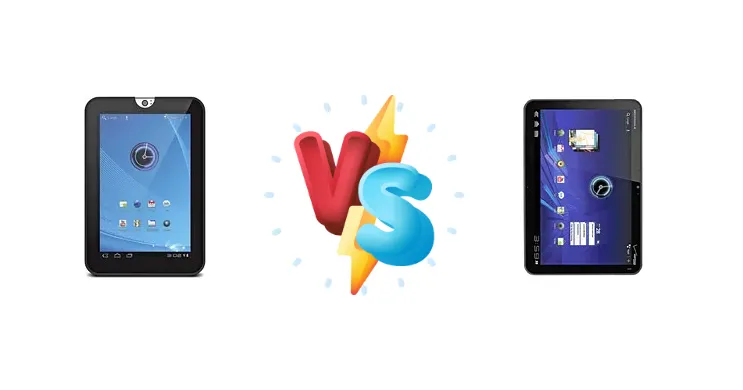
Remember the early days of Android tablets? The Toshiba Thrive 7 and Motorola XOOM were key players, battling for dominance. While both are relics of the past, understanding their strengths and weaknesses can be a fun trip down memory lane. Let's dive into a detailed comparison of these two devices.
🏆 Quick Verdict
The Motorola XOOM edges out the Thrive 7 due to its slightly larger screen, more refined software experience (at launch), and generally better availability of updates. Both offer similar performance thanks to the Tegra 2, but the XOOM's overall package feels a bit more polished.
| Network |
|---|
| 2G bands | N/A | N/A |
| EDGE | No | No |
| GPRS | No | No |
| Technology | No cellular connectivity | No cellular connectivity |
| Launch |
|---|
| Announced | 2011, September. Released 2011, December | 2011, February. Released 2011, May |
| Status | Discontinued | Discontinued |
| Body |
|---|
| Dimensions | 189 x 128.1 x 11.9 mm (7.44 x 5.04 x 0.47 in) | 249.1 x 167.8 x 12.9 mm (9.81 x 6.61 x 0.51 in) |
| SIM | No | No |
| Weight | 400 g (14.11 oz) | 730 g (1.61 lb) |
| Display |
|---|
| Resolution | 1280 x 800 pixels, 16:10 ratio (~216 ppi density) | 800 x 1280 pixels, 16:10 ratio (~149 ppi density) |
| Size | 7.0 inches, 142.1 cm2 (~58.7% screen-to-body ratio) | 10.1 inches, 295.8 cm2 (~70.8% screen-to-body ratio) |
| Type | LED-backlit LCD, | TFT |
| Platform |
|---|
| CPU | Dual-core 1.0 GHz Cortex-A9 | Dual-core 1.0 GHz Cortex-A9 |
| Chipset | Nvidia Tegra 2 T20 | Nvidia Tegra 2 T20 |
| GPU | ULP GeForce | ULP GeForce |
| OS | Android 3.2 (Honeycomb) | Android 3.0 (Honeycomb), upgradable to 4.0.4 (Ice Cream Sandwich) |
| Memory |
|---|
| Card slot | microSDHC (dedicated slot) | microSDHC (dedicated slot) |
| Internal | 16GB 1GB RAM, 32GB 1GB RAM | 16GB 1GB RAM, 32GB 1GB RAM, 64GB 1GB RAM |
| Main Camera |
|---|
| Features | LED flash | Dual-LED flash |
| Single | 5 MP, AF | 5 MP, AF |
| Video | 720p | 720p@30fps |
| Selfie camera |
|---|
| Single | 2 MP | 2 MP |
| Sound |
|---|
| 3.5mm jack | Yes | Yes |
| 35mm jack | Yes | Yes |
| Loudspeaker | Yes, with stereo speakers | Yes, with stereo speakers |
| Comms |
|---|
| Bluetooth | 2.1, A2DP | 2.1, A2DP, EDR |
| Positioning | GPS, A-GPS | GPS, A-GPS |
| Radio | No | No |
| USB | miniUSB 2.0 | microUSB 2.0 |
| WLAN | Wi-Fi 802.11 b/g/n | Wi-Fi 802.11 a/b/g/n, dual-band, hotspot |
| Features |
|---|
| Browser | - | HTML, Adobe Flash |
| Sensors | Accelerometer, gyro, compass | Accelerometer, gyro, barometer, compass |
| | HDMI port
MP3/WAV/WMA/eAAC+ player
MP4/H.264/WMV player
Organizer
Document viewer
Photo editor
Voice memo
Predictive text input (Swype) | HDMI port
MP3/WAV/WMA/AAC+ player
MP4/WMV/H.264 player
Document viewer
Photo viewer/editor
Organizer
Voice memo
Predictive text input |
| Battery |
|---|
| Music play | - | Up to 80 h |
| Stand-by | - | Up to 336 h |
| Talk time | Up to 6 h | Up to 9 h |
| Type | Non-removable Li-Ion battery (15 Wh) | Non-removable Li-Ion battery |
| Misc |
|---|
| Colors | Black | Black |
| Price | About 250 EUR | About 310 EUR |
| Tests |
|---|
| Camera | - |
Photo / Video |
Toshiba Thrive 7
- Unique detachable keyboard dock
- Compact size
- Decent build quality
- Limited software updates
- Smaller screen
- Mediocre performance
- Battery life could be better
Motorola XOOM MZ604
- Larger screen
- Slightly better software support (at launch)
- More refined design
- Generally better availability of accessories
- Limited software updates
- Mediocre performance
- Battery life could be better
- Larger size may be less portable
Display Comparison
The Motorola XOOM boasts a 10.1-inch display, offering a significantly larger viewing area compared to the Thrive 7's 7-inch screen. Both utilize IPS panels, providing decent viewing angles, but the XOOM's larger size makes it better suited for media consumption and multitasking. Resolution is similar, around 1280x800, so pixel density isn't a major differentiator.
Camera Comparison
Camera quality on both devices is unremarkable by today's standards. Both feature front and rear cameras, primarily intended for video calls rather than high-quality photography. Image quality is grainy and lacks detail. Don't expect to capture stunning photos with either of these tablets.
Performance
Both tablets are powered by the Nvidia Tegra 2 T20 chipset with a dual-core 1.0 GHz Cortex-A9 CPU. Performance is comparable for basic tasks like web browsing and email. However, demanding games or apps will struggle on both devices. Expect noticeable lag and slowdowns.
Battery Life
Battery life was a common complaint for both devices. The XOOM, with its larger size, generally offered slightly better battery life, potentially around 6-8 hours of mixed usage. The Thrive 7's battery life was typically in the 5-7 hour range. Both suffered from battery degradation over time.
Buying Guide
Neither tablet is recommended for purchase in 2024. However, if you're a collector of vintage Android devices or need a basic tablet for offline tasks, the XOOM might be a slightly better choice. The Thrive 7's unique keyboard dock could appeal to some, but its software support is even more limited.
Frequently Asked Questions
❓ Are these tablets still usable in 2024?
While technically usable, both tablets are severely outdated. Software support has ended, making them vulnerable to security threats and incompatible with many modern apps. They are best suited for very basic offline tasks.
❓ Which tablet is easier to find?
Both are difficult to find new. Used models are available on online marketplaces, but condition and price can vary significantly. The XOOM was generally more widely available when new.