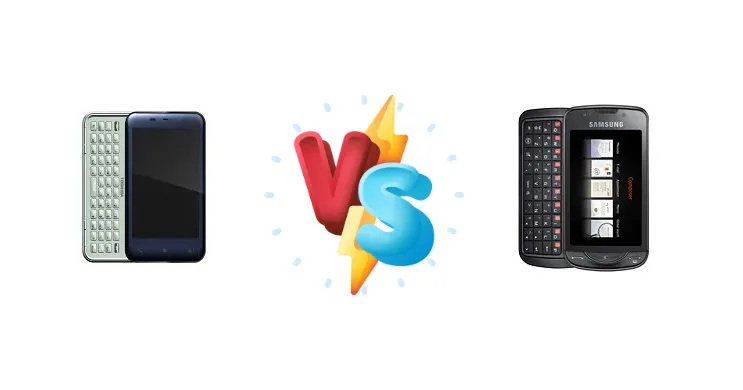
Remember the dawn of the smartphone era? These devices, the Toshiba K01 and Samsung OmniaPRO, represent a pivotal time in mobile technology. Let's dust off these relics and see how they stack up against each other in a nostalgic comparison.
🏆 Quick Verdict
The Samsung OmniaPRO edges out the Toshiba K01 thanks to its dedicated graphics accelerator and slightly more modern (though still dated) features. While both offer a glimpse into mobile history, the OmniaPRO provides a marginally better user experience, especially for basic multimedia.
| Network |
|---|
| 2G bands | GSM 850 / 900 / 1800 / 1900 | GSM 850 / 900 / 1800 / 1900 |
| 3G bands | HSDPA 2100 | HSDPA 900 / 2100 |
| Speed | HSPA 7.2/2 Mbps | HSPA 3.6/0.384 Mbps |
| Technology | GSM / HSPA | GSM / HSPA |
| Launch |
|---|
| Announced | 2010, February. Released 2010, April | 2009, June. Released 2009, September |
| Status | Discontinued | Discontinued |
| Body |
|---|
| Dimensions | 122 x 65 x 12.9 mm (4.80 x 2.56 x 0.51 in) | 112.6 x 57.8 x 16.2 mm (4.43 x 2.28 x 0.64 in) |
| Keyboard | QWERTY | QWERTY |
| SIM | Mini-SIM | Mini-SIM |
| Weight | 158 g (5.57 oz) | 159 g (5.61 oz) |
| Display |
|---|
| Resolution | 480 x 800 pixels, 5:3 ratio (~228 ppi density) | 480 x 800 pixels, 5:3 ratio (~267 ppi density) |
| Size | 4.1 inches, 47.8 cm2 (~60.3% screen-to-body ratio) | 3.5 inches, 34.9 cm2 (~53.6% screen-to-body ratio) |
| Type | AMOLED, 65K colors | AMOLED resistive touchscreen, 16M colors (65K effective) |
| | 3D UI
Shake control | Advanced R touchscreen display |
| Platform |
|---|
| CPU | 1.0 GHz Scorpion | Samsung S3C6410 800MHz, dedicated graphics accelerator |
| Chipset | Qualcomm QSD8250 Snapdragon S1 | - |
| GPU | Adreno 200 | - |
| OS | Microsoft Windows Mobile 6.5 Professional, upgradable to Windows Mobile 6.5.3 | Microsoft Windows Mobile 6.1 Professional, upgradable to Windows Mobile 6.5 |
| Memory |
|---|
| Card slot | microSDHC (dedicated slot) | microSDHC (dedicated slot) |
| Internal | 256MB RAM, 512MB ROM | 2GB 256MB RAM |
| Main Camera |
|---|
| Features | - | LED flash, panorama |
| Single | 3.15 MP, AF | 5 MP, AF |
| Video | 480p@30fps | 480p@30fps |
| Selfie camera |
|---|
| Single | Yes | Yes |
| Sound |
|---|
| 3.5mm jack | No | Yes |
| 35mm jack | No | Yes |
| Loudspeaker | Yes | Yes |
| Comms |
|---|
| Bluetooth | 2.0, A2DP, EDR | 2.0, A2DP |
| Positioning | GPS, A-GPS | GPS, A-GPS |
| Radio | No | Stereo FM radio, RDS |
| USB | microUSB 2.0 | microUSB 2.0 |
| WLAN | Wi-Fi 802.11b/g | Wi-Fi 802.11 b/g, DLNA |
| Features |
|---|
| Browser | WAP 2.0/xHTML, HTML (IE) | WAP 2.0/xHTML, HTML |
| Sensors | Accelerometer | Accelerometer |
| | Pocket Office
MP3/WAV/WMA/eAAC+ player
MP4/H.264/WMV player
Organizer
Facebook and YouTube apps
Photo editor
Voice memo/dial/commands
Predictive text input | Business card scanner
Work & Life mode
MP3/WAV/e-AAC+/WMA/AMR player
DivX/XviD/MP4/3gp/H.264 player
Photo/video editor
Pocket Office
Voice memo/dial
TV-out
Mobile tracker |
| Battery |
|---|
| Stand-by | - | Up to 580 h (2G) / Up to 480 h (3G) |
| Talk time | - | Up to 12 h 18 min (2G) / Up to 6 h 48 min (3G) |
| Type | Removable Li-Ion 1000 mAh battery | Removable Li-Ion 1500 mAh battery |
| Misc |
|---|
| Colors | Black, White | Black |
| Price | - | About 150 EUR |
| SAR | 0.37 W/kg (head) 0.36 W/kg (body) | 0.19 W/kg (head) 0.63 W/kg (body) |
| SAR EU | - | 0.41 W/kg (head) |
| Tests |
|---|
| Audio quality | - |
Noise -90.6dB / Crosstalk -82.5dB |
| Camera | - |
Photo |
| Loudspeaker | - |
Voice 66dB / Noise 64dB / Ring 72dB |
Toshiba K01
- Unique design
- Relatively powerful CPU for its time (1.0 GHz)
- Collectible item
- Small screen
- Limited storage
- Outdated software
- Poor camera
Samsung B7610 OmniaPRO
- Slightly larger screen
- Dedicated graphics accelerator
- More modern (though still dated) features
- Better performance than K01
- Small screen
- Limited storage
- Outdated software
- Poor camera
Display Comparison
Both phones featured relatively small displays by today's standards. The Toshiba K01 likely had a 2.8-inch screen, while the OmniaPRO boasted a 3.2-inch display. The OmniaPRO's slightly larger size offered a bit more viewing space, though resolution and color accuracy were limited on both.
Camera Comparison
Camera quality on both devices was rudimentary by modern standards. Both featured basic photo capabilities, likely around 3-5 megapixels. Image quality was grainy and lacked detail, but they served as early attempts at mobile photography.
Performance
The Samsung OmniaPRO's 800MHz S3C6410 CPU and dedicated graphics accelerator give it a noticeable performance advantage over the Toshiba K01's 1.0GHz Scorpion. While both struggled with modern apps, the OmniaPRO handled basic tasks and older games a bit more smoothly.
Battery Life
Battery life was a significant constraint on both devices. Expect a day's use at best with moderate usage. The OmniaPRO's slightly more efficient processor might have offered a marginal advantage in battery longevity.
Buying Guide
The Toshiba K01 is for serious retro enthusiasts and collectors. The Samsung OmniaPRO is for those wanting a slightly more functional (though still limited) experience from an early smartphone, or those interested in the evolution of mobile operating systems.
Frequently Asked Questions
❓ What operating systems did these phones use?
The Toshiba K01 ran Windows Mobile 6.0, while the Samsung OmniaPRO used Windows Mobile 6.1. Both are significantly outdated and lack app support.
❓ Are these phones still usable today?
While technically possible, using these phones in 2024 is extremely limited. They lack modern app compatibility and have very slow internet speeds. They are primarily of interest to collectors and those studying mobile technology history.