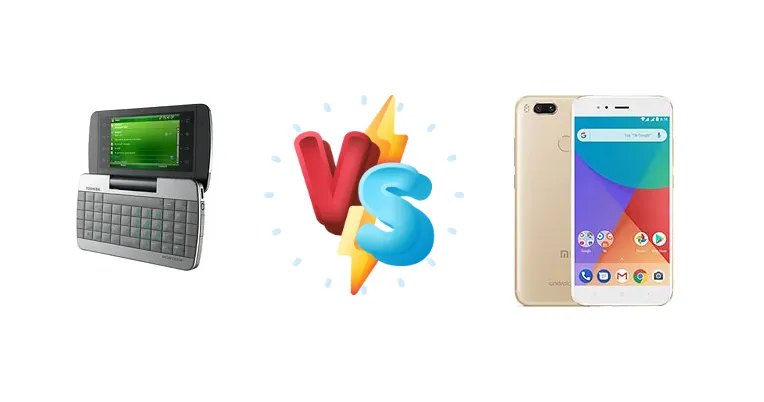
Remember the days of slide-out keyboards and limited processing power? The Toshiba G910/G920 represents that era. Now, let's pit it against the Xiaomi Mi A1 (Mi 5X), a modern mid-range champion. This comparison explores how far smartphone technology has come.
🏆 Quick Verdict
The Xiaomi Mi A1 (Mi 5X) decisively wins this comparison. While the Toshiba G910/G920 holds nostalgic value, the Mi A1's superior performance, camera, battery life, and modern features make it the clear choice for practical use.
| Network |
|---|
| 2G bands | GSM 900 / 1800 / 1900 | GSM 850 / 900 / 1800 / 1900 - SIM 1 & SIM 2 |
| 3G bands | HSDPA 2100 | HSDPA 850 / 900 / 1900 / 2100 |
| 4G bands | - | 1, 3, 5, 7, 8, 20, 38, 40 |
| Speed | HSPA 3.6/0.384 Mbps | HSPA 42.2/5.76 Mbps, LTE (2CA) Cat6 300/50 Mbps |
| Technology | GSM / HSPA | GSM / HSPA / LTE |
| Launch |
|---|
| Announced | 2008, January. Released 2008, June | 2017, September. Released 2017, September |
| Status | Discontinued | Discontinued |
| Body |
|---|
| Build | - | Glass front (Gorilla Glass 3), aluminum back, aluminum frame |
| Dimensions | 117 x 64 x 19.8 mm, 145 cc (4.61 x 2.52 x 0.78 in) | 155.4 x 75.8 x 7.3 mm (6.12 x 2.98 x 0.29 in) |
| Keyboard | QWERTY | - |
| SIM | Mini-SIM | Nano-SIM + Nano-SIM |
| Weight | 183 g (6.46 oz) | 165 g (5.82 oz) |
| Display |
|---|
| Protection | - | Corning Gorilla Glass 3 |
| Resolution | 800 x 480 pixels (Wide-VGA), 5:3 ratio (~311 ppi density) | 1080 x 1920 pixels, 16:9 ratio (~403 ppi density) |
| Size | 3.0 inches, 25.6 cm2 (~34.2% screen-to-body ratio) | 5.5 inches, 82.6 cm2 (~70.1% screen-to-body ratio) |
| Type | TFT resistive touchscreen, 65K colors | IPS LCD |
| Platform |
|---|
| CPU | 400 MHz ARM 11 | Octa-core 2.0 GHz Cortex-A53 |
| Chipset | Qualcomm MSM7200 | Qualcomm MSM8953 Snapdragon 625 (14 nm) |
| GPU | Adreno 130 | Adreno 506 |
| OS | Microsoft Windows Mobile 6 Professional | Android 7.1.2 (Nougat), upgradable to Android 9.0 (Pie), Android One |
| Memory |
|---|
| Card slot | microSD (dedicated slot) | microSDXC (uses shared SIM slot) |
| Internal | 128MB RAM, 256MB ROM | 32GB 4GB RAM, 64GB 4GB RAM |
| | - | eMMC 5.1 |
| Main Camera |
|---|
| Dual | - | 12 MP, f/2.2, 26mm (wide), 1/2.9", 1.25µm, PDAF
12 MP, f/2.6, 50mm (telephoto), 1.0µm, AF, 2x optical zoom |
| Features | - | Dual-LED dual-tone flash, HDR, panorama |
| Single | 2 MP, AF | - |
| Video | Yes | 4K@30fps, 1080p@30fps, 720p@120fps |
| Selfie camera |
|---|
| Single | VGA videocall camera | 5 MP |
| Video | - | 1080p@30fps |
| Sound |
|---|
| 3.5mm jack | No | Yes |
| 35mm jack | No | Yes |
| Alert types | Vibration; Downloadable polyphonic, MP3 ringtones | - |
| Loudspeaker | No | Yes |
| Comms |
|---|
| Bluetooth | 2.0, A2DP | 4.2, A2DP, LE |
| Infrared port | - | Yes |
| NFC | - | No |
| Positioning | GPS, A-GPS | GPS, GLONASS, BDS |
| Radio | No | FM radio |
| USB | Proprietary | USB Type-C 2.0 |
| WLAN | Wi-Fi 802.11b/g, VoIP over WLAN | Wi-Fi 802.11 a/b/g/n/ac, dual-band, Wi-Fi Direct |
| Features |
|---|
| Browser | WAP 2.0/xHTML, HTML (Opera 8.6) | - |
| Sensors | - | Fingerprint (rear-mounted), accelerometer, gyro, proximity |
| | Pocket Office
MP3/ACC+ player
Photo editor
Voice memo
Organizer | - |
| Battery |
|---|
| Charging | - | 10W wired |
| Stand-by | Up to 330 h | - |
| Talk time | Up to 4 h 25 min | - |
| Type | Removable Li-Ion 1320 mAh battery | Li-Po 3080 mAh, non-removable |
| Misc |
|---|
| Colors | Silver | Black, Gold, Rose Gold, Red |
| Models | - | MDG2, MDI2 |
| Price | About 190 EUR | About 170 EUR |
| SAR | 0.33 W/kg (head) 0.66 W/kg (body) | 1.75 W/kg (head) 0.76 W/kg (body) |
| Tests |
|---|
| Audio quality | - |
Noise -91.0dB / Crosstalk -82.5dB |
| Battery life | - | Endurance rating 87h |
| Camera | - |
Photo / Video |
| Display | - |
Contrast ratio: 1570:1 (nominal), 2.689 (sunlight) |
| Loudspeaker | - |
Voice 74dB / Noise 73dB / Ring 90dB |
| Performance | - |
GeekBench: 4292 (v4.4)
GFXBench: 3.5fps (ES 3.1 onscreen) |
Toshiba G910 / G920
- Nostalgic design
- Compact size (likely)
- Unique collector's item
- Extremely slow performance
- Limited app compatibility
- Poor battery life
- Low-resolution display
- Basic camera
Xiaomi Mi A1 (Mi 5X)
- Excellent battery life
- Good camera
- Smooth performance
- Modern features
- Affordable price
- May feel dated compared to current flagships
- Plastic build (typical for the price range)
Display Comparison
The Mi A1 boasts a significantly better display. Its contrast ratio of 1570:1 (nominal) and exceptional sunlight readability (2.689) far surpass the G910/G920's likely lower resolution and poorer outdoor visibility. The G910/G920 likely had a smaller screen size as well.
Camera Comparison
The Mi A1's camera is a major advantage. While specific details are missing for the G910/G920, it almost certainly lacks the Mi A1's features and image quality. The Mi A1 likely offered better low-light performance and more advanced shooting modes.
Performance
The Mi A1's Octa-core 2.0 GHz Cortex-A53 processor is a world apart from the G910/G920's 400 MHz ARM 11. Expect sluggish performance and limited app compatibility on the Toshiba device. The Mi A1 handles multitasking and modern apps with ease.
Battery Life
The Mi A1's endurance rating of 87h is outstanding. The G910/G920, with its older technology, would have a considerably shorter battery life, likely requiring daily charging.
Buying Guide
Who should buy the Toshiba G910/G920? Collectors of vintage phones or those seeking a unique, retro experience. Who should buy the Xiaomi Mi A1 (Mi 5X)? Anyone looking for a reliable, affordable smartphone with a good camera and long battery life.
Frequently Asked Questions
❓ Is the Toshiba G910/G920 worth buying?
Only if you're a collector of vintage phones or appreciate retro technology. It's not a practical choice for everyday use.
❓ Can the Toshiba G910/G920 run modern apps?
Highly unlikely. Its outdated processor and operating system lack the power and compatibility needed for most modern apps.
❓ What operating system did the Toshiba G910/G920 use?
It ran Windows Mobile, a now-obsolete mobile operating system.