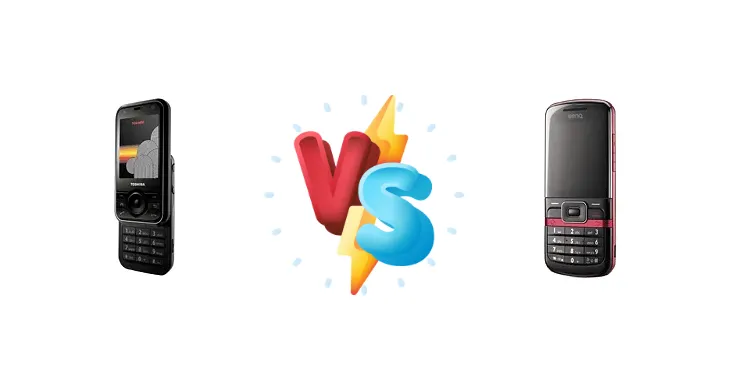
Remember a time before iPhones and Androids dominated the mobile landscape? The Toshiba G500 and BenQ E72 represent that era, offering a glimpse into the early days of smartphones. This comparison dives deep into these nostalgic devices, examining their strengths and weaknesses.
🏆 Quick Verdict
The BenQ E72 edges out the Toshiba G500 thanks to its slightly faster processor and generally more responsive experience. While both are relics of the past, the E72 offers a marginally better user experience, making it the preferred choice for retro enthusiasts.
| Network |
|---|
| 2G bands | GSM 900 / 1800 / 1900 | GSM 850 / 900 / 1800 / 1900 |
| 3G bands | HSDPA 2100 | - |
| EDGE | - | Yes |
| GPRS | - | Class 10 |
| Speed | HSPA 3.6/0.384 Mbps | - |
| Technology | GSM / HSPA | GSM |
| Launch |
|---|
| Announced | 2007, February | 2007, August |
| Status | Discontinued | Discontinued |
| Body |
|---|
| Dimensions | 96 x 49 x 22.9 mm (3.78 x 1.93 x 0.90 in) | 108 x 46 x 13 mm (4.25 x 1.81 x 0.51 in) |
| SIM | Mini-SIM | Mini-SIM |
| Weight | 135 g (4.76 oz) | 90 g (3.17 oz) |
| Display |
|---|
| Resolution | 240 x 320 pixels, 4:3 ratio (~174 ppi density) | 240 x 320 pixels, 4:3 ratio (~200 ppi density) |
| Size | 2.3 inches, 16.4 cm2 (~34.8% screen-to-body ratio) | 2.0 inches, 12.4 cm2 (~24.9% screen-to-body ratio) |
| Type | TFT, 65K colors | TFT, 65K colors |
| | - | Wallpapers |
| Platform |
|---|
| CPU | 32-bit Intel XScale PXA270 312 MHz | 260 MHz |
| Chipset | - | TI OMAP V1030 |
| OS | Microsoft Windows Mobile 5.0 | Microsoft Windows Mobile 6.0 |
| Memory |
|---|
| Card slot | miniSD | microSD (dedicated slot) |
| Internal | 64MB | 128MB 64MB RAM |
| Main Camera |
|---|
| Single | 2 MP | 2 MP |
| Video | Yes | Yes |
| Selfie camera |
|---|
| Single | VGA videocall camera | - |
| | - | No |
| Sound |
|---|
| 3.5mm jack | No | No |
| 35mm jack | No | No |
| Alert types | Vibration, MP3 ringtones | Vibration; Downloadable polyphonic, MP3, MIDI, Flash ringtones |
| Loudspeaker | Yes | Yes |
| | 2.5 mm audio jack | - |
| Comms |
|---|
| Bluetooth | 2.0, A2DP | 2.0, A2DP |
| Positioning | No | No |
| Radio | No | No |
| USB | miniUSB 1.1 | 2.0 |
| WLAN | Wi-Fi 802.11b/g, VoIP over WLAN | Wi-Fi 802.11 b/g |
| Features |
|---|
| Browser | WAP 2.0/xHTML, HTML (Opera 8.6) | WAP 2.0/xHTML, HTML, Email, MSN |
| Sensors | Fingerprint (rear-mounted) | - |
| | Pocket Office
MP3/WMA/ACC+ player
MP4/WMV/H.264/H.263 player
Photo editor
Voice memo
Organizer | MP3/AAC/AAC+/WAV/WMA player
MP4/WMV/3GP player
Voice memo |
| Battery |
|---|
| Stand-by | Up to 240 h (2G) / Up to 240 h (3G) | Up to 180 h |
| Talk time | Up to 4 h (2G) / Up to 3 h (3G) | Up to 4 h |
| Type | Removable Li-Ion 1200 mAh battery | Removable Li-Ion 900 mAh battery |
| Misc |
|---|
| Colors | Silver | Bright red |
| Price | About 260 EUR | About 120 EUR |
| SAR | 0.22 W/kg (head) 1.44 W/kg (body) | - |
Toshiba G500
- Unique and iconic design
- Relatively compact size
- Collectible value
- Slower performance
- Smaller screen
- Limited software support
- Poor camera quality
BenQ E72
- Slightly better performance
- Larger screen
- Potentially better software support (limited)
- Decent battery life
- Still very slow by modern standards
- Low-resolution display
- Basic camera
- Limited app availability
Display Comparison
Both phones featured relatively small, low-resolution screens by today's standards. The Toshiba G500 had a 2.4-inch display, while the BenQ E72 boasted a 2.8-inch screen. The BenQ's larger size provides a slightly better viewing experience, though both suffer from limited color accuracy and low brightness.
Camera Comparison
Camera capabilities were rudimentary on both devices. The Toshiba G500 featured a 2MP camera, while the BenQ E72 had a 3MP camera. Image quality on both is poor by modern standards, suitable only for very basic snapshots in ideal lighting conditions. Don't expect any detail or vibrant colors.
Performance
The BenQ E72's TI OMAP V1030 chipset at 260 MHz holds a slight advantage over the Toshiba G500's 312 MHz Intel XScale PXA270. While the clock speed is higher on the Toshiba, the OMAP V1030 generally offered better overall performance and efficiency. Expect slightly smoother navigation and app loading on the BenQ.
Battery Life
Battery life was a key consideration in the early smartphone era. The BenQ E72 generally offered slightly better battery life than the Toshiba G500, likely due to the more efficient OMAP chipset. Expect a full day of moderate use on the BenQ, while the Toshiba might require charging before the end of the day.
Buying Guide
The Toshiba G500 is for dedicated collectors of early smartphones or those specifically seeking its unique design. The BenQ E72 is for those wanting a slightly more usable retro smartphone experience, appreciating its improved performance and potentially better software support (though limited).
Frequently Asked Questions
❓ Are these phones usable in 2024?
While technically usable, these phones are extremely limited by today's standards. Expect slow performance, limited app compatibility, and a frustrating user experience compared to modern smartphones. They are primarily collector's items.
❓ Can I find apps for these phones?
App availability is extremely limited. Both phones ran proprietary operating systems with very few apps available. You'll be restricted to the pre-installed software and potentially some very basic third-party applications if you can find them.