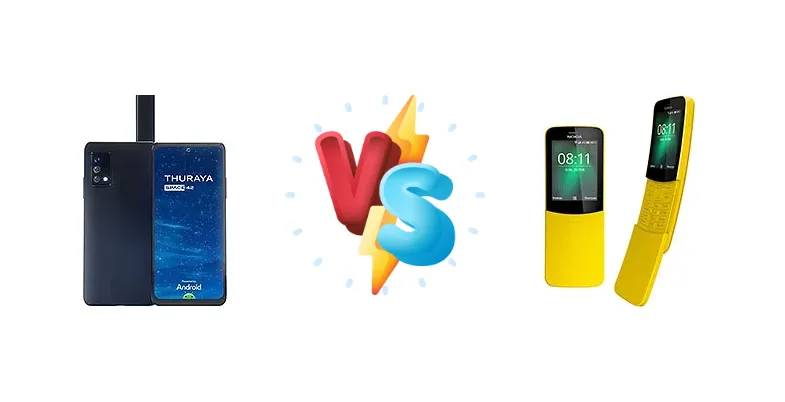
The Thuraya One and Nokia 8110 4G represent vastly different approaches to mobile communication. The Thuraya One aims to bridge the gap between smartphone functionality and remote connectivity with its satellite capabilities, while the Nokia 8110 4G doubles down on the classic feature phone experience with a modern 4G twist. This comparison dissects their core differences, focusing on performance, features, and target users.
🏆 Quick Verdict
For users needing reliable communication in areas without cellular coverage, the Thuraya One is the clear winner, leveraging its Qualcomm QCM4490 chipset and satellite connectivity. However, the Nokia 8110 4G provides exceptional value for those seeking a simple, durable, and affordable phone for basic communication.
| Network |
|---|
| 2G bands | GSM 850 / 900 / 1800 / 1900 | GSM 900 / 1800 |
| 3G bands | HSDPA 850 / 900 / 1900 / 2100 | HSDPA 850 / 900 / 2100 - Europe |
| 4G bands | LTE | 1, 3, 5, 7, 8, 20 - Europe |
| 5G bands | SA/NSA | - |
| Speed | HSPA, LTE, 5G | HSPA 42.2/5.76 Mbps, LTE Cat4 150/50 Mbps |
| Technology | GSM / HSPA / LTE / 5G | GSM / HSPA / LTE |
| | - | 1, 3, 5, 7, 8, 20, 38, 39, 40, 41 - MENA/China |
| Launch |
|---|
| Announced | 2025, January | 2018, February 25. Released 2018, April 23 |
| Status | Available. Released 2025, January | Discontinued |
| Body |
|---|
| Build | Glass front (Corning Gorilla glass 5), plastic back, plastic frame | Glass front, plastic back, plastic frame |
| Dimensions | 167 x 76.5 x 11.6 mm (6.57 x 3.01 x 0.46 in) | 133.5 x 49.3 x 14.9 mm (5.26 x 1.94 x 0.59 in) |
| SIM | Nano-SIM + Nano-SIM | · Micro-SIM· Micro-SIM + Nano-SIM |
| Weight | 230 g (8.11 oz) | 117 g (4.13 oz) |
| | - | Drip protection
Flashlight |
| Display |
|---|
| Protection | Corning Gorilla Glass 5 | - |
| Resolution | 1080 x 2400 pixels, 20:9 ratio (~395 ppi density) | 240 x 320 pixels, 4:3 ratio (~167 ppi density) |
| Size | 6.67 inches, 107.4 cm2 (~84.1% screen-to-body ratio) | 2.4 inches, 17.8 cm2 (~27.1% screen-to-body ratio) |
| Type | AMOLED, 90Hz, 700 nits | TFT |
| Platform |
|---|
| CPU | Octa-core (2x2.4 GHz Cortex-A78 & 6x2.0 GHz Cortex-A55) | Dual-core (2x1.1 GHz Cortex-A7) |
| Chipset | Qualcomm QCM4490 (4 nm) | Qualcomm MSM8905 Snapdragon 205 (28 nm) |
| GPU | Adreno 613 | Adreno 304 |
| OS | Android 14 | KaiOS 2.5.1 |
| Memory |
|---|
| Card slot | microSDXC (uses shared SIM slot) | microSDHC (dedicated slot) |
| Internal | 128GB 6GB RAM | 4GB 512MB RAM |
| | - | eMMC 4.5 |
| Main Camera |
|---|
| Features | LED flash, HDR, panorama | LED flash |
| Single | - | 2 MP |
| Triple | 50 MP, f/1.8, (wide), 1/2.76", PDAF
8 MP, f/2.2, (ultrawide), 1/4.0"
2 MP (macro) | - |
| Video | 1080p@30fps | Yes |
| Selfie camera |
|---|
| Single | 16 MP, f/2.2, (wide), 1/3.0" | - |
| Video | 1080p@30fps | - |
| | - | No |
| Sound |
|---|
| 3.5mm jack | - | Yes |
| 35mm jack | No | Yes |
| Loudspeaker | Yes, with stereo speakers | Yes |
| Comms |
|---|
| Bluetooth | 5.2, A2DP, LE | 4.1, A2DP, LE |
| NFC | No | No |
| Positioning | GPS, GALILEO, GLONASS, BDS | GPS |
| Radio | No | FM radio |
| USB | USB Type-C 3.1 | microUSB 2.0 |
| WLAN | Wi-Fi 802.11 a/b/g/n/ac/6, dual-band, Wi-Fi Direct | Wi-Fi 802.11 b/g/n |
| Features |
|---|
| Sensors | Fingerprint (side-mounted), accelerometer, proximity, compass, gyro | - |
| | - | Downloadable applications Facebook, Gmail, Whatsapp, etc.
Audio/Video player |
| Battery |
|---|
| Charging | 18W wired | - |
| Music play | - | Up to 48 h |
| Stand-by | - | Up to 408 h |
| Talk time | - | Up to 11 h |
| Type | Li-Po 3500 mAh | Li-Ion 1500 mAh battery |
| Misc |
|---|
| Colors | Black | Traditional Black, Banana Yellow |
| Models | - | TA-1071, TA-1067 |
| Price | About 1200 EUR | About 140 EUR |
| SAR | - | 1.16 W/kg (head) 1.18 W/kg (body) |
| SAR EU | - | 0.95 W/kg (head) 1.48 W/kg (body) |
Thuraya One
- Satellite connectivity for remote communication
- Powerful Qualcomm QCM4490 processor
- Modern Android operating system
- Likely higher price point
- Potentially shorter battery life due to power-hungry chipset
Nokia 8110 4G
- Extremely affordable price
- Long battery life due to efficient chipset
- Durable and simple design
- Limited performance with Snapdragon 205
- Basic feature phone functionality
Display Comparison
Display specifications are not provided for either device, but given the Thuraya One's positioning as a modern smartphone, it likely features a higher resolution and brighter panel than the Nokia 8110 4G. The Nokia 8110 4G's curved display is a design choice prioritizing ergonomics over maximizing screen real estate. The Thuraya One, being a more modern device, likely benefits from improved color accuracy and viewing angles.
Camera Comparison
Camera details are limited, but the Thuraya One, as a modern smartphone, is expected to have a more sophisticated camera system. While the Nokia 8110 4G likely includes a basic camera for casual snapshots, the Thuraya One’s QCM4490 chipset likely supports advanced image processing capabilities and potentially a higher-resolution sensor. The absence of details on the Nokia 8110 4G suggests its camera is not a primary selling point.
Performance
The performance disparity between these devices is significant. The Thuraya One’s Qualcomm QCM4490, built on a 4nm process, boasts an octa-core CPU (2x2.4 GHz Cortex-A78 & 6x2.0 GHz Cortex-A55) offering substantial processing power for apps, multitasking, and potentially even light gaming. In contrast, the Nokia 8110 4G’s Qualcomm MSM8905 Snapdragon 205, fabricated on a 28nm node, features a dual-core (2x1.1 GHz Cortex-A7) CPU. This older architecture and larger process node result in significantly lower performance and efficiency. The 4nm process of the QCM4490 translates to better thermal management, preventing throttling during sustained use, a benefit the Nokia 8110 4G simply cannot match.
Battery Life
Battery capacity is not specified for either device. However, the Nokia 8110 4G, with its less demanding chipset, is likely to offer significantly longer battery life on a single charge. The Thuraya One’s 18W wired charging is a modern convenience, allowing for faster replenishment, but the power-hungry QCM4490 will consume energy at a higher rate. The Nokia 8110 4G prioritizes standby time, while the Thuraya One focuses on enabling more features, requiring more frequent charging.
Buying Guide
Buy the Thuraya One if you require robust connectivity in remote locations, need a modern Android experience, and prioritize emergency communication features. Buy the Nokia 8110 4G if you value simplicity, long battery life, a durable build, and an extremely affordable price point for basic calling and texting.
Frequently Asked Questions
❓ What kind of satellite network does the Thuraya One utilize, and what are the associated subscription costs?
The Thuraya One utilizes the Thuraya satellite network, providing coverage across Europe, Africa, Asia, and Australia. Subscription costs vary depending on usage and coverage area, and typically involve monthly fees and per-minute charges for satellite calls and data. Users should consult Thuraya's official website for detailed pricing information.
❓ Can the Nokia 8110 4G be used as a hotspot to share its 4G connection with other devices?
While the Nokia 8110 4G supports 4G connectivity, its hotspot functionality is limited or non-existent. The Snapdragon 205 chipset and limited RAM are not designed to handle the demands of tethering, making it unsuitable for sharing its connection with other devices.
❓ Is the Thuraya One's satellite connectivity affected by weather conditions?
Yes, heavy rain or snow can potentially degrade the Thuraya One's satellite signal strength. However, the Thuraya network is designed to mitigate these effects, and the device should still be able to establish a connection in most weather conditions. Extreme weather may require finding a clear line of sight to the satellite.
❓ Does the Nokia 8110 4G support WhatsApp or other modern messaging apps?
The Nokia 8110 4G supports a limited selection of apps, including WhatsApp, but the experience is basic compared to smartphones. Functionality may be restricted, and the small screen size can make typing and viewing messages challenging. It's primarily designed for voice calls and SMS messaging.