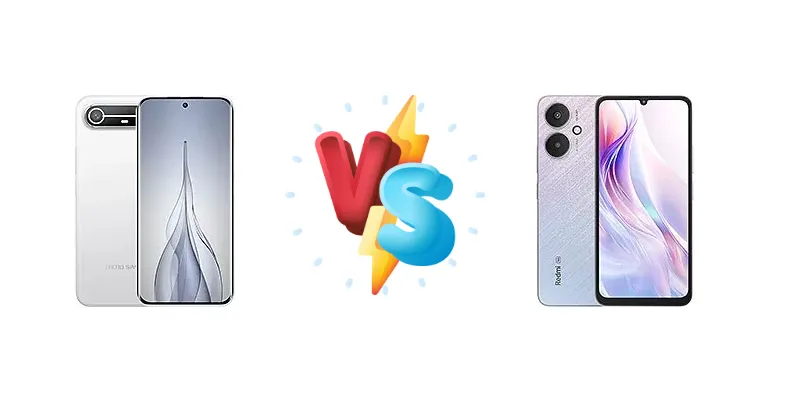
The sub-$200 5G smartphone market is heating up, with the Tecno Spark Slim and Xiaomi Redmi 13C 5G vying for dominance. Both devices aim to deliver 5G connectivity at an accessible price point, but they take different approaches to achieving this. The Spark Slim prioritizes charging speed and convenience, while the Redmi 13C 5G focuses on raw processing power with a more capable chipset.
🏆 Quick Verdict
For the average user prioritizing everyday tasks and quick top-ups, the Tecno Spark Slim is the better choice due to its significantly faster 45W charging. However, users who frequently game or demand more from their processor will find the Xiaomi Redmi 13C 5G’s Dimensity 6100+ a more compelling option.
| Network |
|---|
| 2G bands | GSM 850 / 900 / 1800 / 1900 | GSM 850 / 900 / 1800 / 1900 |
| 3G bands | HSDPA 850 / 900 / 2100 | HSDPA 800 / 850 / 900 / 1700(AWS) / 1900 / 2100 - International |
| 4G bands | LTE | 1, 2, 3, 4, 5, 7, 8, 12, 13, 17, 18, 19, 20, 26, 28, 32, 38, 40, 41, 66 - International |
| 5G bands | - | 1, 3, 5, 7, 8, 20, 28, 38, 40, 41, 66, 77, 78 SA/NSA - International |
| Speed | HSPA, LTE | HSPA, LTE, 5G |
| Technology | GSM / HSPA / LTE | GSM / HSPA / LTE / 5G |
| Launch |
|---|
| Announced | 2025, September 02 | 2023, December 06 |
| Status | Available. Released 2025, October 10 | Available. Released 2023, December 16 |
| Body |
|---|
| Build | Glass front (Gorilla Glass 7i), fiber-reinforced plastic back | Glass front (Gorilla Glass 3), plastic frame, plastic back |
| Dimensions | 164.2 x 75.9 x 5.9 mm (6.46 x 2.99 x 0.23 in) | 168.1 x 77.9 x 8.2 mm (6.62 x 3.07 x 0.32 in) |
| SIM | Nano-SIM | Nano-SIM + Nano-SIM |
| Weight | 156 g (5.50 oz) | 192 g or 195 g (6.77 oz) |
| Display |
|---|
| Protection | Corning Gorilla Glass 7i | Corning Gorilla Glass 3 |
| Resolution | 1224 x 2720 pixels, 20:9 ratio (~440 ppi density) | 720 x 1600 pixels, 20:9 ratio (~260 ppi density) |
| Size | 6.78 inches, 111.0 cm2 (~89.1% screen-to-body ratio) | 6.74 inches, 109.7 cm2 (~83.8% screen-to-body ratio) |
| Type | AMOLED, 144Hz, 1600 nits (HBM), 4500 nits (peak) | IPS LCD, 90Hz, 450 nits (typ), 600 nits (HBM) |
| Platform |
|---|
| CPU | Octa-core (2x2.2 GHz Cortex-A76 & 6x2.0 GHz Cortex-A55) | Octa-core (2x2.2 GHz Cortex-A76 & 6x2.0 GHz Cortex-A55) |
| Chipset | Mediatek Helio G200 (6 nm) | Mediatek Dimensity 6100+ (6 nm) |
| GPU | Mali-G57 MC2 (1.1GHz) | Mali-G57 MC2 |
| OS | Android 15, HIOS 15 | Android 13, MIUI 14 |
| Memory |
|---|
| Card slot | No | microSDXC (dedicated slot) |
| Internal | 256GB 8GB RAM | 64GB 4GB RAM, 128GB 4GB RAM, 128GB 6GB RAM, 256GB 8GB RAM |
| Main Camera |
|---|
| Features | Dual-LED flash | LED flash, HDR |
| Single | 50 MP, (wide), PDAF | 50 MP, f/1.8, 28mm (wide), 1/2.76", 1.12µm, PDAF
Auxiliary lens |
| Video | 1440p@30fps, 1080p@30fps | 1080p@30fps |
| Selfie camera |
|---|
| Features | - | HDR |
| Single | 13 MP, (wide) | 5 MP, f/2.2, (wide) |
| Video | Yes | 1080p@30fps |
| Sound |
|---|
| 35mm jack | No | Yes |
| Loudspeaker | Yes, with dual speakers (with Dolby Atmos) | Yes |
| Comms |
|---|
| Bluetooth | Yes | 5.3, A2DP, LE |
| Infrared port | Yes | - |
| NFC | Yes | Yes (market/region dependent) |
| Positioning | GPS, GLONASS, GALILEO, BDS | GPS, GLONASS, GALILEO, BDS |
| Radio | FM radio | FM radio |
| USB | USB Type-C, OTG | USB Type-C 2.0, OTG |
| WLAN | Yes | Wi-Fi 802.11 a/b/g/n/ac, dual-band |
| Features |
|---|
| Sensors | Fingerprint (under display, optical), accelerometer, gyro | Fingerprint (side-mounted), accelerometer, compass |
| Battery |
|---|
| Charging | 45W wired, 100% in 57 min
10W reverse wired
Bypass charging | 18W wired, PD |
| Type | 5160 mAh | 5000 mAh |
| Misc |
|---|
| Colors | Slim White, Cool Black | Starry Black, Twilight Blue, Starry Silver, Starlight Black, Startrail Green, Startrail Silver |
| Models | KM7k | 23124RN87G, 23124RN87I, 23124RN87C |
| Price | About 180 EUR | $ 198.99 / £ 119.00 / € 116.99 / ₹ 10,895 |
| SAR | - | 1.09 W/kg (head) 1.09 W/kg (body) |
| SAR EU | - | 0.98 W/kg (head) 0.98 W/kg (body) |
Tecno Spark Slim
- Significantly faster 45W charging
- Convenient 10W reverse wired charging
- Competitive price point
- Less powerful chipset compared to the Redmi 13C 5G
- Likely less capable GPU for gaming
Xiaomi Redmi 13C 5G
- More powerful Mediatek Dimensity 6100+ chipset
- Potentially better gaming performance
- Power Delivery (PD) charging support
- Slower 18W charging
- Lacks reverse wireless charging
Display Comparison
Neither device boasts a standout display. Both are likely utilizing LCD panels, common in this price bracket. While specific details like resolution and refresh rate are missing, the focus here is on internal components. The absence of high refresh rates or advanced panel technologies like LTPO isn't surprising at this price point, meaning users should expect standard viewing experiences.
Camera Comparison
Without detailed camera specifications, a direct comparison is difficult. However, it’s safe to assume both phones feature a primary camera and supporting lenses. The Redmi 13C 5G’s chipset likely offers more advanced image signal processing (ISP) capabilities, potentially leading to better image quality, especially in low-light conditions. The focus should be on the main sensor resolution and aperture, as these are the biggest determinants of image quality. The presence of Optical Image Stabilization (OIS) – which is unlikely on either device – would be a significant advantage.
Performance
The core difference lies in the chipsets. Both the Tecno Spark Slim (Helio G200) and Xiaomi Redmi 13C 5G (Dimensity 6100+) utilize an octa-core configuration with the same 2x2.2 GHz Cortex-A76 and 6x2.0 GHz Cortex-A55 setup. However, the Dimensity 6100+ is a more modern and efficient design. While the CPU clock speeds are identical, the Dimensity 6100+ benefits from architectural improvements and a potentially more capable GPU, translating to better sustained performance in gaming and demanding applications. The Redmi 13C 5G will likely exhibit less throttling under load. The Spark Slim's Helio G200 is still adequate for everyday tasks, but will struggle with graphically intensive games.
Battery Life
The Tecno Spark Slim’s 45W wired charging is a clear advantage over the Redmi 13C 5G’s 18W charging. The Spark Slim can reach 100% charge in just 57 minutes, a substantial time saving. While battery capacity isn’t specified, the faster charging speed mitigates the impact of a potentially smaller battery. The Redmi 13C 5G’s 18W charging, while supporting Power Delivery (PD), will take considerably longer to fully charge. The Spark Slim also offers 10W reverse wired charging, a useful feature for topping up accessories like earbuds, which the Redmi 13C 5G lacks.
Buying Guide
Buy the Tecno Spark Slim if you need a phone that can rapidly recharge, offers reverse wired charging for accessories, and handles daily tasks smoothly. It’s ideal for users who value convenience and aren’t heavy gamers. Buy the Xiaomi Redmi 13C 5G if you prioritize performance for gaming or demanding applications, and are willing to trade off charging speed for a more powerful processor. This phone suits users who want the most processing power for their money.
Frequently Asked Questions
❓ Does the Mediatek Dimensity 6100+ in the Redmi 13C 5G overheat during prolonged gaming sessions?
While the Dimensity 6100+ is a capable chipset, sustained gaming can generate heat. However, it's designed with efficiency in mind and should manage temperatures better than the Helio G200 in the Spark Slim, minimizing throttling and maintaining performance for longer periods. The phone's thermal design will also play a crucial role.
❓ Is the 45W charging on the Tecno Spark Slim compatible with all USB-PD chargers?
No, while the Spark Slim supports 45W charging, it doesn't necessarily mean it's fully USB-PD compliant. It's best to use the charger included in the box or a charger specifically designed for Tecno's 45W charging protocol to ensure optimal charging speeds and safety. Using a standard USB-PD charger may result in slower charging.
❓ How does the Helio G200 perform with multitasking and app switching?
The Helio G200 is adequate for basic multitasking, handling a few apps simultaneously without significant slowdown. However, with numerous apps open or demanding applications running in the background, you may experience some lag. The Redmi 13C 5G’s Dimensity 6100+ will offer a smoother multitasking experience due to its more powerful architecture.