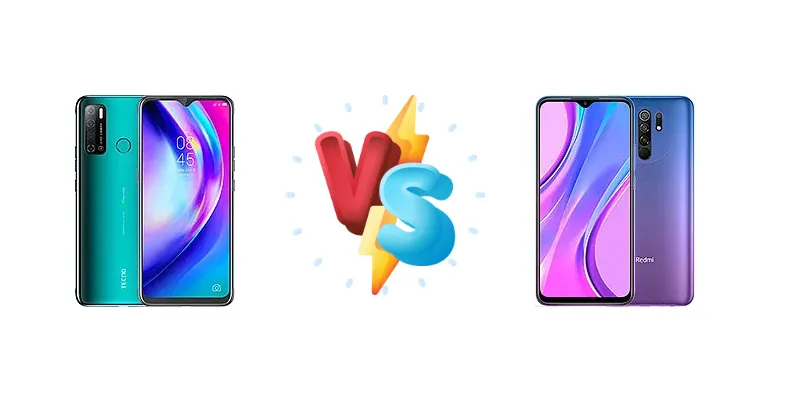
Both the Tecno Spark Power 2 and Xiaomi Redmi 9 Prime target the ultra-budget smartphone market, but they approach it with different strategies. The Spark Power 2 prioritizes a large battery, while the Redmi 9 Prime focuses on delivering more processing power for the price. This comparison dissects the key differences to help you choose the right device.
🏆 Quick Verdict
For most users, the Xiaomi Redmi 9 Prime is the better choice. Its Helio G80 chipset provides a noticeable performance advantage over the Tecno Spark Power 2’s Helio P22, making it more suitable for gaming and demanding applications. While the Spark Power 2 offers a larger battery, the Redmi 9 Prime’s efficiency and faster processor offset this difference.
| Network |
|---|
| 2G bands | GSM 850 / 900 / 1800 / 1900 | GSM 850 / 900 / 1800 / 1900 |
| 3G bands | HSDPA 850 / 900 / 2100 | HSDPA 850 / 900 / 1900 / 2100 |
| 4G bands | 1, 3, 5, 7, 8, 20, 38, 40, 41 | 1, 3, 5, 8, 40, 41 |
| EDGE | - | No |
| GPRS | - | No |
| Speed | HSPA 42.2/5.76 Mbps, LTE Cat4 150/50 Mbps | HSPA, LTE |
| Technology | GSM / HSPA / LTE | GSM / HSPA / LTE |
| Launch |
|---|
| Announced | 2020, June 17. Released 2020, June 23 | 2020, August 04 |
| Status | Discontinued | Available. Released 2020, August 06 |
| Body |
|---|
| Build | Glass front, plastic back, plastic frame | Glass front (Gorilla Glass 3), plastic back, plastic frame |
| Dimensions | 174.9 x 79.6 x 9.2 mm (6.89 x 3.13 x 0.36 in) | 163.3 x 77 x 9.1 mm (6.43 x 3.03 x 0.36 in) |
| SIM | Nano-SIM + Nano-SIM | Nano-SIM + Nano-SIM |
| Weight | 220 g (7.76 oz) | 198 g (6.98 oz) |
| | - | Water-repellent coating |
| Display |
|---|
| Protection | - | Corning Gorilla Glass 3 |
| Resolution | 720 x 1640 pixels (~256 ppi density) | 1080 x 2340 pixels, 19.5:9 ratio (~395 ppi density) |
| Size | 7.0 inches, 116.4 cm2 (~83.6% screen-to-body ratio) | 6.53 inches, 104.7 cm2 (~83.2% screen-to-body ratio) |
| Type | IPS LCD, 480 nits (typ) | IPS LCD, 400 nits (typ) |
| Platform |
|---|
| CPU | Octa-core 2.0 GHz Cortex-A53 | Octa-core (2x2.0 GHz Cortex-A75 & 6x1.8 GHz Cortex-A55) |
| Chipset | Mediatek MT6762 Helio P22 (12 nm) | Mediatek MT6769V/CU Helio G80 (12 nm) |
| GPU | PowerVR GE8320 | Mali-G52 MC2 |
| OS | Android 10, HIOS 6.1 | Android 10, MIUI 11 |
| Memory |
|---|
| Card slot | microSDXC (dedicated slot) | microSDXC (dedicated slot) |
| Internal | 64GB 4GB RAM | 64GB 4GB RAM, 128GB 4GB RAM |
| | eMMC 5.1 | eMMC 5.1 |
| Main Camera |
|---|
| Features | Quad-LED flash, panorama, HDR | LED flash, HDR, panorama |
| Quad | 16 MP, f/1.8, 27mm (wide), AF
5 MP, 115˚ (ultrawide)
2 MP (macro)
Auxiliary lens | 13 MP, f/2.2, 28mm (wide), 1/3.1", 1.12µm, PDAF
8 MP, f/2.2, 118˚ (ultrawide), 1/4.0", 1.12µm
5 MP (macro)
Auxiliary lens |
| Video | 1080p@30fps | 1080p@30fps |
| Selfie camera |
|---|
| Features | Dual-LED flash, HDR | HDR |
| Single | 16 MP, f/2.0, 27mm (wide) | 8 MP, f/2.0, 27mm (wide), 1/4.0", 1.12µm |
| Video | 1080p@30fps | 1080p@30fps |
| Sound |
|---|
| 3.5mm jack | Yes | Yes |
| 35mm jack | Yes | Yes |
| Loudspeaker | Yes, with stereo speakers | Yes |
| Comms |
|---|
| Bluetooth | 5.0, A2DP, LE | 5.0, A2DP, LE |
| Infrared port | - | Yes |
| NFC | No | No |
| Positioning | GPS, GLONASS, GALILEO, BDS | GPS, GLONASS, BDS |
| Radio | FM radio | Wireless FM radio (no wired headphones required) |
| USB | microUSB 2.0, OTG | USB Type-C 2.0, OTG |
| WLAN | Wi-Fi 802.11 b/g/n/ac | Wi-Fi 802.11 a/b/g/n/ac, dual-band, Wi-Fi Direct |
| Features |
|---|
| Sensors | Fingerprint (rear-mounted), accelerometer, proximity | Fingerprint (rear-mounted), accelerometer, proximity, compass |
| Battery |
|---|
| Charging | 18W wired, 50% in 60 min | 18W wired |
| Type | 6000 mAh | Li-Po 5020 mAh |
| Misc |
|---|
| Colors | Ice Jadeite, Misty Grey, Fascinating Purple | Space Blue, Mint Green, Matte Black, Sunrise Flare |
| Models | LC8 | M2004J19PI |
| Price | About 120 EUR | About 110 EUR |
| SAR | 0.85 W/kg (head) 0.80 W/kg (body) | 0.85 W/kg (head) 0.42 W/kg (body) |
Tecno Spark Power 2
- Potentially larger battery capacity for extended use.
- Affordable price point.
- Simple and user-friendly interface (typical of Tecno).
- Significantly weaker processor performance.
- Struggles with demanding applications and gaming.
- Likely slower app launch times.
Xiaomi Redmi 9 Prime
- Faster and more responsive processor (Helio G80).
- Better gaming performance.
- Improved multitasking capabilities.
- Potentially shorter battery life compared to Spark Power 2 (though mitigated by efficiency).
- May be slightly more expensive.
- Xiaomi’s MIUI can be resource-intensive.
Display Comparison
Neither device boasts a particularly impressive display. Both utilize 12nm chipsets, suggesting similar power constraints impacting display capabilities. While specific display specs (resolution, panel type) are missing, the focus here is on performance. The Redmi 9 Prime’s more powerful processor can potentially handle more demanding display tasks, like smoother animations, even if the panel itself is comparable.
Camera Comparison
Without detailed camera specifications, a direct comparison is difficult. However, the Redmi 9 Prime’s more powerful processor allows for more sophisticated image processing. This could result in better dynamic range, noise reduction, and overall image quality, even with similar sensor sizes. The presence of a more capable ISP (Image Signal Processor) within the Helio G80 is a key advantage. The market segment suggests both phones likely feature basic camera setups, so the software processing will be a major differentiator.
Performance
The core difference lies in the chipsets. The Xiaomi Redmi 9 Prime’s Mediatek Helio G80 is a significant upgrade over the Tecno Spark Power 2’s Helio P22. The G80 features a combination of 2x 2.0 GHz Cortex-A75 and 6x 1.8 GHz Cortex-A55 cores, compared to the P22’s 8x 2.0 GHz Cortex-A53 cores. The A75 cores in the G80 offer substantially higher single-core performance, crucial for app launch speeds and responsiveness. This translates to a smoother user experience and better gaming performance on the Redmi 9 Prime. The P22, while adequate for basic tasks, will struggle with more demanding applications.
Battery Life
Both phones feature 18W wired charging, offering similar charging speeds (approximately 60 minutes to 50% charge). While the Tecno Spark Power 2 likely has a larger battery capacity (specific mAh not provided), the Redmi 9 Prime’s more efficient Helio G80 chipset can deliver comparable real-world battery life. The G80’s improved power management offsets the potential capacity difference, meaning users won’t necessarily see a dramatic difference in daily usage.
Buying Guide
Buy the Tecno Spark Power 2 if your primary need is extended battery life and you primarily use your phone for basic tasks like calling, texting, and light social media. Buy the Xiaomi Redmi 9 Prime if you want a more responsive experience, enjoy mobile gaming, or frequently multitask between applications. The Redmi 9 Prime offers a better balance of performance and features for the average user.
Frequently Asked Questions
❓ Will the Redmi 9 Prime handle popular games like PUBG Mobile smoothly?
The Redmi 9 Prime’s Helio G80 chipset is capable of running PUBG Mobile at medium settings with reasonable frame rates. While it won’t deliver a flagship gaming experience, it’s a significant improvement over the Spark Power 2 and provides a playable experience for casual gamers.
❓ Is the difference in performance between the Helio G80 and Helio P22 noticeable in everyday use?
Yes, the difference is quite noticeable. The Helio G80’s faster cores and improved architecture result in snappier app launches, smoother scrolling, and a more responsive overall user experience. The Spark Power 2’s Helio P22 can feel sluggish in comparison, especially when multitasking.
❓ Does the Redmi 9 Prime support fast charging beyond the advertised 18W?
While the Redmi 9 Prime supports 18W charging, it doesn't support significantly faster protocols like Quick Charge 4.0. Using a compatible 18W charger is recommended for optimal charging speeds.
❓ Which phone is better for watching videos and streaming content?
The Redmi 9 Prime’s more powerful processor can handle video decoding and streaming more efficiently, potentially resulting in smoother playback and less buffering. While both phones can play videos, the Redmi 9 Prime offers a more reliable experience.