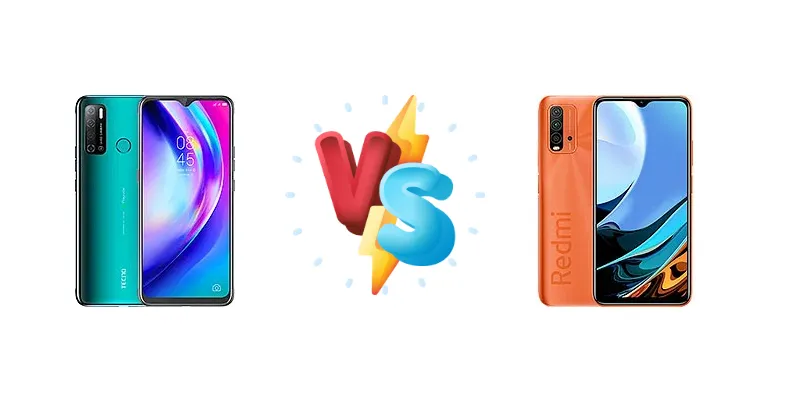
The Tecno Spark Power 2 and Xiaomi Redmi 9 Power represent compelling options in the ultra-budget smartphone segment. Both aim to deliver essential features at a low price point, but they take different approaches to achieving this. The key differentiator lies in their chipsets: MediaTek’s Helio P22 in the Tecno versus Qualcomm’s Snapdragon 662 in the Xiaomi. This comparison will dissect these differences and determine which device offers the best value for your money.
🏆 Quick Verdict
For most users, the Xiaomi Redmi 9 Power emerges as the better choice. While both phones offer 18W charging, the Snapdragon 662 provides a noticeable performance uplift over the Helio P22, translating to smoother multitasking and a more responsive user experience. The addition of reverse wired charging is a bonus for accessory users.
| Network |
|---|
| 2G bands | GSM 850 / 900 / 1800 / 1900 | GSM 850 / 900 / 1800 / 1900 |
| 3G bands | HSDPA 850 / 900 / 2100 | HSDPA 850 / 900 / 2100 |
| 4G bands | 1, 3, 5, 7, 8, 20, 38, 40, 41 | 1, 3, 5, 8, 40, 41 |
| Speed | HSPA 42.2/5.76 Mbps, LTE Cat4 150/50 Mbps | HSPA, LTE |
| Technology | GSM / HSPA / LTE | GSM / HSPA / LTE |
| Launch |
|---|
| Announced | 2020, June 17. Released 2020, June 23 | 2020, December 17 |
| Status | Discontinued | Available. Released 2020, December 22 |
| Body |
|---|
| Build | Glass front, plastic back, plastic frame | Glass front (Gorilla Glass 3), plastic frame, plastic back |
| Dimensions | 174.9 x 79.6 x 9.2 mm (6.89 x 3.13 x 0.36 in) | 162.3 x 77.3 x 9.6 mm (6.39 x 3.04 x 0.38 in) |
| SIM | Nano-SIM + Nano-SIM | Nano-SIM + Nano-SIM |
| Weight | 220 g (7.76 oz) | 198 g (6.98 oz) |
| Display |
|---|
| Protection | - | Corning Gorilla Glass 3 |
| Resolution | 720 x 1640 pixels (~256 ppi density) | 1080 x 2340 pixels, 19.5:9 ratio (~395 ppi density) |
| Size | 7.0 inches, 116.4 cm2 (~83.6% screen-to-body ratio) | 6.53 inches, 104.7 cm2 (~83.4% screen-to-body ratio) |
| Type | IPS LCD, 480 nits (typ) | IPS LCD, 400 nits (typ) |
| Platform |
|---|
| CPU | Octa-core 2.0 GHz Cortex-A53 | Octa-core (4x2.0 GHz Kryo 260 Gold & 4x1.8 GHz Kryo 260 Silver) |
| Chipset | Mediatek MT6762 Helio P22 (12 nm) | Qualcomm SM6115 Snapdragon 662 (11 nm) |
| GPU | PowerVR GE8320 | Adreno 610 |
| OS | Android 10, HIOS 6.1 | Android 10, MIUI 12 |
| Memory |
|---|
| Card slot | microSDXC (dedicated slot) | microSDXC (dedicated slot) |
| Internal | 64GB 4GB RAM | 64GB 4GB RAM, 128GB 4GB RAM, 128GB 6GB RAM |
| | eMMC 5.1 | eMMC 4.5 |
| Main Camera |
|---|
| Features | Quad-LED flash, panorama, HDR | LED flash, HDR, panorama |
| Quad | 16 MP, f/1.8, 27mm (wide), AF
5 MP, 115˚ (ultrawide)
2 MP (macro)
Auxiliary lens | 48 MP, f/1.8, 26mm (wide), 1/2.0", 0.8µm, PDAF
8 MP, f/2.2, 120˚ (ultrawide), 1/4.0", 1.12µm
2 MP (macro)
Auxiliary lens |
| Single | - | 5 MP, AF |
| Video | 1080p@30fps | 1080p@30fps |
| Selfie camera |
|---|
| Features | Dual-LED flash, HDR | - |
| Single | 16 MP, f/2.0, 27mm (wide) | 8 MP, f/2.0, 27mm (wide), 1/4.0", 1.12µm |
| Video | 1080p@30fps | 1080p@30fps |
| Sound |
|---|
| 3.5mm jack | Yes | Yes |
| 35mm jack | Yes | Yes |
| Loudspeaker | Yes, with stereo speakers | Yes, with stereo speakers |
| Comms |
|---|
| Bluetooth | 5.0, A2DP, LE | 5.0, A2DP, LE |
| Infrared port | - | Yes |
| NFC | No | No |
| Positioning | GPS, GLONASS, GALILEO, BDS | GPS, GLONASS, BDS |
| Radio | FM radio | FM radio |
| USB | microUSB 2.0, OTG | USB Type-C 2.0, OTG |
| WLAN | Wi-Fi 802.11 b/g/n/ac | Wi-Fi 802.11 a/b/g/n/ac, dual-band, Wi-Fi Direct |
| Features |
|---|
| Sensors | Fingerprint (rear-mounted), accelerometer, proximity | Fingerprint (side-mounted), accelerometer, proximity, compass |
| Battery |
|---|
| Charging | 18W wired, 50% in 60 min | 18W wired
2.5W reverse wired |
| Stand-by | - | Up to 350 h (3G) |
| Talk time | - | Up to 8 h (3G) |
| Type | 6000 mAh | Li-Po 6000 mAh |
| Misc |
|---|
| Colors | Ice Jadeite, Misty Grey, Fascinating Purple | Mighty Black, Fiery Red, Electric Green, Blazing Blue |
| Models | LC8 | M2010J19SI, M2010J19SL |
| Price | About 120 EUR | About 120 EUR |
| SAR | 0.85 W/kg (head) 0.80 W/kg (body) | 0.87 W/kg (head) 0.86 W/kg (body) |
Tecno Spark Power 2
- Potentially lower price point
- Large display for media consumption
- Simple and straightforward user experience
- Significantly weaker performance compared to the Redmi 9 Power
- Less efficient chipset leading to potentially shorter battery life
- Lacks reverse charging capability
Xiaomi Redmi 9 Power
- Superior performance thanks to the Snapdragon 662
- More efficient chipset for better battery life
- Convenient reverse wired charging
- Slightly higher price compared to the Tecno Spark Power 2
- May not offer a dramatically better camera experience without detailed sensor specs
- Still a budget device with inherent limitations
Display Comparison
Neither device boasts a particularly standout display. Both likely utilize LCD panels, common in this price bracket. However, the lack of detailed display specs (resolution, brightness) necessitates a focus on the chipset's impact on UI smoothness. A more powerful chipset like the Snapdragon 662 will make scrolling and animations feel more responsive, indirectly improving the perceived display quality. Bezels are likely comparable, given the similar target price points.
Camera Comparison
Without detailed camera specs beyond the presence of cameras, a direct comparison is difficult. However, the chipset plays a role in image processing speed. The Snapdragon 662’s ISP (Image Signal Processor) is more advanced than the Helio P22’s, enabling faster image capture and potentially better image quality, particularly in low-light conditions. It's reasonable to assume the Redmi 9 Power will offer a more refined camera experience, even if the sensor resolutions are similar. The presence of a 2MP macro camera on either device is unlikely to significantly impact image quality.
Performance
The core difference lies in the chipsets. The Xiaomi Redmi 9 Power’s Qualcomm Snapdragon 662 (11nm) is a significant step up from the Tecno Spark Power 2’s MediaTek Helio P22 (12nm). The Snapdragon 662 utilizes a Kryo CPU architecture with a combination of performance (Gold) and efficiency (Silver) cores, offering a more balanced approach to power consumption and performance. The Helio P22 relies solely on Cortex-A53 cores, which are less efficient and deliver lower peak performance. This translates to faster app loading times, smoother multitasking, and a better gaming experience on the Redmi 9 Power. The 11nm process node of the Snapdragon 662 also contributes to better thermal efficiency, reducing the likelihood of throttling during sustained workloads.
Battery Life
Both phones feature 18W wired charging, with the Redmi 9 Power adding 2.5W reverse wired charging. While the battery capacity isn't specified, the Snapdragon 662’s improved power efficiency means the Redmi 9 Power is likely to achieve comparable or better battery life despite potentially having a similar capacity to the Tecno Spark Power 2. The reverse charging feature on the Redmi 9 Power allows users to top up accessories like wireless earbuds or smartwatches, a feature absent on the Tecno.
Buying Guide
Buy the Tecno Spark Power 2 if your primary need is a large-screen phone for basic tasks like calling, messaging, and light social media use, and you prioritize a lower initial cost. Buy the Xiaomi Redmi 9 Power if you value a more fluid user experience, occasional gaming, and the convenience of reverse charging, even if it means spending slightly more upfront.
Frequently Asked Questions
❓ Will the Redmi 9 Power handle popular games like PUBG Mobile smoothly?
The Snapdragon 662 in the Redmi 9 Power is capable of running PUBG Mobile at medium settings with reasonable frame rates. While it won't deliver a flagship gaming experience, it provides a significantly smoother experience than the Helio P22 in the Tecno Spark Power 2, which may struggle with consistent performance.
❓ Does the Redmi 9 Power's reverse charging work with any device?
The Redmi 9 Power's 2.5W reverse wired charging is compatible with most devices that charge via USB-C or Micro-USB, including wireless earbuds, smartwatches, and other smartphones. However, charging speeds will be slow, and it's best suited for topping up smaller devices.
❓ Is the difference in performance between the Helio P22 and Snapdragon 662 noticeable in everyday tasks?
Yes, the difference is quite noticeable. The Snapdragon 662 offers a much more responsive user experience when navigating the interface, opening apps, and multitasking. The Helio P22 can feel sluggish, especially with multiple apps open.