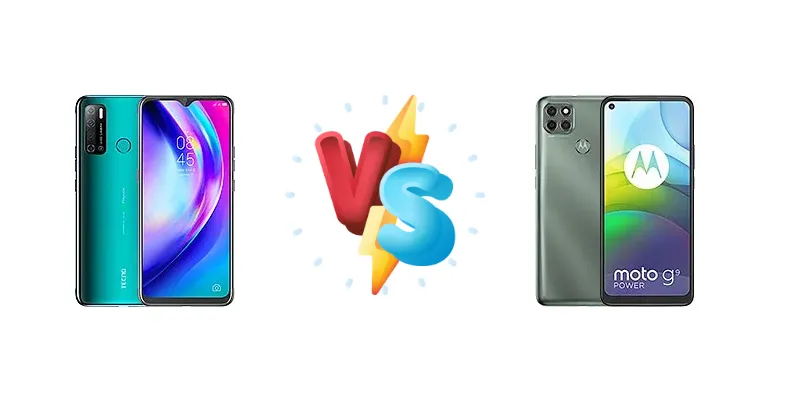
The Tecno Spark Power 2 and Motorola Moto G9 Power represent compelling options in the ultra-budget smartphone segment, both prioritizing extended battery life. However, they take different approaches to achieving this, with Motorola leveraging a more modern chipset and Tecno focusing on maximizing capacity. This comparison dissects their strengths and weaknesses to determine which device delivers the best overall experience.
🏆 Quick Verdict
For the average user prioritizing a smoother, more responsive experience, the Motorola Moto G9 Power is the better choice. Its Snapdragon 662 chipset, built on an 11nm process, offers a significant performance advantage over the Tecno’s Helio P22, despite both phones sharing an identical 155-hour endurance rating.
| Network |
|---|
| 2G bands | GSM 850 / 900 / 1800 / 1900 | GSM 850 / 900 / 1800 / 1900 |
| 3G bands | HSDPA 850 / 900 / 2100 | HSDPA 850 / 900 / 1700(AWS) / 1900 / 2100 |
| 4G bands | 1, 3, 5, 7, 8, 20, 38, 40, 41 | 1, 2, 3, 4, 5, 7, 8, 18, 19, 20, 26, 28, 38, 40, 41 - Europe, APEM |
| Speed | HSPA 42.2/5.76 Mbps, LTE Cat4 150/50 Mbps | HSPA, LTE |
| Technology | GSM / HSPA / LTE | GSM / HSPA / LTE |
| | - | 1, 2, 3, 4, 5, 7, 28, 66 - LATAM |
| Launch |
|---|
| Announced | 2020, June 17. Released 2020, June 23 | 2020, November 05. Released 2020, December 05 |
| Status | Discontinued | Discontinued |
| Body |
|---|
| Build | Glass front, plastic back, plastic frame | Glass front (Gorilla Glass 2), plastic back, plastic frame |
| Dimensions | 174.9 x 79.6 x 9.2 mm (6.89 x 3.13 x 0.36 in) | 172.1 x 76.8 x 9.7 mm (6.78 x 3.02 x 0.38 in) |
| SIM | Nano-SIM + Nano-SIM | · Nano-SIM· Nano-SIM + Nano-SIM |
| Weight | 220 g (7.76 oz) | 221 g (7.80 oz) |
| | - | Water-repellent coating |
| Display |
|---|
| Protection | - | Corning Gorilla Glass 2 |
| Resolution | 720 x 1640 pixels (~256 ppi density) | 720 x 1640 pixels (~263 ppi density) |
| Size | 7.0 inches, 116.4 cm2 (~83.6% screen-to-body ratio) | 6.8 inches, 109.8 cm2 (~83.1% screen-to-body ratio) |
| Type | IPS LCD, 480 nits (typ) | IPS LCD |
| Platform |
|---|
| CPU | Octa-core 2.0 GHz Cortex-A53 | Octa-core (4x2.0 GHz Kryo 260 Gold & 4x1.8 GHz Kryo 260 Silver) |
| Chipset | Mediatek MT6762 Helio P22 (12 nm) | Qualcomm SM6115 Snapdragon 662 (11 nm) |
| GPU | PowerVR GE8320 | Adreno 610 |
| OS | Android 10, HIOS 6.1 | Android 10, upgradable to Android 11 |
| Memory |
|---|
| Card slot | microSDXC (dedicated slot) | microSDXC (uses shared SIM slot) |
| Internal | 64GB 4GB RAM | 64GB 4GB RAM, 128GB 4GB RAM |
| | eMMC 5.1 | - |
| Main Camera |
|---|
| Features | Quad-LED flash, panorama, HDR | LED flash, HDR, panorama |
| Quad | 16 MP, f/1.8, 27mm (wide), AF
5 MP, 115˚ (ultrawide)
2 MP (macro)
Auxiliary lens | - |
| Single | - | 8 MP, f/2.6, 1/3", AF |
| Triple | - | 64 MP, f/1.8, 26mm (wide), 1/1.97", 0.7µm, PDAF
2 MP (macro), AF
Auxiliary lens |
| Video | 1080p@30fps | 1080p@30/60fps |
| Selfie camera |
|---|
| Features | Dual-LED flash, HDR | HDR |
| Single | 16 MP, f/2.0, 27mm (wide) | 16 MP, f/2.2, 1.0µm |
| Video | 1080p@30fps | 1080p@30fps |
| Sound |
|---|
| 3.5mm jack | Yes | Yes |
| 35mm jack | Yes | Yes |
| Loudspeaker | Yes, with stereo speakers | Yes |
| Comms |
|---|
| Bluetooth | 5.0, A2DP, LE | 5.0, A2DP, LE |
| NFC | No | Yes (market/region dependent) |
| Positioning | GPS, GLONASS, GALILEO, BDS | GPS, GLONASS, GALILEO |
| Radio | FM radio | FM radio |
| USB | microUSB 2.0, OTG | USB Type-C 2.0 |
| WLAN | Wi-Fi 802.11 b/g/n/ac | Wi-Fi 802.11 a/b/g/n/ac, dual-band, Wi-Fi Direct |
| Features |
|---|
| Sensors | Fingerprint (rear-mounted), accelerometer, proximity | Fingerprint (rear-mounted), accelerometer, gyro, proximity |
| Battery |
|---|
| Charging | 18W wired, 50% in 60 min | 20W wired |
| Stand-by | - | Up to 590 h (2G) / Up to 790 h (3G) |
| Talk time | - | Up to 21 h 40 min (2G) / Up to 11 h 40 min (3G) |
| Type | 6000 mAh | Li-Po 6000 mAh |
| Misc |
|---|
| Colors | Ice Jadeite, Misty Grey, Fascinating Purple | Electric Violet, Metallic Sage |
| Models | LC8 | XT2091-3, XT2091-4 |
| Price | About 120 EUR | About 260 EUR |
| SAR | 0.85 W/kg (head) 0.80 W/kg (body) | 0.55 W/kg (head) 1.49 W/kg (body) |
| SAR EU | - | 0.21 W/kg (head) |
| Pricing |
|---|
| 128GB 4GB RAM | - | $ 149.99 |
| 64GB 4GB RAM | - | $ 485.00 |
| Tests |
|---|
| Audio quality | - |
Noise -90.3dB / Crosstalk -92.6dB |
| Battery life | - |
Endurance rating 155h
|
| Camera | - |
Photo / Video |
| Display | - |
Contrast ratio: 1680:1 (nominal) |
| Loudspeaker | - |
-28.6 LUFS (Average)
|
| Performance | - |
AnTuTu: 182875 (v8)
GeekBench: 1374 (v5.1)
GFXBench: 13fps (ES 3.1 onscreen) |
Tecno Spark Power 2
- Potentially longer battery life in extremely light usage scenarios.
- May be available at a slightly lower price point.
- Large battery capacity for extended use.
- Significantly weaker processor performance.
- Less responsive user experience.
- Lower brightness display.
Motorola Moto G9 Power
- Faster and more efficient Snapdragon 662 processor.
- Brighter and more visible display.
- Faster 20W charging.
- Smoother multitasking and app loading.
- May be slightly more expensive.
- Battery life is comparable, not significantly better.
Display Comparison
The Motorola Moto G9 Power boasts a noticeably brighter display, peaking at 521 nits, compared to the Tecno Spark Power 2 (brightness unspecified). Both share a 1680:1 contrast ratio, suggesting similar color reproduction capabilities. However, the higher brightness of the Moto G9 Power translates to better outdoor visibility, a crucial advantage for users frequently exposed to sunlight. While both displays are likely LCD panels given the price point, the Moto G9 Power’s superior brightness provides a more comfortable viewing experience in various lighting conditions.
Camera Comparison
Both devices list 'Photo / Video' capabilities, but lack specific details. Given the price bracket, image quality will likely be similar, relying heavily on software processing. The absence of detailed sensor information suggests neither phone will excel in low-light photography. Focusing on the chipset, the Snapdragon 662 in the Moto G9 Power benefits from Qualcomm’s image signal processor (ISP), potentially offering slightly better image processing and video stabilization compared to the Helio P22’s ISP. The lack of information on lens apertures and sensor sizes makes a definitive comparison impossible.
Performance
The core difference lies in the chipsets. The Motorola Moto G9 Power’s Qualcomm Snapdragon 662 (11nm) is a significant upgrade over the Tecno Spark Power 2’s MediaTek Helio P22 (12nm). The Snapdragon 662 utilizes a Kryo CPU architecture with a mix of performance (Gold) and efficiency (Silver) cores, offering a more balanced and responsive experience. The Helio P22, while an octa-core processor, relies solely on Cortex-A53 cores, which are less efficient and deliver lower peak performance. This translates to faster app loading times, smoother multitasking, and better gaming performance on the Moto G9 Power.
Battery Life
Both the Tecno Spark Power 2 and Motorola Moto G9 Power achieve an impressive endurance rating of 155 hours, indicating comparable battery life under similar usage scenarios. However, the charging speeds differ. The Moto G9 Power supports 20W wired charging, allowing for a faster top-up compared to the Tecno Spark Power 2’s 18W charging. While both phones prioritize longevity, the Moto G9 Power’s faster charging mitigates the impact of draining the battery, offering greater convenience for users on the go. The Tecno advertises 50% charge in 60 minutes, while the Moto G9 Power's charging time is not specified but is expected to be similar or faster.
Buying Guide
Buy the Tecno Spark Power 2 if your absolute priority is maximizing screen-on time and you primarily use your phone for basic tasks like calls, messaging, and light social media. Buy the Motorola Moto G9 Power if you value a more fluid user experience, occasionally play mobile games, or appreciate a brighter, more visible display, even if it means slightly less extreme battery longevity.
Frequently Asked Questions
❓ Does the Helio P22 chipset struggle with modern mobile games?
Yes, the MediaTek Helio P22 is a relatively low-end chipset and will likely struggle with graphically demanding games. Expect low frame rates and the need to lower graphics settings significantly, even for less intensive titles. The Motorola Moto G9 Power’s Snapdragon 662 offers a much more playable gaming experience.
❓ How does the 20W charging on the Moto G9 Power compare to the 18W charging on the Tecno Spark Power 2 in real-world use?
While the difference is only 2W, the Snapdragon 662's power efficiency allows the Moto G9 Power to maintain faster charging speeds for a longer duration. Expect a slightly quicker top-up time with the Moto G9 Power, potentially shaving off 10-15 minutes for a full charge.
❓ Is the camera quality significantly different between these two phones?
Given the lack of detailed camera specifications, the difference in camera quality is likely to be minimal. Both phones will likely produce acceptable photos in good lighting conditions, but struggle in low-light scenarios. The Moto G9 Power's Snapdragon 662 may offer slightly better image processing, but don't expect flagship-level results from either device.