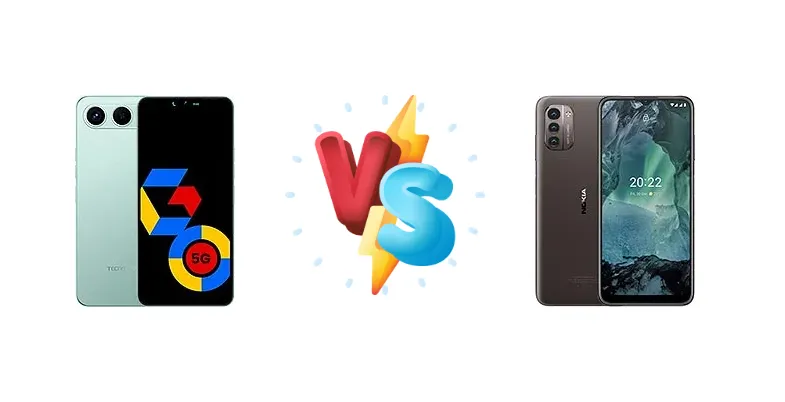
The sub-$150 smartphone market is fiercely competitive. The Tecno Spark Go and Nokia G21 both aim to deliver essential smartphone functionality at an accessible price point, but they take different approaches. The Spark Go prioritizes processing power with a newer Mediatek Dimensity chipset, while the G21 focuses on longevity and a measured user experience, boasting a respectable endurance rating. This comparison will dissect their key differences to determine which device offers the best value.
🏆 Quick Verdict
For users prioritizing responsiveness and app performance, the Tecno Spark Go is the clear winner. Its Mediatek Dimensity 6400 chipset offers a significant performance advantage over the Nokia G21’s Unisoc T606. However, the Nokia G21’s endurance rating and PD3.0 charging provide a more reliable and potentially longer-lasting experience for those who value battery life above all else.
| Network |
|---|
| 2G bands | GSM 850 / 900 / 1800 / 1900 | GSM 850 / 900 / 1800 / 1900 |
| 3G bands | HSDPA 900 / 2100 | HSDPA 850 / 900 / 2100 - International |
| 4G bands | LTE | 1, 3, 5, 7, 8, 20, 28, 38, 40, 41 - International |
| 5G bands | SA/NSA | - |
| Speed | HSPA, LTE, 5G | HSPA 42.2/5.76 Mbps, LTE Cat4 150/50 Mbps |
| Technology | GSM / HSPA / LTE / 5G | GSM / HSPA / LTE |
| | - | 1, 2, 3, 4, 5, 7, 8, 12, 17, 28, 40, 66 - LATAM |
| Launch |
|---|
| Announced | 2025, August 14 | 2022, February 14 |
| Status | Available. Released 2025, August 21 | Available. Released 2022, February 15 |
| Body |
|---|
| Build | Glass front, plastic back, plastic frame | Glass front, plastic frame, plastic back |
| Dimensions | 167.7 x 77.9 x 8 mm (6.60 x 3.07 x 0.31 in) | 164.6 x 75.9 x 8.5 mm (6.48 x 2.99 x 0.33 in) |
| SIM | Nano-SIM + Nano-SIM | · Nano-SIM· Nano-SIM + Nano-SIM |
| Weight | 194 g (6.84 oz) | 190 g (6.70 oz) |
| Display |
|---|
| Resolution | 720 x 1600 pixels, 20:9 ratio (~260 ppi density) | 720 x 1600 pixels, 20:9 ratio (~270 ppi density) |
| Size | 6.75 inches, 110.0 cm2 (~84.2% screen-to-body ratio) | 6.5 inches, 102.0 cm2 (~81.6% screen-to-body ratio) |
| Type | IPS LCD, 120Hz | IPS LCD, 90Hz, 400 nits (typ) |
| Platform |
|---|
| CPU | Octa-core (2x2.5 GHz Cortex-A76 & 6x2.0 GHz Cortex-A55) | Octa-core (2x1.6 GHz Cortex-A75 & 6x1.6 GHz Cortex-A55) |
| Chipset | Mediatek Dimensity 6400 (6 nm) | Unisoc T606 (12 nm) |
| GPU | Mali-G57 MC2 | Mali-G57 MP1 |
| OS | Android 15, HIOS 15 | Android 11, upgradable to Android 13 |
| Memory |
|---|
| Card slot | microSDXC (dedicated slot) | microSDXC (dedicated slot) |
| Internal | 128GB 4GB RAM, 256GB 8GB RAM | 64GB 3GB RAM, 64GB 4GB RAM, 128GB 4GB RAM, 128GB 6GB RAM |
| | eMMC 5.1 | eMMC 5.1 |
| Main Camera |
|---|
| Features | Dual-LED flash | LED flash, HDR, panorama |
| Single | 50 MP | 8 MP, f/2.0, (wide) |
| Triple | - | 50 MP, f/1.8, 28mm (wide), 1/2.76", 0.64µm, PDAF
2 MP (macro)
Auxiliary lens |
| Video | 1440p@30fps, 1080p@30fps | 1080p@30fps |
| Selfie camera |
|---|
| Features | LED flash | - |
| Single | 5 MP | 8 MP, f/2.0, (wide) |
| Video | Yes | 1080p@30fps |
| Sound |
|---|
| 3.5mm jack | Yes | Yes |
| 35mm jack | Yes | Yes |
| Loudspeaker | Yes | Yes |
| Comms |
|---|
| Bluetooth | 5.4, A2DP, LE | 5.0, A2DP, LE |
| Infrared port | Yes | - |
| NFC | Yes (market/region dependent) | Yes (market/region dependent) |
| Positioning | GPS | GPS, GLONASS, GALILEO |
| Radio | FM radio | FM radio, RDS |
| USB | USB Type-C, OTG | USB Type-C 2.0, OTG |
| WLAN | Wi-Fi 802.11 a/b/g/n/ac, dual-band | Wi-Fi 802.11 a/b/g/n/ac, dual-band, Wi-Fi Direct |
| Features |
|---|
| Sensors | Fingerprint (side-mounted), accelerometer, proximity, compass | Fingerprint (side-mounted), accelerometer, proximity |
| Battery |
|---|
| Charging | 18W wired | 18W wired, PD3.0 |
| Type | Li-Po 6000 mAh | Li-Po 5050 mAh |
| Misc |
|---|
| Colors | Sky Blue, Ink Black, Turquoise Green | Nordic Blue, Dusk |
| Models | KM8 | TA-1418, TA-1477, TA-1415, TA-1405, TA-1404, TA-1412 |
| Price | About 100 EUR | About 90 EUR |
| SAR | - | 1.00 W/kg (head) 1.10 W/kg (body) |
| SAR EU | - | 0.34 W/kg (head) 1.05 W/kg (body) |
| Tests |
|---|
| Battery life | - |
Endurance rating 126h
|
| Camera | - |
Photo / Video |
| Display | - |
Contrast ratio: 1631:1 (nominal) |
| Loudspeaker | - |
-30.7 LUFS (Below average)
|
| Performance | - |
AnTuTu: 171299 (v9)
GeekBench: 1193 (v5.1)
GFXBench: 8.9fps (ES 3.1 onscreen) |
Tecno Spark Go
- Significantly faster processor for smoother performance
- More efficient 6nm chipset for better thermal management
- Potentially better gaming experience due to stronger GPU
- Battery life details are unknown, potentially less than the G21
- Display specifications are limited, potentially lower brightness/color accuracy
Nokia G21
- Excellent battery endurance (126h rating)
- PD3.0 charging support for faster charging with compatible adapters
- Measured 500 nits peak brightness for good outdoor visibility
- Slower Unisoc T606 chipset for less demanding users
- 12nm process less efficient than the Spark Go’s 6nm
Display Comparison
Both the Tecno Spark Go and Nokia G21 share a contrast ratio of 1631:1, suggesting similar visual pop. However, the Nokia G21 boasts a measured peak brightness of 500 nits, providing better visibility in direct sunlight. While both displays are likely LCD panels (given the price point), the lack of information on the Spark Go’s panel type leaves its color accuracy and viewing angles uncertain. The G21’s specified brightness gives it a clear advantage for outdoor usability.
Camera Comparison
Both phones feature 'Photo / Video' capabilities, but lack specific details regarding sensor size, aperture, or image processing. Given the price bracket, expectations should be tempered. The absence of any mention of Optical Image Stabilization (OIS) on either device suggests reliance on software stabilization, which is less effective. Without further information, it’s difficult to definitively assess camera quality, but the larger sensor (if present) generally performs better in low-light conditions. The lack of detail makes it difficult to assess the value of any included macro or depth sensors.
Performance
The performance gap between these two devices is substantial. The Tecno Spark Go’s Mediatek Dimensity 6400, built on a 6nm process, significantly outperforms the Nokia G21’s Unisoc T606 (12nm). The Dimensity 6400’s Cortex-A76 cores, clocked at 2.5GHz, offer a considerable uplift in single-core performance compared to the G21’s 1.6GHz Cortex-A75 cores. This translates to faster app loading times, smoother multitasking, and a more responsive user interface. The 6nm process also contributes to better thermal efficiency, potentially reducing throttling during sustained workloads. The Unisoc T606 is adequate for basic tasks, but will struggle with more demanding applications.
Battery Life
The Nokia G21’s standout feature is its endurance rating of 126 hours, indicating excellent battery life. While the capacity isn’t specified, this rating suggests efficient power management. Both phones support 18W wired charging, but the G21 adds PD3.0 support, potentially allowing for faster charging with compatible chargers. The Spark Go’s charging speed is adequate, but the G21’s combination of endurance and PD3.0 gives it an edge for users who prioritize minimizing downtime.
Buying Guide
Buy the Tecno Spark Go if you need a phone for multitasking, light gaming, and generally snappy performance. Its newer chipset will handle demanding apps and switching between tasks with greater ease. Buy the Nokia G21 if you prioritize battery life and a consistent, if less powerful, experience. The G21 is ideal for users who primarily use their phone for calls, texts, and basic social media, and want a device that will reliably last through a full day of moderate use.
Frequently Asked Questions
❓ Is the Unisoc T606 in the Nokia G21 powerful enough for playing games like PUBG Mobile?
The Unisoc T606 can run PUBG Mobile, but likely at lower graphics settings and frame rates to maintain a playable experience. Expect noticeable frame drops and potential lag during intense moments. The Tecno Spark Go’s Dimensity 6400 is significantly better suited for gaming.
❓ Does the Tecno Spark Go support fast charging, and how long does it take to fully charge?
The Tecno Spark Go supports 18W wired charging. However, without knowing the battery capacity, it’s difficult to estimate the exact 0-100% charging time. Expect it to take around 2-3 hours with a compatible 18W charger.
❓ What type of display does the Nokia G21 use, and is the color accuracy good?
The Nokia G21 uses an LCD display. While the contrast ratio is decent, the color accuracy is likely average for this price point. It's not ideal for color-critical work, but sufficient for everyday use.
❓ How does the thermal performance of the Tecno Spark Go compare to the Nokia G21?
The Tecno Spark Go’s Mediatek Dimensity 6400, built on a 6nm process, is more thermally efficient than the Nokia G21’s Unisoc T606 (12nm). This means the Spark Go is less likely to overheat and throttle performance during prolonged use, such as gaming or video recording.