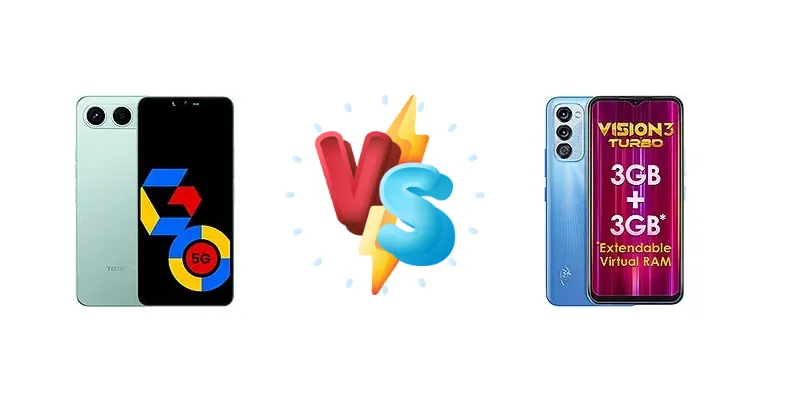
The sub-$150 smartphone market is fiercely competitive. Both the Tecno Spark Go and the itel Vision 3 Turbo aim to deliver essential smartphone functionality at an incredibly accessible price point. However, significant differences in their core hardware – specifically the chipset – dictate vastly different user experiences. This comparison dissects those differences to determine which device offers the best value.
🏆 Quick Verdict
For the average user prioritizing responsiveness and future-proofing, the Tecno Spark Go is the clear winner. Its Mediatek Dimensity 6400 chipset provides a substantial performance advantage over the itel Vision 3 Turbo’s Unisoc SC9863A, making everyday tasks and even light gaming noticeably smoother. While both offer 18W charging, the Spark Go’s superior processing power justifies its slightly higher price.
| Network |
|---|
| 2G bands | GSM 850 / 900 / 1800 / 1900 | GSM 850 / 900 / 1800 / 1900 |
| 3G bands | HSDPA 900 / 2100 | HSDPA 850 / 900 / 2100 |
| 4G bands | LTE | LTE |
| 5G bands | SA/NSA | - |
| Speed | HSPA, LTE, 5G | HSPA, LTE |
| Technology | GSM / HSPA / LTE / 5G | GSM / HSPA / LTE |
| Launch |
|---|
| Announced | 2025, August 14 | 2022 |
| Status | Available. Released 2025, August 21 | Available. Released 2022 |
| Body |
|---|
| Build | Glass front, plastic back, plastic frame | - |
| Dimensions | 167.7 x 77.9 x 8 mm (6.60 x 3.07 x 0.31 in) | - |
| SIM | Nano-SIM + Nano-SIM | Dual SIM |
| Weight | 194 g (6.84 oz) | - |
| Display |
|---|
| Resolution | 720 x 1600 pixels, 20:9 ratio (~260 ppi density) | 720 x 1600 pixels, 20:9 ratio (~266 ppi density) |
| Size | 6.75 inches, 110.0 cm2 (~84.2% screen-to-body ratio) | 6.6 inches, 105.2 cm2 |
| Type | IPS LCD, 120Hz | IPS LCD |
| Platform |
|---|
| CPU | Octa-core (2x2.5 GHz Cortex-A76 & 6x2.0 GHz Cortex-A55) | Octa-core (4x1.6 GHz Cortex-A55 & 4x1.2 GHz Cortex-A55) |
| Chipset | Mediatek Dimensity 6400 (6 nm) | Unisoc SC9863A (28 nm) |
| GPU | Mali-G57 MC2 | IMG8322 |
| OS | Android 15, HIOS 15 | Android 11 (Go edition) |
| Memory |
|---|
| Card slot | microSDXC (dedicated slot) | microSDXC |
| Internal | 128GB 4GB RAM, 256GB 8GB RAM | 64GB 3GB RAM |
| | eMMC 5.1 | - |
| Main Camera |
|---|
| Features | Dual-LED flash | LED flash |
| Single | 50 MP | 8 MP (wide)
Auxiliary lens |
| Video | 1440p@30fps, 1080p@30fps | 1080p@30fps |
| Selfie camera |
|---|
| Features | LED flash | - |
| Single | 5 MP | 5 MP |
| Video | Yes | Yes |
| Sound |
|---|
| 3.5mm jack | Yes | - |
| 35mm jack | Yes | Yes |
| Loudspeaker | Yes | Yes |
| Comms |
|---|
| Bluetooth | 5.4, A2DP, LE | Yes |
| Infrared port | Yes | - |
| NFC | Yes (market/region dependent) | No |
| Positioning | GPS | GPS |
| Radio | FM radio | Unspecified |
| USB | USB Type-C, OTG | microUSB |
| WLAN | Wi-Fi 802.11 a/b/g/n/ac, dual-band | Yes |
| Features |
|---|
| Sensors | Fingerprint (side-mounted), accelerometer, proximity, compass | Fingerprint (rear-mounted), accelerometer |
| Battery |
|---|
| Charging | 18W wired | 18W wired |
| Type | Li-Po 6000 mAh | 5000 mAh |
| Misc |
|---|
| Colors | Sky Blue, Ink Black, Turquoise Green | Blue |
| Models | KM8 | - |
| Price | About 100 EUR | - |
Tecno Spark Go
- Significantly faster processor (Dimensity 6400)
- More efficient 6nm process for better battery life
- Potentially better camera image processing
- Likely slightly higher price than the itel Vision 3 Turbo
- May not include advanced features like NFC
itel Vision 3 Turbo
- Extremely affordable price point
- Acceptable for very basic smartphone tasks
- 18W fast charging
- Slow and inefficient Unisoc SC9863A processor
- Poor performance with multitasking or demanding apps
- Limited future-proofing
Display Comparison
Neither Tecno nor itel provide display specifications beyond resolution. Given the price bracket, both likely utilize LCD panels. However, the chipset difference suggests the Spark Go may be able to drive a higher refresh rate display if one were implemented, due to its more powerful GPU. The older Unisoc SC9863A will struggle with anything beyond a standard 60Hz panel. Bezels are expected to be substantial on both devices, and color accuracy will likely be basic, prioritizing power efficiency over fidelity.
Camera Comparison
Both devices likely feature basic camera setups. Without specific sensor details, it’s safe to assume the Tecno Spark Go benefits from the image signal processor (ISP) within the Dimensity 6400, offering potentially better image processing and noise reduction. The Unisoc SC9863A’s ISP is considerably less capable. While both may include a primary camera and auxiliary sensors (likely a depth or macro lens), image quality will be heavily dependent on software optimization, and users shouldn’t expect flagship-level results. The Spark Go’s processing power gives it an edge in computational photography.
Performance
The performance gap is the defining characteristic of this comparison. The Tecno Spark Go’s Mediatek Dimensity 6400, built on a 6nm process, is significantly more efficient and powerful than the itel Vision 3 Turbo’s Unisoc SC9863A, fabricated on a dated 28nm node. The Dimensity 6400’s octa-core configuration, featuring two high-performance Cortex-A76 cores clocked at 2.5 GHz, provides a substantial boost in CPU performance compared to the Vision 3 Turbo’s four Cortex-A55 cores at 1.6 GHz and another four at 1.2 GHz. This translates to faster app launches, smoother multitasking, and a more responsive user interface. The 6nm process also means better thermal management, reducing the likelihood of throttling during sustained workloads.
Battery Life
Both phones feature 18W wired charging, suggesting similar charging speeds. However, the Dimensity 6400’s superior power efficiency means the Tecno Spark Go is likely to achieve longer battery life despite potentially having a similar capacity battery to the itel Vision 3 Turbo. The 28nm Unisoc chip will consume more power for the same tasks, leading to faster battery drain. While 18W charging isn’t particularly fast, it’s adequate for this price segment.
Buying Guide
Buy the Tecno Spark Go if you need a smartphone capable of handling more than just basic tasks, such as social media and calls. Its Dimensity 6400 processor will provide a smoother experience with multitasking and app loading. Buy the itel Vision 3 Turbo if your primary needs are extremely basic – making calls, sending texts, and light web browsing – and you are prioritizing the absolute lowest possible price point. Be prepared for noticeable slowdowns with even moderate usage.
Frequently Asked Questions
❓ Will the itel Vision 3 Turbo struggle with popular apps like WhatsApp and Facebook?
While the itel Vision 3 Turbo can run these apps, users may experience noticeable lag and slowdowns, especially when multitasking or using the apps for extended periods. The Unisoc SC9863A processor is simply not powerful enough to handle these apps smoothly under heavy load.
❓ Is the Tecno Spark Go a good option for playing mobile games?
The Tecno Spark Go is capable of playing some less demanding mobile games, but it’s not a gaming powerhouse. The Dimensity 6400 can handle titles like PUBG Mobile at lower settings, but expect frame drops and occasional stuttering. More graphically intensive games will likely be unplayable.
❓ Does either phone support VoLTE or VoWiFi for improved call quality?
Support for VoLTE and VoWiFi varies by region and carrier. Neither manufacturer explicitly lists this information. It's best to check with your mobile carrier to confirm compatibility before purchasing either device.
❓ What version of Android do these phones run?
Given the hardware specifications, the itel Vision 3 Turbo likely runs a heavily customized version of Android Go Edition to optimize performance on its limited hardware. The Tecno Spark Go likely runs a standard, though customized, version of Android, benefitting from the Dimensity 6400's processing power.