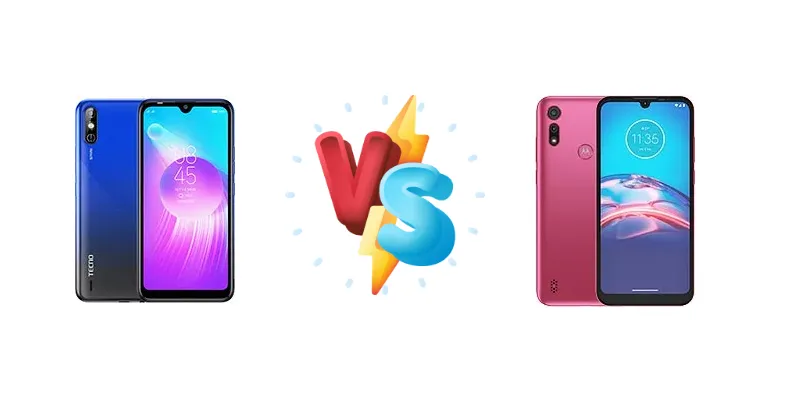
The Tecno Spark Go (2019) and Motorola Moto E6i represent the absolute bottom end of the smartphone market, often serving as first phones or emergency backups. Both aim for extreme affordability, but achieve this through very different hardware choices. This comparison dissects those choices, focusing on how the chipset impacts everyday use and long-term value.
🏆 Quick Verdict
For most users, the Motorola Moto E6i offers a slight edge due to its octa-core processor, providing a smoother experience with multitasking and moderately demanding apps. However, the older 28nm process of the Unisoc chip impacts battery efficiency, making the Tecno Spark Go a viable option for those prioritizing longevity over raw speed.
| Network |
|---|
| 2G bands | GSM 850 / 900 / 1800 / 1900 | GSM 850 / 900 / 1800 / 1900 |
| 3G bands | HSDPA 850 / 900 / 2100 | HSDPA 850 / 900 / 1700(AWS) / 1900 / 2100 |
| 4G bands | 1, 3, 5, 8, 38, 40, 41 | 1, 2, 3, 4, 5, 7, 8, 19, 28, 66 |
| Speed | HSPA 42.2/5.76 Mbps, LTE Cat4 150/50 Mbps | HSPA, LTE |
| Technology | GSM / HSPA / LTE | GSM / HSPA / LTE |
| Launch |
|---|
| Announced | 2019, August. Released 2019, August | 2021, February 11 |
| Status | Discontinued | Available. Released 2021, February 11 |
| Body |
|---|
| Build | - | Glass front, plastic back, plastic frame |
| Dimensions | 156.1 x 75 x 9.2 mm (6.15 x 2.95 x 0.36 in) | 155.6 x 73 x 8.5 mm (6.13 x 2.87 x 0.33 in) |
| SIM | Dual SIM | Nano-SIM + Nano-SIM |
| Weight | 174 g (6.14 oz) | 160 g (5.64 oz) |
| Display |
|---|
| Resolution | 720 x 1560 pixels, 19.5:9 ratio (~282 ppi density) | 720 x 1560 pixels, 19.5:9 ratio (~282 ppi density) |
| Size | 6.1 inches, 91.3 cm2 (~78.0% screen-to-body ratio) | 6.1 inches, 91.3 cm2 (~80.4% screen-to-body ratio) |
| Type | IPS LCD | IPS LCD |
| Platform |
|---|
| CPU | Quad-core 2.0 GHz Cortex-A53 | Octa-core (4x1.6 GHz Cortex-A55 & 4x1.2 GHz Cortex-A55) |
| Chipset | Mediatek MT6761 Helio A22 (12 nm) | Unisoc SC9863A (28 nm) |
| GPU | PowerVR GE8320 | IMG8322 |
| OS | Android 9.0 (Pie), HIOS 5.0 | Android 10 (Go edition) |
| Memory |
|---|
| Card slot | microSDXC (dedicated slot) | microSDXC (uses shared SIM slot) |
| Internal | 16GB 1GB RAM, 16GB 2GB RAM | 32GB 2GB RAM |
| | - | eMMC 5.1 |
| Main Camera |
|---|
| Dual | - | 13 MP, f/2.2, 26mm (wide), 1/3.1", 1.12µm, PDAF
Auxiliary lens |
| Features | Dual-LED flash, HDR, panorama | LED flash, HDR, panorama |
| Single | 8 MP, f/2.0, AF | - |
| Video | 1080p@30fps | 1080p@30fps |
| Selfie camera |
|---|
| Features | LED flash | - |
| Single | 5 MP, f/2.2 | 5 MP, f/2.2, 27mm (wide), 1.12µm |
| Video | - | 1080p@30fps |
| Sound |
|---|
| 3.5mm jack | - | Yes |
| 35mm jack | Yes | Yes |
| Loudspeaker | Yes | Yes |
| Comms |
|---|
| Bluetooth | 5.0, A2DP, LE | 4.2, A2DP, LE |
| NFC | No | No |
| Positioning | GPS | GPS, GLONASS |
| Radio | FM radio | Unspecified |
| USB | microUSB 2.0, OTG | microUSB 2.0, OTG |
| WLAN | Wi-Fi 802.11 b/g/n | Wi-Fi 802.11 b/g/n |
| Features |
|---|
| Sensors | Fingerprint (rear-mounted), accelerometer, proximity | Fingerprint (rear-mounted), accelerometer, proximity |
| Battery |
|---|
| Charging | - | 10W wired |
| Type | Li-Ion 3000 mAh, removable | Li-Ion 3000 mAh |
| Misc |
|---|
| Colors | Nebula Black, Royal Purple | Titanium Gray, Pink |
| Models | KC1 | XT2053-5 |
| Price | - | About 170 EUR |
Tecno Spark Go (2019)
- More power-efficient chipset (12nm)
- Potentially longer battery life
- Likely lower operating temperatures
- Quad-core processor may struggle with multitasking
- Potentially slower performance in multi-threaded apps
Motorola Moto E6i
- Octa-core processor for smoother multitasking
- Potentially better performance in some apps
- 10W charging included
- Less efficient chipset (28nm)
- Shorter battery life expected
- Potential for overheating under load
Display Comparison
Neither device boasts a standout display. Both are expected to feature low-resolution panels (likely 720p+) with standard LCD technology. The lack of specified brightness or color gamut data suggests both will struggle in direct sunlight. Bezels are likely substantial on both, reflecting their budget positioning. Display quality is not a differentiating factor here.
Camera Comparison
Camera performance on both devices will be limited. Details are scarce, but both are likely to feature a primary sensor paired with a basic depth or macro sensor. Given the price point, image quality will be acceptable in good lighting conditions but will suffer significantly in low light. The aperture and sensor size are unknown, but it's safe to assume they are small, limiting light gathering capabilities. Focusing on megapixel counts alone is misleading; image processing plays a larger role, and both devices likely employ basic algorithms.
Performance
The core difference lies in the chipsets. The Tecno Spark Go utilizes the Mediatek MT6761 Helio A22, a quad-core Cortex-A53 processor built on a more efficient 12nm process. The Motorola Moto E6i counters with the Unisoc SC9863A, an octa-core chip featuring a combination of Cortex-A55 cores clocked at 1.6GHz and 1.2GHz. While the E6i has more cores, the A53 architecture in the Helio A22 is generally more capable per core than the A55. However, the Unisoc's octa-core configuration will likely show benefits in multi-threaded tasks. The 28nm process of the Unisoc chip is a significant drawback, leading to higher power consumption and potentially more heat generation compared to the 12nm Helio A22. This impacts sustained performance and battery life.
Battery Life
Battery capacity is not specified for either device, but both likely house batteries in the 3000-4000mAh range. The Motorola Moto E6i includes 10W wired charging, a standard offering in this segment. The Tecno Spark Go’s charging speed is unknown, but likely similar. The Unisoc SC9863A’s less efficient 28nm process will likely result in shorter battery life for the Moto E6i, despite potentially having a similar capacity battery. The Helio A22’s 12nm process gives the Tecno Spark Go an advantage in power efficiency.
Buying Guide
Buy the Tecno Spark Go (2019) if you prioritize maximizing battery life and are primarily using the phone for basic tasks like calls, texts, and light social media. Buy the Motorola Moto E6i if you frequently switch between apps, occasionally play simple games, and value a slightly more responsive user interface, understanding that you may need to charge it more often.
Frequently Asked Questions
❓ Will the Motorola Moto E6i struggle with popular apps like Facebook or WhatsApp?
While the octa-core processor should handle these apps adequately, the Unisoc SC9863A's architecture isn't the most powerful. Expect occasional slowdowns when multitasking or using resource-intensive features within these apps. The Tecno Spark Go might feel slower overall, but potentially more stable due to its more efficient processor.
❓ Is the difference in processor architecture (Cortex-A53 vs A55) significant in real-world use?
Yes, although the difference isn't massive. The Cortex-A53 in the Tecno Spark Go generally offers higher single-core performance, which impacts app launch speeds and responsiveness. The Cortex-A55 in the Moto E6i excels in power efficiency and multi-core tasks. The benefit of the E6i's octa-core configuration will be most noticeable when running multiple apps simultaneously.
❓ Which phone is better for someone who primarily uses their phone for calls and texts?
The Tecno Spark Go (2019) is the better choice. Its more efficient processor will translate to longer battery life, which is crucial for a phone primarily used for communication. The Moto E6i's more powerful processor is overkill for basic tasks and will consume more power.