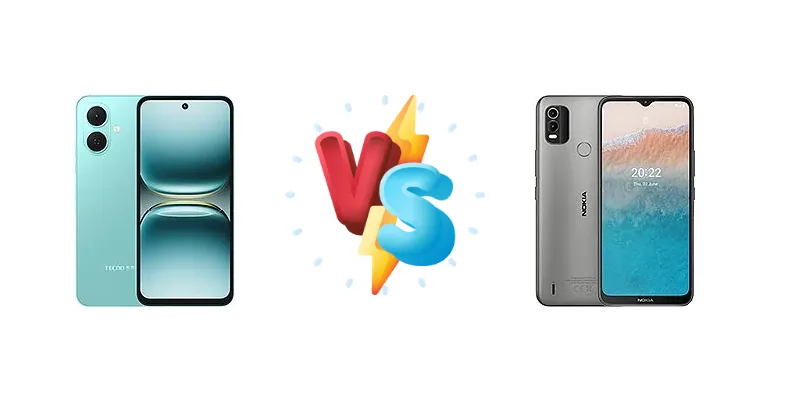
The Tecno Spark Go 2 and Nokia C21 Plus represent the extreme end of the budget smartphone spectrum, targeting first-time smartphone buyers or those needing a reliable secondary device. Both phones run Android Go Edition, but significant differences in their underlying hardware – specifically the chipsets – dictate their real-world performance and suitability for different users. This comparison dissects those differences to help you choose the right device.
🏆 Quick Verdict
For most users, the Tecno Spark Go 2 emerges as the better choice. Its Unisoc T7250 chipset, built on a more modern 12nm process, delivers noticeably faster performance than the Nokia C21 Plus’s older 28nm Unisoc SC9863A. While the Nokia offers a slightly more refined software experience, the performance gap justifies the small price difference.
| Network |
|---|
| 2G bands | GSM 850 / 900 / 1800 / 1900 | GSM 850 / 900 / 1800 / 1900 |
| 3G bands | HSDPA 900 / 2100 | HSDPA 850 / 900 / 2100 |
| 4G bands | LTE | LTE |
| Speed | HSPA, LTE | HSPA 42.2/5.76 Mbps, LTE Cat4 150/50 Mbps |
| Technology | GSM / HSPA / LTE | GSM / HSPA / LTE |
| | - | HSDPA 850 / 900 / 1700(AWS) / 1900 / 2100 |
| Launch |
|---|
| Announced | 2025, June 24 | 2022, February 28 |
| Status | Available. Released 2025, June | Available. Released 2022, April 29 |
| Body |
|---|
| Build | Glass front, plastic back, plastic frame | Glass front, aluminum frame, plastic back |
| Dimensions | 165.6 x 77 x 8.3 mm (6.52 x 3.03 x 0.33 in) | 164.8 x 75.9 x 8.6 mm (6.49 x 2.99 x 0.34 in) |
| SIM | Nano-SIM + Nano-SIM | · Nano-SIM· Nano-SIM + Nano-SIM |
| Weight | - | 178 g or 191 g (6.28 oz) |
| | - | Splash protection |
| Display |
|---|
| Protection | - | Scratch-resistant glass |
| Resolution | 720 x 1600 pixels, 20:9 ratio (~263 ppi density) | 720 x 1600 pixels, 20:9 ratio (~269 ppi density) |
| Size | 6.67 inches, 107.4 cm2 (~84.2% screen-to-body ratio) | 6.52 inches, 102.6 cm2 (~82.1% screen-to-body ratio) |
| Type | IPS LCD, 120Hz | IPS LCD |
| Platform |
|---|
| CPU | Octa-core (2x1.8 GHz Cortex-A75 & 6x1.6 GHz Cortex-A55) | Octa-core (4x1.6 GHz Cortex-A55 & 4x1.2 GHz Cortex-A55) |
| Chipset | Unisoc T7250 (12 nm) | Unisoc SC9863A (28 nm) |
| GPU | Mali-G57 MP1 | IMG8322 |
| OS | Android 15, HIOS 15 | Android 11 (Go edition) |
| Memory |
|---|
| Card slot | microSDXC | microSDXC (dedicated slot) |
| Internal | 64GB 3GB RAM, 64GB 4GB RAM, 128GB 3GB RAM, 128GB 4GB RAM, 256GB 4GB RAM | 32GB 2GB RAM, 32GB 3GB RAM, 64GB 2GB RAM, 64GB 3GB RAM, 64GB 4GB RAM |
| | - | eMMC 5.1 |
| Main Camera |
|---|
| Dual | - | 13 MP, (wide), AF
Auxiliary lens |
| Features | Dual-LED flash, HDR | LED flash, HDR, panorama |
| Single | 13 MP, f/1.8, 27mm (wide), PDAF | 5 MP |
| Video | 1080p@30fps | 1080p@30fps |
| Selfie camera |
|---|
| Features | Dual-LED flash | LED flash |
| Single | 8 MP | 5 MP |
| Video | Yes | 720p |
| Sound |
|---|
| 3.5mm jack | - | Yes |
| 35mm jack | Yes | Yes |
| Loudspeaker | Yes, with dual speakers | Yes |
| Comms |
|---|
| Bluetooth | Yes | 4.2, A2DP |
| Infrared port | Yes | - |
| NFC | No | No |
| Positioning | GPS | GPS |
| Radio | FM radio | FM radio |
| USB | USB Type-C, OTG | microUSB 2.0 |
| WLAN | Yes | Wi-Fi 802.11 b/g/n |
| Features |
|---|
| Sensors | Fingerprint (side-mounted); unspecified sensors | Fingerprint (rear-mounted), accelerometer, proximity |
| Battery |
|---|
| Charging | 15W wired | 10W wired |
| Type | 5000 mAh | Li-Ion 4000/5050 mAh |
| Misc |
|---|
| Colors | Ink Black, Titanium Grey, Veil White, Turquoise Green | Dark Cyan, Warm Gray |
| Models | KM4 | TA-1433, TA-1431, TA-1426, TA-1424 |
| Price | About 80 EUR | About 120 EUR |
| SAR | - | 0.57 W/kg (head) 0.65 W/kg (body) |
| SAR EU | - | 0.40 W/kg (head) 0.99 W/kg (body) |
Tecno Spark Go 2
- Faster processor for smoother performance
- More efficient chipset for better battery life
- Faster 15W charging
- Software experience may be less refined than Nokia
- Camera quality likely similar to Nokia
Nokia C21 Plus
- Clean, stock Android Go Edition experience
- Potentially more durable build quality
- Often includes a larger battery capacity
- Significantly slower processor
- Less efficient chipset
- Slower 10W charging
Display Comparison
Neither device boasts a standout display. Both likely feature LCD panels, typical for this price point. However, details like resolution and brightness are missing. The Nokia C21 Plus’s focus on durability suggests a potentially more robust panel, but the Tecno’s larger screen size (typically found in this series) could offer a more immersive viewing experience. Without specific nit ratings, it’s difficult to assess which offers better outdoor visibility.
Camera Comparison
Both phones likely feature basic camera setups, and detailed sensor information is unavailable. However, given the price bracket, expectations should be tempered. The Nokia C21 Plus often emphasizes image processing for natural colors, while Tecno tends towards more vibrant, saturated images. Without knowing the megapixel counts or aperture values, it’s difficult to declare a clear winner. Any secondary cameras (depth or macro) on either device are likely to be of limited utility.
Performance
The core difference lies in the chipsets. The Tecno Spark Go 2’s Unisoc T7250 (12nm) is a significant upgrade over the Nokia C21 Plus’s Unisoc SC9863A (28nm). The T7250’s architecture – featuring two Cortex-A75 cores alongside six A55 cores – provides a substantial boost in single-core and multi-core performance. This translates to faster app loading times, smoother multitasking, and a more responsive user interface. The older 28nm process of the SC9863A also implies lower power efficiency, potentially impacting battery life despite the Nokia’s slightly larger battery capacity (often seen in this series).
Battery Life
The Nokia C21 Plus often includes a larger battery capacity in its variants, but the Tecno Spark Go 2 compensates with a faster 15W charging speed compared to the Nokia’s 10W. The more efficient Unisoc T7250 chipset in the Tecno also contributes to better battery life. While the Nokia might offer slightly longer screen-on time for very light usage, the Tecno’s faster charging means less time tethered to a wall outlet.
Buying Guide
Buy the Tecno Spark Go 2 if you prioritize responsiveness and the ability to run multiple apps without significant slowdown. It’s ideal for users who occasionally browse social media, stream videos, or play light games. Buy the Nokia C21 Plus if you value a clean, stock Android experience and are primarily focused on basic communication tasks like calls, texts, and WhatsApp – and are willing to accept slower performance.
Frequently Asked Questions
❓ Will the Tecno Spark Go 2 struggle with popular apps like Facebook or WhatsApp?
While the Tecno Spark Go 2 isn't a powerhouse, the Unisoc T7250 chipset is capable of running Facebook and WhatsApp smoothly. You might experience some slowdown with multiple apps open simultaneously, but for typical social media usage, it should be adequate.
❓ Is the Nokia C21 Plus a good choice for someone who primarily makes calls and sends texts?
Yes, the Nokia C21 Plus is well-suited for basic communication tasks. Its clean Android Go Edition software and focus on reliability make it a dependable device for calls, texts, and essential apps like WhatsApp, even if performance isn't its strong suit.
❓ Can either of these phones handle light gaming?
The Tecno Spark Go 2 is the better option for light gaming. The Unisoc T7250’s GPU offers a noticeable advantage over the SC9863A in the Nokia C21 Plus, allowing for playable frame rates in less demanding titles. However, don’t expect to run graphically intensive games smoothly.
❓ How does Android Go Edition affect the user experience on these phones?
Android Go Edition is a lightweight version of Android designed for devices with limited resources. It uses less storage space and data, and features optimized apps. This results in a smoother experience on these budget phones compared to running the full version of Android, but also means some features are simplified.