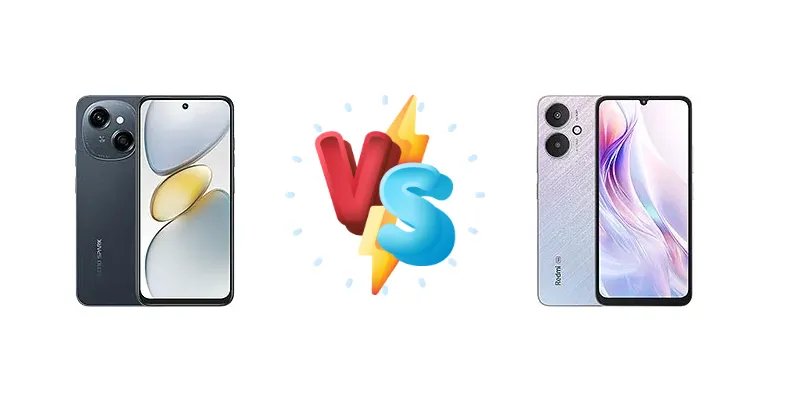
The sub-$150 smartphone market is fiercely competitive, and both the Tecno Spark Go 1S and the Xiaomi Redmi 13C 5G aim to deliver 5G connectivity at an accessible price. However, they take very different approaches to achieving this, with a substantial gap in processing power. This comparison will dissect the key differences to help you determine which device best suits your needs.
🏆 Quick Verdict
For most users, the Xiaomi Redmi 13C 5G is the clear winner. Its Mediatek Dimensity 6100+ chipset provides a significantly smoother and more responsive experience, especially for multitasking and gaming. While the Tecno Spark Go 1S offers a slightly lower entry price, the performance trade-off is too significant for all but the most basic users.
| Network |
|---|
| 2G bands | GSM 850 / 900 / 1800 / 1900 | GSM 850 / 900 / 1800 / 1900 |
| 3G bands | HSDPA 900 / 2100 | HSDPA 800 / 850 / 900 / 1700(AWS) / 1900 / 2100 - International |
| 4G bands | LTE | 1, 2, 3, 4, 5, 7, 8, 12, 13, 17, 18, 19, 20, 26, 28, 32, 38, 40, 41, 66 - International |
| 5G bands | - | 1, 3, 5, 7, 8, 20, 28, 38, 40, 41, 66, 77, 78 SA/NSA - International |
| Speed | HSPA, LTE | HSPA, LTE, 5G |
| Technology | GSM / HSPA / LTE | GSM / HSPA / LTE / 5G |
| Launch |
|---|
| Announced | 2025, January 06 | 2023, December 06 |
| Status | Available. Released 2025, January | Available. Released 2023, December 16 |
| Body |
|---|
| Build | Glass front, plastic back, plastic frame | Glass front (Gorilla Glass 3), plastic frame, plastic back |
| Dimensions | 165.6 x 77 x 8.4 mm (6.52 x 3.03 x 0.33 in) | 168.1 x 77.9 x 8.2 mm (6.62 x 3.07 x 0.32 in) |
| SIM | Nano-SIM + Nano-SIM | Nano-SIM + Nano-SIM |
| Weight | - | 192 g or 195 g (6.77 oz) |
| Display |
|---|
| Protection | - | Corning Gorilla Glass 3 |
| Resolution | 720 x 1600 pixels, 20:9 ratio (~263 ppi density) | 720 x 1600 pixels, 20:9 ratio (~260 ppi density) |
| Size | 6.67 inches, 107.4 cm2 (~84.2% screen-to-body ratio) | 6.74 inches, 109.7 cm2 (~83.8% screen-to-body ratio) |
| Type | IPS LCD, 90Hz | IPS LCD, 90Hz, 450 nits (typ), 600 nits (HBM) |
| Platform |
|---|
| CPU | Octa-core 2.2 GHz Cortex-A53 | Octa-core (2x2.2 GHz Cortex-A76 & 6x2.0 GHz Cortex-A55) |
| Chipset | Mediatek Helio G50 | Mediatek Dimensity 6100+ (6 nm) |
| GPU | PowerVR GE8320 | Mali-G57 MC2 |
| OS | Android 14 (Go edition), HIOS 14 | Android 13, MIUI 14 |
| Memory |
|---|
| Card slot | microSDXC | microSDXC (dedicated slot) |
| Internal | 64GB 3GB RAM | 64GB 4GB RAM, 128GB 4GB RAM, 128GB 6GB RAM, 256GB 8GB RAM |
| Main Camera |
|---|
| Features | Dual-LED flash, HDR | LED flash, HDR |
| Single | 13 MP, f/1.8, 27mm (wide), PDAF | 50 MP, f/1.8, 28mm (wide), 1/2.76", 1.12µm, PDAF
Auxiliary lens |
| Video | 1080p@30fps | 1080p@30fps |
| Selfie camera |
|---|
| Features | - | HDR |
| Single | 8 MP | 5 MP, f/2.2, (wide) |
| Video | Yes | 1080p@30fps |
| Sound |
|---|
| 35mm jack | Yes | Yes |
| Loudspeaker | Yes, with dual speakers | Yes |
| Comms |
|---|
| Bluetooth | Yes | 5.3, A2DP, LE |
| Infrared port | Yes | - |
| NFC | No | Yes (market/region dependent) |
| Positioning | GPS | GPS, GLONASS, GALILEO, BDS |
| Radio | Unspecified | FM radio |
| USB | USB Type-C, OTG | USB Type-C 2.0, OTG |
| WLAN | Yes | Wi-Fi 802.11 a/b/g/n/ac, dual-band |
| Features |
|---|
| Sensors | Fingerprint (side-mounted); unspecified sensors | Fingerprint (side-mounted), accelerometer, compass |
| Battery |
|---|
| Charging | 15W wired | 18W wired, PD |
| Type | 5000 mAh | 5000 mAh |
| Misc |
|---|
| Colors | Startrail Black, Glittery White | Starry Black, Twilight Blue, Starry Silver, Starlight Black, Startrail Green, Startrail Silver |
| Models | KL4h | 23124RN87G, 23124RN87I, 23124RN87C |
| Price | About 70 EUR | $ 198.99 / £ 119.00 / € 116.99 / ₹ 10,895 |
| SAR | - | 1.09 W/kg (head) 1.09 W/kg (body) |
| SAR EU | - | 0.98 W/kg (head) 0.98 W/kg (body) |
Tecno Spark Go 1S
- Potentially lower price point
- Simple and easy-to-use interface
- Acceptable for basic communication tasks
- Significantly weaker processor
- Limited multitasking capabilities
- Poor gaming performance
Xiaomi Redmi 13C 5G
- Much faster and more responsive performance
- 5G connectivity for faster data speeds
- Faster charging with Power Delivery
- May be slightly more expensive
- Potentially less optimized software
- Display quality likely similar to Spark Go 1S
Display Comparison
Neither device boasts a standout display. Both likely utilize LCD panels, a common cost-saving measure in this segment. The Redmi 13C 5G’s display specifications are not provided, but given its price point, it’s unlikely to surpass the Spark Go 1S in quality. The focus here is functionality over fidelity. Expect adequate viewing angles and color reproduction for everyday tasks, but neither will impress enthusiasts.
Camera Comparison
Camera performance is likely to be similar in real-world usage, given the focus on affordability. Both devices will likely feature a primary camera alongside depth and potentially macro sensors. Without specific sensor details, it’s difficult to make a definitive judgment. However, the Redmi 13C 5G’s more powerful processor will likely enable better image processing, potentially resulting in slightly sharper and more detailed photos, especially in challenging lighting conditions. The 2MP macro sensors on both devices are unlikely to deliver significant detail and should be considered a marketing feature rather than a practical tool.
Performance
This is where the Redmi 13C 5G truly shines. The Mediatek Dimensity 6100+ (6nm) is a generational leap over the Tecno’s Helio G50. The Dimensity 6100+ features a more modern CPU architecture – Cortex-A76 cores alongside A55s versus the Spark Go 1S’s all-Cortex-A53 setup. This translates to a noticeable improvement in application launch times, smoother scrolling, and better multitasking. The 6nm process node also contributes to improved power efficiency. While both are octa-core, the architectural differences are critical; the Redmi 13C 5G will handle demanding apps and games with far greater ease.
Battery Life
The Redmi 13C 5G’s 18W charging with Power Delivery (PD) support offers a clear advantage over the Spark Go 1S’s 15W charging. PD allows for more efficient charging and compatibility with a wider range of chargers. While battery capacity isn’t specified for either device, the Dimensity 6100+’s superior power efficiency will likely result in comparable, if not better, battery life on the Redmi 13C 5G despite potentially having a similar capacity. Expect a full charge in around 2-3 hours for the Redmi 13C 5G and slightly longer for the Spark Go 1S.
Buying Guide
Buy the Tecno Spark Go 1S if you primarily need a phone for calls, texts, and very light social media use, and your budget is extremely limited. Buy the Xiaomi Redmi 13C 5G if you want a phone capable of handling more demanding tasks like streaming video, playing mobile games, and running multiple apps simultaneously, and you value future-proofing with 5G connectivity.
Frequently Asked Questions
❓ Will the Dimensity 6100+ in the Redmi 13C 5G get noticeably hot during extended gaming sessions?
The Dimensity 6100+’s 6nm process node is relatively efficient, and while it will generate heat during gaming, it’s unlikely to experience severe throttling. Xiaomi typically implements thermal management solutions in their budget devices, but sustained high-intensity gaming will still lead to some temperature increase.
❓ Is the 5G connectivity on the Redmi 13C 5G actually useful, or is it just a marketing gimmick?
The usefulness of 5G depends on your location and carrier coverage. If you live in an area with robust 5G infrastructure, you’ll experience significantly faster download and upload speeds compared to 4G. However, if 5G coverage is limited, the benefit will be minimal. The Redmi 13C 5G offers future-proofing and the potential for faster speeds as 5G networks expand.
❓ How much storage does the Tecno Spark Go 1S typically come with, and is it expandable?
While not specified, Tecno typically offers their entry-level phones with 32GB or 64GB of internal storage. It almost certainly includes a microSD card slot for storage expansion, a crucial feature given the limited base storage.
❓ Does the Redmi 13C 5G support VoWiFi (Wi-Fi Calling)?
Support for VoWiFi varies by carrier and region. It's best to check with your mobile carrier to confirm if the Redmi 13C 5G is compatible with their VoWiFi service. Xiaomi phones generally support VoWiFi, but it's not guaranteed.