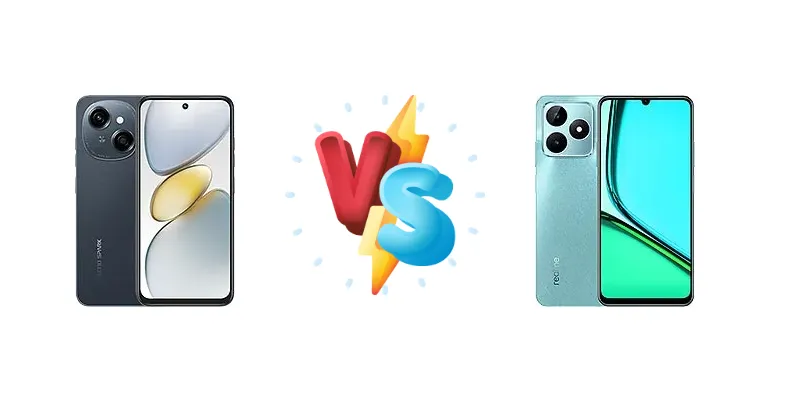
The sub-$150 smartphone market is fiercely competitive. The Tecno Spark Go 1S and Realme C51s both aim to deliver essential smartphone functionality at an accessible price. However, they take different approaches to achieving this, with the Realme prioritizing faster charging and a more modern chipset, while the Tecno focuses on a more established, if less powerful, platform. This comparison will dissect their key differences to determine which device offers the best value.
🏆 Quick Verdict
For most users, the Realme C51s emerges as the better choice. Its Unisoc Tiger T612 chipset offers a noticeable performance uplift over the Tecno Spark Go 1S’s Helio G50, and the 33W fast charging is a game-changer in this price bracket, significantly reducing downtime. While the Tecno remains a viable option, the Realme’s advantages are compelling.
| Network |
|---|
| 2G bands | GSM 850 / 900 / 1800 / 1900 | GSM 850 / 900 / 1800 / 1900 |
| 3G bands | HSDPA 900 / 2100 | HSDPA 900 / 2100 |
| 4G bands | LTE | 1, 3, 5, 8, 38, 40 |
| Speed | HSPA, LTE | HSPA, LTE |
| Technology | GSM / HSPA / LTE | GSM / HSPA / LTE |
| Launch |
|---|
| Announced | 2025, January 06 | 2024, March 15 |
| Status | Available. Released 2025, January | Available. Released 2024, March 15 |
| Body |
|---|
| Build | Glass front, plastic back, plastic frame | Glass front, plastic frame, plastic back |
| Dimensions | 165.6 x 77 x 8.4 mm (6.52 x 3.03 x 0.33 in) | 167.2 x 76.7 x 7.5 mm (6.58 x 3.02 x 0.30 in) |
| SIM | Nano-SIM + Nano-SIM | Nano-SIM + Nano-SIM |
| Weight | - | 182 g (6.42 oz) |
| Display |
|---|
| Resolution | 720 x 1600 pixels, 20:9 ratio (~263 ppi density) | 720 x 1600 pixels, 20:9 ratio (~260 ppi density) |
| Size | 6.67 inches, 107.4 cm2 (~84.2% screen-to-body ratio) | 6.74 inches, 109.7 cm2 (~85.5% screen-to-body ratio) |
| Type | IPS LCD, 90Hz | IPS LCD, 90Hz, 560 nits (peak) |
| Platform |
|---|
| CPU | Octa-core 2.2 GHz Cortex-A53 | Octa-core (2x1.8 GHz Cortex-A75 & 6x1.8 GHz Cortex-A55) |
| Chipset | Mediatek Helio G50 | Unisoc Tiger T612 (12 nm) |
| GPU | PowerVR GE8320 | Mali-G57 |
| OS | Android 14 (Go edition), HIOS 14 | Android 13, Realme UI |
| Memory |
|---|
| Card slot | microSDXC | microSDXC (dedicated slot) |
| Internal | 64GB 3GB RAM | 128GB 6GB RAM |
| Main Camera |
|---|
| Features | Dual-LED flash, HDR | LED flash, HDR, panorama |
| Single | 13 MP, f/1.8, 27mm (wide), PDAF | 50 MP, f/1.8, 27mm (wide), 1/2.76", 0.64µm, PDAF
Auxiliary lens |
| Video | 1080p@30fps | 1080p@30fps |
| Selfie camera |
|---|
| Features | - | HDR |
| Single | 8 MP | 5 MP, f/2.2, 28mm (wide), 1/5.0", 1.12µm |
| Video | Yes | 720p@30fps |
| Sound |
|---|
| 35mm jack | Yes | Yes |
| Loudspeaker | Yes, with dual speakers | Yes |
| Comms |
|---|
| Bluetooth | Yes | 5.0, A2DP, LE |
| Infrared port | Yes | - |
| NFC | No | Yes, 360˚ (market/region dependent) |
| Positioning | GPS | GPS, GLONASS, GALILEO |
| Radio | Unspecified | Unspecified |
| USB | USB Type-C, OTG | USB Type-C |
| WLAN | Yes | Wi-Fi 802.11 a/b/g/n/ac, dual-band |
| Features |
|---|
| Sensors | Fingerprint (side-mounted); unspecified sensors | Fingerprint (side-mounted), accelerometer, gyro, proximity, compass |
| Battery |
|---|
| Charging | 15W wired | 33W wired, 0-50% in 28 min |
| Type | 5000 mAh | 5000 mAh |
| Misc |
|---|
| Colors | Startrail Black, Glittery White | Shiny Green, Mighty Black |
| Models | KL4h | RMX3765 |
| Price | About 70 EUR | About 100 EUR |
Tecno Spark Go 1S
- Familiar Mediatek Helio G50 platform
- Potentially lower price point
- Reliable for basic smartphone tasks
- Outdated chipset architecture
- Slow 15W charging
- Limited performance for demanding apps
Realme C51s
- Faster Unisoc Tiger T612 chipset
- 33W fast charging (0-50% in 28 min)
- Improved power efficiency
- Unisoc chipset may have less software optimization
- Potentially slightly higher price
Display Comparison
Neither device boasts a standout display. Both are likely to feature 720p+ resolution panels, typical for this segment. However, the Realme C51s benefits from the newer Unisoc chipset potentially offering better display processing capabilities. While specific brightness nits aren't provided, the Realme's newer architecture suggests a slight edge in color reproduction and viewing angles. Bezels are expected to be similar on both, prioritizing cost-effectiveness over premium aesthetics.
Camera Comparison
Without detailed camera specs, a direct comparison is difficult. However, both phones likely feature a primary camera paired with auxiliary lenses of limited utility (often 2MP macro or depth sensors). The Realme C51s’s newer image signal processor (ISP) within the Unisoc T612 chipset will likely offer improved image processing, resulting in better dynamic range and noise reduction compared to the Helio G50’s ISP. The aperture of the main sensor will be a key factor, but without that data, we can only assume the Realme has a slight advantage due to its more modern processing capabilities.
Performance
The core difference lies in the chipsets. The Realme C51s’s Unisoc Tiger T612 (12nm) utilizes a more modern architecture with 2x Cortex-A75 cores alongside 6x Cortex-A55 cores, offering a significant advantage over the Tecno Spark Go 1S’s Mediatek Helio G50 (28nm). The Helio G50 relies on older Cortex-A53 cores across all eight threads. This translates to faster app loading times and smoother multitasking on the Realme. The Unisoc’s 12nm process also contributes to better power efficiency. While both likely pair with similar RAM configurations, the Realme’s chipset will handle RAM more efficiently, reducing lag and improving overall responsiveness.
Battery Life
The Realme C51s’s 33W wired charging is a clear win. Achieving 0-50% charge in just 28 minutes is a substantial advantage over the Tecno Spark Go 1S’s 15W charging. While battery capacity isn’t specified, the faster charging speed mitigates any potential disadvantage if the Realme has a slightly smaller battery. The Unisoc T612’s improved power efficiency also contributes to longer battery life during typical usage, offsetting any capacity differences.
Buying Guide
Buy the Tecno Spark Go 1S if you prioritize a familiar Mediatek chipset and are less concerned with rapid charging or demanding applications. It’s a solid choice for basic communication and light social media use. Buy the Realme C51s if you value faster performance for multitasking and gaming, and if the convenience of 33W fast charging is a high priority. It’s the better option for users who want a more responsive and versatile experience.
Frequently Asked Questions
❓ Is the Unisoc Tiger T612 in the Realme C51s known to overheat during prolonged gaming sessions?
While Unisoc chipsets haven't historically had the same thermal management reputation as Qualcomm or MediaTek, the Tiger T612 is a relatively efficient chip. Given the Realme C51s's target market and likely plastic construction, thermal throttling is possible during extended gaming, but it shouldn't be a major issue for casual gaming. The 12nm process helps mitigate heat compared to the Tecno's 28nm Helio G50.
❓ How does the Helio G50 in the Tecno Spark Go 1S handle multitasking compared to the Realme C51s?
The Helio G50’s older Cortex-A53 cores struggle with multitasking compared to the Realme C51s’s Unisoc Tiger T612, which features more powerful Cortex-A75 cores. Expect more app reloading and noticeable lag when switching between applications on the Tecno, especially with multiple apps open simultaneously. The Realme will offer a smoother, more responsive multitasking experience.
❓ Will the 33W charging on the Realme C51s work with any USB-PD charger, or is it a proprietary standard?
The Realme C51s utilizes a proprietary 33W charging standard. While it *may* charge with some USB-PD chargers, it won't achieve the full 33W speed unless you use the included charger or a compatible Realme/OPPO SuperVOOC charger. Using a standard USB-PD charger will still charge the device, but at a slower rate.