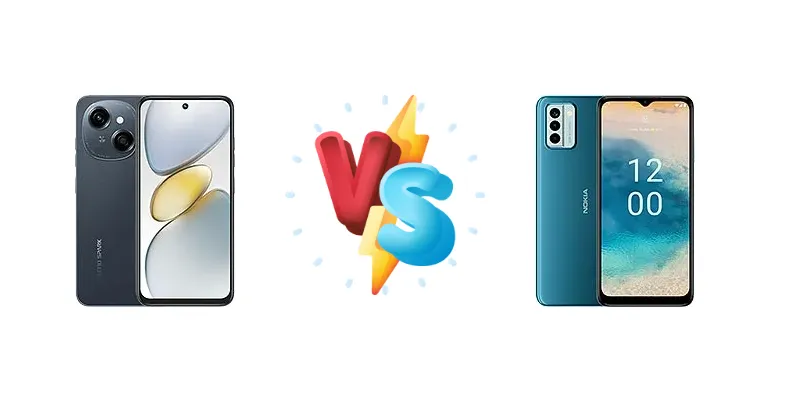
The Tecno Spark Go 1S and Nokia G22 represent two distinct approaches to the ultra-budget smartphone market. The Spark Go 1S prioritizes a lower initial cost, while the Nokia G22 emphasizes longevity and ease of repair. This comparison dissects their core components to determine which device delivers the best value for your money.
🏆 Quick Verdict
For the average user prioritizing long-term usability and repair options, the Nokia G22 is the better choice. Its Unisoc T606 chipset, coupled with 20W PD3.0 charging, offers a more future-proof experience, despite the Tecno Spark Go 1S's slightly lower price point.
| Network |
|---|
| 2G bands | GSM 850 / 900 / 1800 / 1900 | GSM 850 / 900 / 1800 / 1900 |
| 3G bands | HSDPA 900 / 2100 | HSDPA 850 / 900 / 2100 |
| 4G bands | LTE | 1, 3, 5, 7, 8, 20, 28, 38, 39, 40, 41 |
| Speed | HSPA, LTE | HSPA, LTE |
| Technology | GSM / HSPA / LTE | GSM / HSPA / LTE |
| Launch |
|---|
| Announced | 2025, January 06 | 2023, February 25 |
| Status | Available. Released 2025, January | Available. Released 2023, February 25 |
| Body |
|---|
| Build | Glass front, plastic back, plastic frame | Glass front (Gorilla Glass 3), plastic frame, plastic back |
| Dimensions | 165.6 x 77 x 8.4 mm (6.52 x 3.03 x 0.33 in) | 165 x 76.2 x 8.5 mm (6.50 x 3.00 x 0.33 in) |
| SIM | Nano-SIM + Nano-SIM | Nano-SIM + Nano-SIM |
| Weight | - | 196.2 g (6.91 oz) |
| | - | Dust and splash resistant
QuickFix user-reparable design |
| Display |
|---|
| Protection | - | Corning Gorilla Glass 3 |
| Resolution | 720 x 1600 pixels, 20:9 ratio (~263 ppi density) | 720 x 1600 pixels, 20:9 ratio (~270 ppi density) |
| Size | 6.67 inches, 107.4 cm2 (~84.2% screen-to-body ratio) | 6.5 inches, 102.0 cm2 (~81.1% screen-to-body ratio) |
| Type | IPS LCD, 90Hz | IPS LCD, 90Hz, 500 nits (typ) |
| Platform |
|---|
| CPU | Octa-core 2.2 GHz Cortex-A53 | Octa-core (2x1.6 GHz Cortex-A75 & 6x1.6 GHz Cortex-A55) |
| Chipset | Mediatek Helio G50 | Unisoc T606 (12 nm) |
| GPU | PowerVR GE8320 | Mali-G57 MP1 |
| OS | Android 14 (Go edition), HIOS 14 | Android 12 |
| Memory |
|---|
| Card slot | microSDXC | microSDXC (uses shared SIM slot) |
| Internal | 64GB 3GB RAM | 64GB 4GB RAM, 128GB 4GB RAM, 256GB 6GB RAM |
| | - | UFS 2.2 |
| Main Camera |
|---|
| Features | Dual-LED flash, HDR | LED flash, HDR, panorama |
| Single | 13 MP, f/1.8, 27mm (wide), PDAF | - |
| Triple | - | 50 MP, f/1.8, (wide), 1/2.76", 0.64µm, PDAF
2 MP (macro)
Auxiliary lens |
| Video | 1080p@30fps | 1080p@30fps |
| Selfie camera |
|---|
| Single | 8 MP | 8 MP, f/2.0, (wide) |
| Video | Yes | 1080p@30fps |
| Sound |
|---|
| 3.5mm jack | - | Yes |
| 35mm jack | Yes | Yes |
| Loudspeaker | Yes, with dual speakers | Yes |
| Comms |
|---|
| Bluetooth | Yes | 5.0, A2DP, LE |
| Infrared port | Yes | - |
| NFC | No | Yes (market/region dependent) |
| Positioning | GPS | GPS, GLONASS, GALILEO |
| Radio | Unspecified | FM radio, RDS |
| USB | USB Type-C, OTG | USB Type-C 2.0, OTG |
| WLAN | Yes | Wi-Fi 802.11 a/b/g/n/ac, dual-band |
| Features |
|---|
| Sensors | Fingerprint (side-mounted); unspecified sensors | Fingerprint (side-mounted), accelerometer, proximity |
| Battery |
|---|
| Charging | 15W wired | 20W wired, PD3.0 |
| Type | 5000 mAh | Li-Po 5050 mAh |
| Misc |
|---|
| Colors | Startrail Black, Glittery White | Lagoon Blue, Meteor Gray, So Peach |
| Models | KL4h | - |
| Price | About 70 EUR | About 120 EUR |
Tecno Spark Go 1S
- Lower initial purchase price
- Widely available
- Simple and straightforward software experience
- Older chipset architecture
- Slower charging speed
- Potentially limited software updates
Nokia G22
- More modern chipset with better efficiency
- Faster 20W PD3.0 charging
- Emphasis on repairability and longevity
- Slightly higher price point
- Unisoc chipsets may have less software support (though Nokia aims to mitigate this)
- May not be as readily available in all markets
Display Comparison
Neither device boasts a standout display. Given the price bracket, we can assume both utilize LCD panels, likely with 720p+ resolution. The absence of specific display specs necessitates focusing on performance. The Nokia G22's Unisoc T606, fabricated on a 12nm process, suggests potentially better power efficiency in driving the display compared to the Helio G50's older architecture.
Camera Comparison
Without detailed camera specs, a direct comparison is difficult. However, both phones likely feature a primary camera paired with auxiliary lenses of limited utility. The focus should be on image processing capabilities, which are tied to the chipset. The Unisoc T606's ISP (Image Signal Processor) is likely more advanced than the Helio G50's, potentially resulting in better dynamic range and noise reduction in photos. We can expect similar performance in good lighting conditions, but the Nokia G22 should have an edge in challenging scenarios.
Performance
The core difference lies in the chipsets. The Tecno Spark Go 1S's MediaTek Helio G50 utilizes eight Cortex-A53 cores clocked at 2.2 GHz. While the core count is the same, the Nokia G22's Unisoc T606 employs a more modern architecture: two Cortex-A75 cores at 1.6 GHz and six Cortex-A55 cores, also at 1.6 GHz. The A75 cores provide a significant performance boost in single-threaded tasks and responsiveness, making the Nokia G22 feel snappier for everyday use. The 12nm process of the T606 also contributes to improved thermal management, potentially reducing throttling during sustained workloads. The Helio G50, while capable, is an older design and will likely struggle with more demanding applications.
Battery Life
Both devices likely feature batteries in the 5000mAh range, typical for this price segment. However, the Nokia G22's 20W wired charging with PD3.0 support is a significant advantage. PD3.0 allows for faster and more efficient charging compared to the Tecno Spark Go 1S's 15W charging. This translates to a quicker 0-100% charge time and less time tethered to a wall outlet. While battery capacity is important, the charging speed significantly impacts the user experience.
Buying Guide
Buy the Tecno Spark Go 1S if you need the absolute lowest upfront cost and are comfortable with a potentially shorter lifespan. It's ideal for first-time smartphone users or as a temporary device. Buy the Nokia G22 if you value repairability, faster charging, and a chipset architecture that, while not a performance leader, is more efficient and supports modern standards like Power Delivery.
Frequently Asked Questions
❓ Is the Nokia G22's repairability actually useful, or is it just marketing?
Nokia partnered with iFixit to provide genuine parts and detailed repair guides for the G22. This means users can easily replace components like the display, battery, and charging port themselves, extending the phone's lifespan and reducing electronic waste. This is a significant advantage over the Tecno Spark Go 1S, which is unlikely to have readily available parts or repair guides.
❓ Will the Unisoc T606 in the Nokia G22 handle popular apps like WhatsApp and Facebook smoothly?
Yes, the Unisoc T606 is more than capable of handling everyday tasks like running WhatsApp, Facebook, and browsing the web. The Cortex-A75 cores provide a noticeable performance boost over the Helio G50, ensuring a smoother and more responsive user experience. While it won't excel at demanding games, it's perfectly adequate for typical smartphone usage.
❓ How much faster is the 20W charging on the Nokia G22 compared to the 15W charging on the Tecno Spark Go 1S?
While exact charging times depend on various factors, the Nokia G22's 20W PD3.0 charging will significantly reduce charging time. Expect a roughly 30-45 minute difference for a full charge, making it much more convenient for users who need to quickly top up their battery.