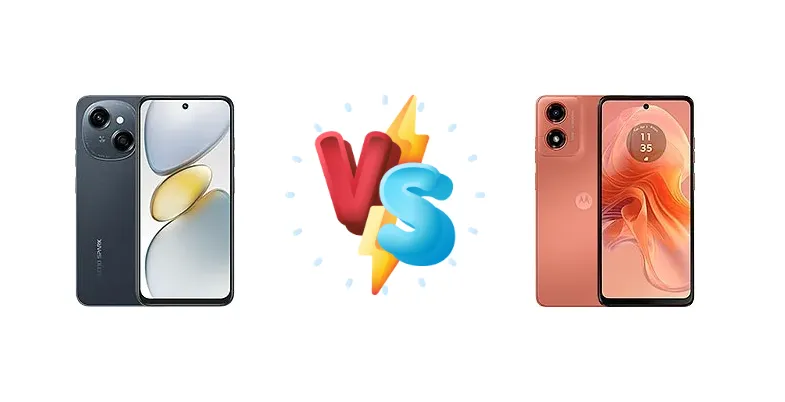
The Tecno Spark Go 1S and Motorola Moto G04s represent the fiercely competitive sub-$150 smartphone market. Both aim to deliver essential smartphone functionality at an accessible price, but they take different approaches to achieving this. The Spark Go 1S relies on Mediatek’s Helio G50, while the Moto G04s opts for the newer Unisoc T606. This comparison will dissect the key differences to determine which device offers the best value.
🏆 Quick Verdict
For the average user prioritizing a slightly more modern chipset architecture and potentially better long-term software support, the Motorola Moto G04s is the better choice. While both phones offer similar charging speeds, the Unisoc T606’s Cortex-A75 cores provide a noticeable performance edge in everyday tasks and light multitasking.
| Network |
|---|
| 2G bands | GSM 850 / 900 / 1800 / 1900 | GSM 850 / 900 / 1800 / 1900 |
| 3G bands | HSDPA 900 / 2100 | HSDPA 850 / 900 / 2100 |
| 4G bands | LTE | 1, 3, 5, 7, 8, 20, 28, 38, 40, 41 |
| Speed | HSPA, LTE | HSPA, LTE |
| Technology | GSM / HSPA / LTE | GSM / HSPA / LTE |
| Launch |
|---|
| Announced | 2025, January 06 | 2024, April 09 |
| Status | Available. Released 2025, January | Available. Released 2024, April 29 |
| Body |
|---|
| Build | Glass front, plastic back, plastic frame | Glass front (Gorilla Glass 3), plastic frame, plastic back |
| Dimensions | 165.6 x 77 x 8.4 mm (6.52 x 3.03 x 0.33 in) | 163.5 x 74.5 x 8 mm (6.44 x 2.93 x 0.31 in) |
| SIM | Nano-SIM + Nano-SIM | Nano-SIM + Nano-SIM |
| Weight | - | 178.8 g (6.31 oz) |
| Display |
|---|
| Protection | - | Corning Gorilla Glass 3 |
| Resolution | 720 x 1600 pixels, 20:9 ratio (~263 ppi density) | 720 x 1612 pixels, 20:9 ratio (~269 ppi density) |
| Size | 6.67 inches, 107.4 cm2 (~84.2% screen-to-body ratio) | 6.56 inches, 103.4 cm2 (~84.9% screen-to-body ratio) |
| Type | IPS LCD, 90Hz | IPS LCD, 90Hz |
| Platform |
|---|
| CPU | Octa-core 2.2 GHz Cortex-A53 | Octa-core (2x1.6 GHz Cortex-A75 & 6x1.6 GHz Cortex-A55) |
| Chipset | Mediatek Helio G50 | Unisoc T606 (12 nm) |
| GPU | PowerVR GE8320 | Mali-G57 MP1 |
| OS | Android 14 (Go edition), HIOS 14 | Android 14, no major Android upgrades planned |
| Memory |
|---|
| Card slot | microSDXC | microSDXC (dedicated slot) |
| Internal | 64GB 3GB RAM | 64GB 4GB RAM, 128GB 4GB RAM, 128GB 8GB RAM, 256GB 4GB RAM |
| Main Camera |
|---|
| Features | Dual-LED flash, HDR | LED flash, HDR |
| Single | 13 MP, f/1.8, 27mm (wide), PDAF | 50 MP, f/1.8, (wide), 0.64µm, PDAF |
| Video | 1080p@30fps | 1080p@30fps |
| Selfie camera |
|---|
| Features | - | HDR |
| Single | 8 MP | 5 MP, f/2.2, (wide) |
| Video | Yes | 1080p@30fps |
| Sound |
|---|
| 35mm jack | Yes | Yes |
| Loudspeaker | Yes, with dual speakers | Yes |
| Comms |
|---|
| Bluetooth | Yes | 5.0, A2DP, LE |
| Infrared port | Yes | - |
| NFC | No | Yes (market/region dependent) |
| Positioning | GPS | GPS, GALILEO, GLONASS |
| Radio | Unspecified | No |
| USB | USB Type-C, OTG | USB Type-C 2.0 |
| WLAN | Yes | Wi-Fi 802.11 a/b/g/n/ac, dual-band |
| Features |
|---|
| Sensors | Fingerprint (side-mounted); unspecified sensors | Fingerprint (side-mounted), accelerometer, proximity |
| Battery |
|---|
| Charging | 15W wired | 15W wired |
| Type | 5000 mAh | 5000 mAh |
| Misc |
|---|
| Colors | Startrail Black, Glittery White | Concord Black, Sea Green, Satin Blue, Sunrise Orange |
| Models | KL4h | XT2421-8 |
| Price | About 70 EUR | £ 90.86 / € 78.23 |
Tecno Spark Go 1S
- Potentially lower price point.
- Familiar Mediatek chipset.
- Simple and straightforward user experience.
- Older chipset architecture.
- Likely slower performance in demanding tasks.
- Potentially less frequent software updates.
Motorola Moto G04s
- More modern Unisoc T606 chipset.
- Improved CPU architecture for better responsiveness.
- Potential for better long-term software support from Motorola.
- More efficient 12nm process.
- Unisoc chipsets sometimes have limited app optimization.
- May be slightly more expensive than the Tecno Spark Go 1S.
Display Comparison
Neither device boasts a standout display. Given the lack of detailed display specs, we can assume both utilize LCD panels typical of this price bracket. The focus here is on functionality rather than fidelity. The real difference will likely come down to color calibration and viewing angles, areas where Motorola generally performs slightly better. Bezels are expected to be substantial on both devices, maximizing screen real estate within a compact form factor.
Camera Comparison
Camera performance is likely to be similar, with both phones relying on budget sensors. Without specific sensor details, it’s safe to assume both will struggle in low-light conditions. The inclusion of a 2MP macro camera on both devices is largely a marketing tactic, offering limited practical benefit due to the low resolution and lack of autofocus. Image processing will be key, and Motorola’s software tends to prioritize natural-looking images, while Tecno often leans towards more saturated colors. Expect acceptable results in good lighting, but don't anticipate flagship-level image quality.
Performance
The core difference lies in the chipsets. The Tecno Spark Go 1S’s Mediatek Helio G50 features an octa-core Cortex-A53 CPU clocked at 2.2 GHz. The Motorola Moto G04s, however, utilizes the Unisoc T606, built on a more efficient 12nm process. Crucially, the T606 incorporates two Cortex-A75 cores at 1.6 GHz alongside six Cortex-A55 cores, also at 1.6 GHz. This 'big.LITTLE' architecture provides a significant boost in single-core performance, translating to snappier app launches and smoother multitasking. While both have octa-core CPUs, the architectural difference means the Moto G04s will feel more responsive. The G50's higher clock speed doesn't fully compensate for the older core design.
Battery Life
Both the Tecno Spark Go 1S and Motorola Moto G04s support 15W wired charging. This is standard for this price point and will likely take around 2-3 hours for a full charge. Battery capacity isn't specified, but both are likely to be in the 4000-5000 mAh range. The Unisoc T606’s 12nm process efficiency *could* translate to slightly better battery life on the Moto G04s, but the difference will likely be marginal and dependent on usage patterns.
Buying Guide
Buy the Tecno Spark Go 1S if you need a phone primarily for basic communication – calls, texts, and WhatsApp – and are comfortable with a chipset that, while capable, is showing its age. Buy the Motorola Moto G04s if you prefer a more responsive experience for social media, web browsing, and occasional light gaming, and value the potential for more consistent software updates from a well-established brand.
Frequently Asked Questions
❓ Will the Unisoc T606 in the Moto G04s struggle with popular apps like TikTok or Instagram?
While the Unisoc T606 isn't a powerhouse, its Cortex-A75 cores provide a noticeable performance boost over the Helio G50. It should handle TikTok and Instagram smoothly for most users, though intensive multitasking with these apps and others simultaneously might cause some slowdown. The Moto G04s is better equipped for these social media workloads.
❓ Is the 15W charging on either phone fast enough for daily use?
15W charging is fairly standard for phones in this price range. It's not 'fast charging' in the modern sense, but it's adequate for overnight charging or topping up throughout the day. Expect a full charge to take around 2-3 hours. Neither phone offers significantly faster charging capabilities.
❓ Which phone is likely to receive more software updates and security patches?
Motorola generally provides more consistent software updates and security patches than Tecno, even on their budget devices. While neither brand is known for rapid updates, Motorola has a better track record of providing at least basic security updates for a longer period.
❓ Does the Moto G04s support VoLTE and VoWiFi for improved call quality?
Support for VoLTE (Voice over LTE) and VoWiFi (Voice over Wi-Fi) varies by carrier and region. It's crucial to check with your mobile carrier to confirm compatibility with the Motorola Moto G04s before purchasing, as these features significantly improve call quality in areas with poor cellular coverage.