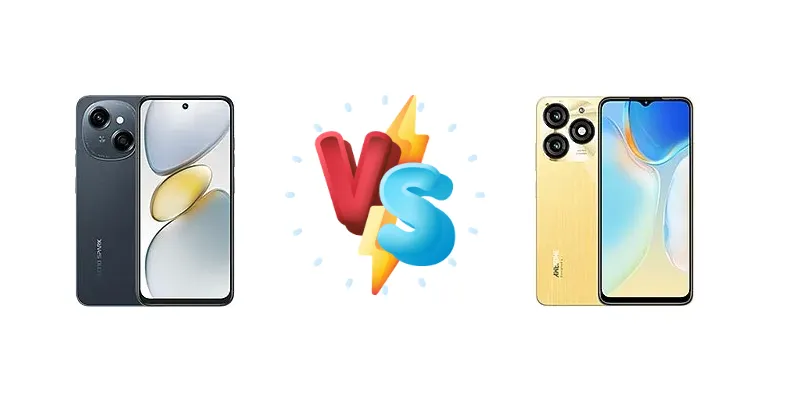
The Tecno Spark Go 1S and itel A70 represent the ultra-budget end of the smartphone spectrum, targeting first-time buyers or those needing a reliable secondary device. While both aim for affordability, they take different approaches to achieving it, primarily through chipset selection. This comparison dissects those choices and reveals which phone delivers the best experience for the price.
🏆 Quick Verdict
For users prioritizing responsiveness and slightly better multitasking, the Tecno Spark Go 1S emerges as the winner. Its Mediatek Helio G50, with a higher clock speed of 2.2 GHz, offers a noticeable performance edge over the itel A70’s Unisoc T603. However, the itel A70’s more efficient chipset may translate to slightly better battery life in real-world usage.
| Network |
|---|
| 2G bands | GSM 850 / 900 / 1800 / 1900 | GSM 850 / 900 / 1800 / 1900 |
| 3G bands | HSDPA 900 / 2100 | HSDPA 850 / 900 / 2100 |
| 4G bands | LTE | LTE |
| Speed | HSPA, LTE | HSPA, LTE |
| Technology | GSM / HSPA / LTE | GSM / HSPA / LTE |
| Launch |
|---|
| Announced | 2025, January 06 | 2023, October 30 |
| Status | Available. Released 2025, January | Available. Released 2023, November |
| Body |
|---|
| Build | Glass front, plastic back, plastic frame | - |
| Dimensions | 165.6 x 77 x 8.4 mm (6.52 x 3.03 x 0.33 in) | 8.6 mm thickness |
| SIM | Nano-SIM + Nano-SIM | Dual SIM |
| Weight | - | - |
| Display |
|---|
| Resolution | 720 x 1600 pixels, 20:9 ratio (~263 ppi density) | 720 x 1612 pixels, 20:9 ratio (~267 ppi density) |
| Size | 6.67 inches, 107.4 cm2 (~84.2% screen-to-body ratio) | 6.6 inches, 104.6 cm2 |
| Type | IPS LCD, 90Hz | IPS LCD, 500 nits (peak) |
| Platform |
|---|
| CPU | Octa-core 2.2 GHz Cortex-A53 | Octa-core |
| Chipset | Mediatek Helio G50 | Unisoc T603 |
| GPU | PowerVR GE8320 | - |
| OS | Android 14 (Go edition), HIOS 14 | Android 13 (Go edition) |
| Memory |
|---|
| Card slot | microSDXC | microSDXC (dedicated slot) |
| Internal | 64GB 3GB RAM | 64GB 4GB RAM, 128GB 3GB RAM, 128GB 4GB RAM, 256GB 4GB RAM |
| Main Camera |
|---|
| Features | Dual-LED flash, HDR | Dual-LED flash, HDR |
| Single | 13 MP, f/1.8, 27mm (wide), PDAF | 13 MP
Auxiliary lens |
| Video | 1080p@30fps | Yes |
| Selfie camera |
|---|
| Single | 8 MP | 8 MP |
| Video | Yes | Yes |
| Sound |
|---|
| 35mm jack | Yes | Yes |
| Loudspeaker | Yes, with dual speakers | Yes |
| Comms |
|---|
| Bluetooth | Yes | Yes |
| Infrared port | Yes | - |
| NFC | No | No |
| Positioning | GPS | GPS |
| Radio | Unspecified | Unspecified |
| USB | USB Type-C, OTG | USB Type-C 2.0 |
| WLAN | Yes | Yes |
| Features |
|---|
| Sensors | Fingerprint (side-mounted); unspecified sensors | Fingerprint (side-mounted); unspecified sensors |
| Battery |
|---|
| Charging | 15W wired | 10W wired |
| Type | 5000 mAh | 5000 mAh |
| Misc |
|---|
| Colors | Startrail Black, Glittery White | Brilliant Gold, Stylish Black, Field Green, Azure Blue |
| Models | KL4h | A665L |
| Price | About 70 EUR | - |
Tecno Spark Go 1S
- Faster processor (Helio G50)
- Faster charging (15W)
- Potentially smoother multitasking
- Potentially lower battery life
- May run slightly warmer under load
itel A70
- More power-efficient chipset (Unisoc T603)
- Potentially longer battery life
- Lower price (likely)
- Slower processor
- Slower charging (10W)
- Less responsive user experience
Display Comparison
Neither device boasts a standout display. Given the price point, both likely utilize LCD panels with 720p+ resolutions. The absence of detailed display specs necessitates focusing on the chipset’s ability to drive the UI smoothly. A more powerful chipset, like the Helio G50 in the Tecno Spark Go 1S, can mitigate the impact of a lower-quality display by ensuring animations and transitions remain fluid.
Camera Comparison
Both phones likely feature basic camera setups geared towards casual photography. Without detailed sensor information, it’s safe to assume both rely on primary sensors with modest resolutions. The absence of Optical Image Stabilization (OIS) on either device means image quality will be heavily reliant on software processing. Given the limited processing power of both chipsets, expect image processing to be relatively basic, potentially resulting in softer details and less dynamic range in challenging lighting conditions. Focusing on the chipset’s image signal processor (ISP) capabilities would be crucial, but that data is unavailable.
Performance
The core difference lies in the chipsets. The Tecno Spark Go 1S’s Mediatek Helio G50 features an octa-core CPU clocked at 2.2 GHz, utilizing Cortex-A53 cores. This higher clock speed suggests faster single-core performance, beneficial for app launch times and general responsiveness. The itel A70, powered by the Unisoc T603, also has an octa-core CPU, but lacks a specified clock speed. Unisoc typically prioritizes efficiency, meaning the T603 likely operates at a lower frequency to conserve power. While both are entry-level chipsets, the Helio G50’s architecture and clock speed give it a theoretical advantage in processing power.
Battery Life
The Tecno Spark Go 1S supports 15W wired charging, while the itel A70 is limited to 10W. This translates to faster charging times for the Tecno, potentially reducing the time spent tethered to a power outlet. However, battery life is also heavily influenced by chipset efficiency. The Unisoc T603 in the itel A70 is designed for lower power consumption, which could offset the slower charging speed and result in longer overall usage between charges. Without knowing the battery capacity of each device, it’s difficult to definitively declare a winner, but the itel A70 has a potential edge in longevity.
Buying Guide
Buy the Tecno Spark Go 1S if you need a phone that feels snappier for everyday tasks like browsing, social media, and light gaming. The Helio G50 provides a more fluid experience. Buy the itel A70 if you prioritize maximizing battery life and are primarily focused on basic communication – calls, texts, and minimal app usage. Its Unisoc T603 is designed for efficiency, even if it means sacrificing some processing power.
Frequently Asked Questions
❓ Will the Tecno Spark Go 1S handle popular social media apps like Facebook and Instagram smoothly?
The Mediatek Helio G50 in the Tecno Spark Go 1S should provide a reasonably smooth experience with social media apps. While not a powerhouse, the 2.2 GHz clock speed and octa-core configuration are sufficient for handling the demands of these applications. Expect occasional slowdowns with multiple apps open simultaneously.
❓ Is the Unisoc T603 in the itel A70 sufficient for basic tasks like calling, texting, and WhatsApp?
Yes, the Unisoc T603 is well-suited for basic communication tasks. Its focus on power efficiency ensures reliable performance for calls, texts, and messaging apps like WhatsApp. However, it may struggle with more demanding applications or multitasking.
❓ Can either of these phones play PUBG Mobile, and if so, at what settings?
While technically possible to launch PUBG Mobile on both devices, the experience will be far from ideal. Expect very low frame rates and significant lag, even on the lowest graphics settings. These phones are not designed for gaming.
❓ How long will it take to fully charge each phone from 0%?
With 15W charging, the Tecno Spark Go 1S should fully charge in approximately 2.5 to 3 hours. The itel A70, with its 10W charging, will likely take around 3.5 to 4 hours for a full charge. These are estimates, and actual charging times may vary.