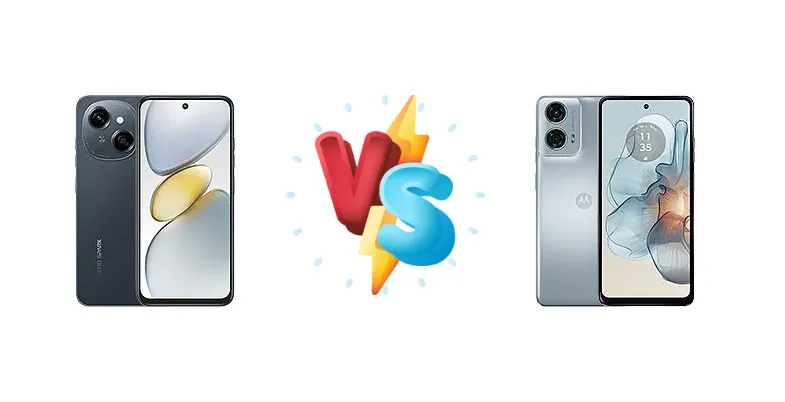
The sub-$150 smartphone market is fiercely competitive. The Tecno Spark Go 1 and Motorola Moto G24 Power both aim to deliver essential features at an accessible price point, but they take different approaches. The Spark Go 1 focuses on affordability, while the Moto G24 Power prioritizes faster charging and a slightly more powerful chipset. This comparison will dissect their key differences to determine which device offers the best value.
🏆 Quick Verdict
For the average user prioritizing quick top-ups and slightly smoother performance, the Motorola Moto G24 Power is the better choice. Its 30W charging significantly reduces downtime, and the Helio G85 chipset offers a modest performance advantage over the Spark Go 1’s Unisoc T615. However, the Spark Go 1 remains a viable option for those on the tightest budgets.
| Network |
|---|
| 2G bands | GSM 850 / 900 / 1800 / 1900 | GSM 850 / 900 / 1800 / 1900 |
| 3G bands | HSDPA 900 / 2100 | HSDPA 850 / 900 / 1900 / 2100 |
| 4G bands | LTE | 1, 2, 3, 5, 7, 8, 20, 28, 38, 40, 41 |
| Speed | HSPA, LTE | HSPA, LTE |
| Technology | GSM / HSPA / LTE | GSM / HSPA / LTE |
| Launch |
|---|
| Announced | 2024, August 19 | 2024, January 30 |
| Status | Available. Released 2024, August | Available. Released 2024, February 07 |
| Body |
|---|
| Build | Glass front, plastic back, plastic frame | Glass front, plastic back, plastic frame |
| Dimensions | 165.6 x 77 x 8.4 mm (6.52 x 3.03 x 0.33 in) | 163.5 x 74.5 x 9 mm (6.44 x 2.93 x 0.35 in) |
| SIM | Nano-SIM + Nano-SIM | Nano-SIM + Nano-SIM |
| Weight | - | 197 g (6.95 oz) |
| Display |
|---|
| Resolution | 720 x 1600 pixels, 20:9 ratio (~263 ppi density) | 720 x 1612 pixels, 20:9 ratio (~269 ppi density) |
| Size | 6.67 inches, 107.4 cm2 (~84.2% screen-to-body ratio) | 6.56 inches, 103.4 cm2 (~84.9% screen-to-body ratio) |
| Type | IPS LCD, 120Hz | IPS LCD, 90Hz, 537 nits (peak) |
| Platform |
|---|
| CPU | Octa-core (2x1.8 GHz Cortex-A75 & 6x1.6 GHz Cortex-A55) | Octa-core (2x2.0 GHz Cortex-A75 & 6x1.7 GHz Cortex-A55) |
| Chipset | Unisoc T615 (12 nm) | Mediatek MT6769Z Helio G85 (12 nm) |
| GPU | Mali-G57 MP1 | Mali-G52 MC2 |
| OS | Android 14 (Go edition), HIOS 14 | Android 14 |
| Memory |
|---|
| Card slot | microSDXC | microSDXC (dedicated slot) |
| Internal | 64GB 3GB RAM, 64GB 4GB RAM, 128GB 3GB RAM, 128GB 4GB RAM | 128GB 4GB RAM, 128GB 8GB RAM, 256GB 4GB RAM, 256GB 8GB RAM |
| Main Camera |
|---|
| Dual | - | 50 MP, f/1.8 (wide), 0.64µm, PDAF
2 MP (macro) |
| Features | Dual-LED flash, HDR | LED flash, HDR, panorama |
| Single | 13 MP, f/1.8, 27mm (wide), PDAF | - |
| Video | 1080p@30fps | 1080p@30fps |
| Selfie camera |
|---|
| Features | Dual-LED flash | - |
| Single | 8 MP | 8 MP, f/2.0, (wide), 1.12µm - International version
16 MP, f/2.5, (wide), 1.0µm - India version |
| Video | Yes | 1080p@30fps |
| Sound |
|---|
| 35mm jack | Yes | Yes |
| Loudspeaker | Yes, with dual speakers | Yes, with stereo speakers |
| Comms |
|---|
| Bluetooth | Yes | 5.0, A2DP, LE |
| Infrared port | Yes | - |
| NFC | No | Yes (market/region dependent) |
| Positioning | GPS | GPS, GALILEO, GLONASS |
| Radio | Unspecified | FM radio (market/region dependent) |
| USB | USB Type-C, OTG | USB Type-C 2.0 |
| WLAN | Yes | Wi-Fi 802.11 a/b/g/n/ac, dual-band |
| Features |
|---|
| Sensors | Fingerprint (side-mounted); unspecified sensors | Fingerprint (side-mounted), accelerometer, gyro, proximity, compass |
| Battery |
|---|
| Charging | 15W wired | 30W wired |
| Type | 5000 mAh | 6000 mAh |
| Misc |
|---|
| Colors | Startrail Black, Glittery White | Glacier Blue, Ink Blue |
| Price | $ 172.85 | € 132.29 |
Tecno Spark Go 1
- Lowest possible price point
- Acceptable for basic tasks
- Functional for essential communication
- Slow 15W charging
- Less powerful Unisoc T615 chipset
- Likely limited multitasking capabilities
Motorola Moto G24 Power
- Faster 30W charging
- More powerful MediaTek Helio G85 chipset
- Better suited for casual gaming
- Improved multitasking performance
- Slightly higher price than Tecno Spark Go 1
- Camera performance likely similar to Tecno
- May still struggle with demanding apps
Display Comparison
Neither device boasts a standout display. Both utilize 12nm chipsets, suggesting a focus on cost optimization over premium display features. While specific display specs (resolution, panel type) are missing, the focus here is on the core processing power. Expect basic LCD panels on both, likely 720p+, with similar levels of color accuracy and brightness geared towards indoor use. Bezels are likely comparable, reflecting the budget nature of both devices.
Camera Comparison
Camera performance is likely to be similar, with both devices prioritizing affordability over high-end imaging. Without specific sensor details, it’s safe to assume both feature a primary camera paired with auxiliary lenses (likely depth or macro) of limited utility. The G24 Power *may* benefit from slightly better image processing capabilities due to the more powerful chipset, but significant differences are unlikely. Expect acceptable image quality in good lighting conditions, but struggles in low light. Focusing on the primary sensor's megapixel count is more relevant than the presence of 2MP macro lenses.
Performance
The Motorola Moto G24 Power holds a clear advantage in processing power. Its MediaTek Helio G85, with 2x2.0 GHz Cortex-A75 cores, operates at a higher clock speed than the Tecno Spark Go 1’s Unisoc T615 (2x1.8 GHz Cortex-A75). This translates to snappier app launches and smoother multitasking. While both chips feature the same core architecture (Cortex-A75 and A55), the higher clock speed of the Helio G85 provides a tangible performance boost. The G85 is also known for its slightly better GPU performance, making it a more suitable choice for casual gaming. Both devices likely utilize LPDDR4X RAM, a common choice in this price bracket.
Battery Life
The Motorola Moto G24 Power’s 30W charging is the standout feature here. While the battery capacity isn’t specified, 30W charging will drastically reduce charging times compared to the Tecno Spark Go 1’s 15W charging. This is a significant benefit for users who need to quickly top up their phone throughout the day. Even with a slightly smaller battery capacity, the faster charging speed of the G24 Power will likely result in more usable uptime for many users. The Spark Go 1’s 15W charging will require a longer time to reach a full charge, potentially becoming a bottleneck for power users.
Buying Guide
Buy the Tecno Spark Go 1 if you need a truly minimal-cost smartphone for basic tasks like calls, messaging, and light social media use, and aren't concerned with fast charging or demanding applications. Buy the Motorola Moto G24 Power if you prefer a phone that can handle moderate multitasking, occasional gaming, and benefits from significantly faster 30W charging, making it ideal for users who are frequently on the go.
Frequently Asked Questions
❓ Will the Motorola Moto G24 Power overheat during extended gaming sessions?
The Helio G85 is a relatively efficient chipset. While it may get warm during prolonged gaming, it's unlikely to experience significant thermal throttling. Motorola's software optimization also plays a role in managing heat. Expect playable frame rates for less demanding titles, but don't expect flagship-level performance.
❓ Is the 15W charging on the Tecno Spark Go 1 slow enough to be a major inconvenience?
Yes, for many users, 15W charging will be noticeably slow. A full charge could take over 3 hours, making it less convenient for those who need to quickly top up their phone. This is a key area where the Moto G24 Power excels.
❓ Can the Motorola Moto G24 Power handle popular social media apps like TikTok and Instagram without lag?
The Helio G85 chipset should be capable of running TikTok and Instagram smoothly. However, running multiple apps simultaneously or using them for extended periods might lead to some slowdown. It's a capable performer for social media, but not a powerhouse.
❓ Does the Tecno Spark Go 1 support software updates?
Tecno's software update track record is inconsistent. While they do provide updates, they are often less frequent and slower to roll out compared to Motorola. Expect limited long-term software support on the Spark Go 1.