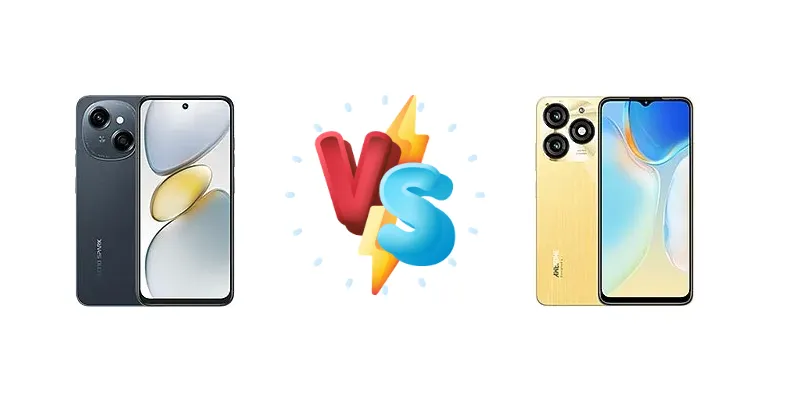
The Tecno Spark Go 1 and itel A70 represent the fiercely competitive entry-level smartphone market. Both aim to deliver essential smartphone functionality at an incredibly affordable price point. However, subtle differences in their core components – specifically the chipset and charging capabilities – can significantly impact the user experience. This comparison dissects these differences to help you choose the right device.
🏆 Quick Verdict
For most users, the Tecno Spark Go 1 emerges as the slightly better choice. Its Unisoc T615 chipset, featuring Cortex-A75 performance cores, provides a noticeable performance edge over the itel A70’s T603, making it more suitable for multitasking and moderately demanding apps. While the itel A70 is still a capable device, the Spark Go 1 offers a better balance of performance for the price.
| Network |
|---|
| 2G bands | GSM 850 / 900 / 1800 / 1900 | GSM 850 / 900 / 1800 / 1900 |
| 3G bands | HSDPA 900 / 2100 | HSDPA 850 / 900 / 2100 |
| 4G bands | LTE | LTE |
| Speed | HSPA, LTE | HSPA, LTE |
| Technology | GSM / HSPA / LTE | GSM / HSPA / LTE |
| Launch |
|---|
| Announced | 2024, August 19 | 2023, October 30 |
| Status | Available. Released 2024, August | Available. Released 2023, November |
| Body |
|---|
| Build | Glass front, plastic back, plastic frame | - |
| Dimensions | 165.6 x 77 x 8.4 mm (6.52 x 3.03 x 0.33 in) | 8.6 mm thickness |
| SIM | Nano-SIM + Nano-SIM | Dual SIM |
| Weight | - | - |
| Display |
|---|
| Resolution | 720 x 1600 pixels, 20:9 ratio (~263 ppi density) | 720 x 1612 pixels, 20:9 ratio (~267 ppi density) |
| Size | 6.67 inches, 107.4 cm2 (~84.2% screen-to-body ratio) | 6.6 inches, 104.6 cm2 |
| Type | IPS LCD, 120Hz | IPS LCD, 500 nits (peak) |
| Platform |
|---|
| CPU | Octa-core (2x1.8 GHz Cortex-A75 & 6x1.6 GHz Cortex-A55) | Octa-core |
| Chipset | Unisoc T615 (12 nm) | Unisoc T603 |
| GPU | Mali-G57 MP1 | - |
| OS | Android 14 (Go edition), HIOS 14 | Android 13 (Go edition) |
| Memory |
|---|
| Card slot | microSDXC | microSDXC (dedicated slot) |
| Internal | 64GB 3GB RAM, 64GB 4GB RAM, 128GB 3GB RAM, 128GB 4GB RAM | 64GB 4GB RAM, 128GB 3GB RAM, 128GB 4GB RAM, 256GB 4GB RAM |
| Main Camera |
|---|
| Features | Dual-LED flash, HDR | Dual-LED flash, HDR |
| Single | 13 MP, f/1.8, 27mm (wide), PDAF | 13 MP
Auxiliary lens |
| Video | 1080p@30fps | Yes |
| Selfie camera |
|---|
| Features | Dual-LED flash | - |
| Single | 8 MP | 8 MP |
| Video | Yes | Yes |
| Sound |
|---|
| 35mm jack | Yes | Yes |
| Loudspeaker | Yes, with dual speakers | Yes |
| Comms |
|---|
| Bluetooth | Yes | Yes |
| Infrared port | Yes | - |
| NFC | No | No |
| Positioning | GPS | GPS |
| Radio | Unspecified | Unspecified |
| USB | USB Type-C, OTG | USB Type-C 2.0 |
| WLAN | Yes | Yes |
| Features |
|---|
| Sensors | Fingerprint (side-mounted); unspecified sensors | Fingerprint (side-mounted); unspecified sensors |
| Battery |
|---|
| Charging | 15W wired | 10W wired |
| Type | 5000 mAh | 5000 mAh |
| Misc |
|---|
| Colors | Startrail Black, Glittery White | Brilliant Gold, Stylish Black, Field Green, Azure Blue |
| Models | - | A665L |
| Price | $ 172.85 | - |
Tecno Spark Go 1
- Faster chipset (Unisoc T615) for smoother performance
- Faster 15W charging for quicker top-ups
- More responsive user experience
- Potentially slightly shorter battery life due to more powerful chipset
- May be marginally more expensive than the itel A70
itel A70
- Potentially longer battery life due to the less power-hungry T603
- Simpler user experience for basic tasks
- Likely more affordable
- Slower chipset (Unisoc T603) resulting in laggy performance
- Significantly slower 10W charging
- Less capable for multitasking and demanding apps
Display Comparison
Neither Tecno nor itel provide detailed display specifications in the provided data. Given their price point, both likely utilize LCD panels with 720p+ resolution. The absence of information regarding peak brightness, color gamut coverage, or refresh rates suggests a focus on cost optimization over display quality. Expect similar viewing experiences in typical indoor conditions, but neither will excel in direct sunlight.
Camera Comparison
Without detailed camera specifications, a direct comparison is difficult. Both phones likely feature a primary camera and potentially a secondary depth sensor. However, the image processing capabilities and sensor quality are unknown. Given the price bracket, image quality will likely be acceptable for social media sharing in good lighting conditions, but expect limitations in low-light scenarios. The absence of OIS (Optical Image Stabilization) on either device suggests reliance on software stabilization, which may not be as effective.
Performance
The core difference lies in the chipsets. The Tecno Spark Go 1’s Unisoc T615 (12nm) boasts an octa-core configuration with 2x 1.8 GHz Cortex-A75 cores and 6x 1.6 GHz Cortex-A55 cores. This architecture provides a significant advantage in single-core and multi-core performance compared to the itel A70’s Unisoc T603, which features an octa-core setup without specifying core types. The Cortex-A75 cores in the T615 are considerably more powerful than the cores found in the T603, resulting in faster app loading times and smoother operation. While both are adequate for basic tasks, the T615 will handle more demanding applications with greater ease. The 12nm process node of the T615 is also slightly more efficient than the T603's, potentially leading to better thermal management under sustained load.
Battery Life
The itel A70’s 10W charging is significantly slower than the Tecno Spark Go 1’s 15W charging. This translates to a longer time to fully charge the battery. While battery capacity isn’t specified, the more efficient chipset in the Tecno Spark Go 1, combined with faster charging, offers a more convenient user experience. Users who frequently top up their phones throughout the day will appreciate the faster charging speed of the Spark Go 1. The T603's lower power consumption might result in slightly longer battery life *between* charges, but the convenience of quicker top-ups favors the Tecno.
Buying Guide
Buy the Tecno Spark Go 1 if you prioritize responsiveness and smoother multitasking, even if it means slightly slower charging. This phone is ideal for users who occasionally play casual games or use multiple apps simultaneously. Buy the itel A70 if your primary needs are basic communication – calls, texts, and light social media – and you value simplicity and potentially longer battery life due to the lower power draw of the T603 chipset, accepting a trade-off in overall speed.
Frequently Asked Questions
❓ Will the Tecno Spark Go 1 handle popular games like PUBG Mobile or Call of Duty?
While the Unisoc T615 can run these games, expect to play them at lower graphics settings and frame rates to maintain a playable experience. The chipset isn't designed for high-end gaming, but it can handle casual gaming sessions without significant issues. The itel A70 will struggle even more with these titles.
❓ How long will it take to fully charge each phone from 0%?
With 15W charging, the Tecno Spark Go 1 will likely take around 2.5 to 3 hours to fully charge. The itel A70, with its 10W charging, will take considerably longer – potentially 4 to 5 hours. This difference is significant for users who need to quickly top up their battery.
❓ Is the difference in chipset performance noticeable for everyday tasks like browsing and social media?
Yes, the difference is noticeable. The Tecno Spark Go 1’s Unisoc T615 will result in snappier app launches, smoother scrolling, and a more responsive overall experience when browsing the web or using social media apps. The itel A70 will feel slower and may exhibit occasional lag.