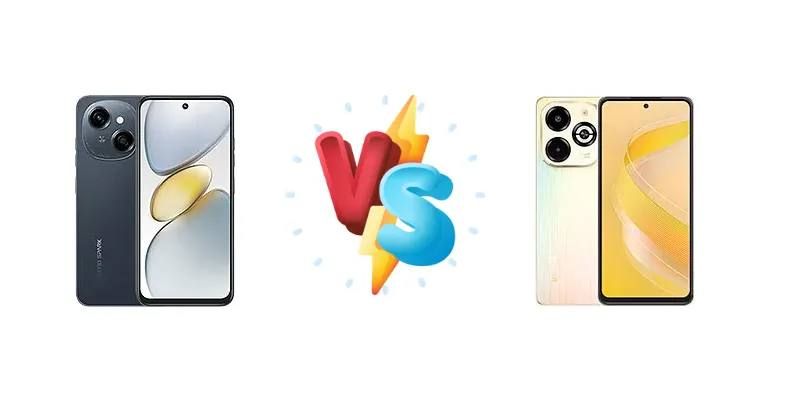
The Tecno Spark Go 1 and Infinix Smart 8 Plus represent the fiercely competitive sub-$150 smartphone market. Both aim to deliver essential smartphone functionality at an incredibly accessible price point, but they achieve this with different chipsets and feature sets. This comparison dissects their key differences to help you choose the best option for your needs.
🏆 Quick Verdict
For most users, the Infinix Smart 8 Plus edges out the Tecno Spark Go 1. Its Mediatek Helio G36, while utilizing older Cortex-A53 cores, offers a higher peak clock speed, translating to a slightly more responsive experience. The 18W charging with reverse wired capability is also a significant advantage.
| Network |
|---|
| 2G bands | GSM 850 / 900 / 1800 / 1900 | GSM 850 / 900 / 1800 / 1900 |
| 3G bands | HSDPA 900 / 2100 | HSDPA 850 / 900 / 1700(AWS) / 1900 / 2100 |
| 4G bands | LTE | 1, 2, 3, 4, 5, 7, 8, 20, 28, 38, 41, 40 |
| Speed | HSPA, LTE | HSPA, LTE |
| Technology | GSM / HSPA / LTE | GSM / HSPA / LTE |
| Launch |
|---|
| Announced | 2024, August 19 | 2024, January 30 |
| Status | Available. Released 2024, August | Available. Released 2024, February |
| Body |
|---|
| Build | Glass front, plastic back, plastic frame | Glass front, plastic back, plastic frame |
| Dimensions | 165.6 x 77 x 8.4 mm (6.52 x 3.03 x 0.33 in) | 163.7 x 75.7 x 9 mm (6.44 x 2.98 x 0.35 in) |
| SIM | Nano-SIM + Nano-SIM | Nano-SIM + Nano-SIM |
| Weight | - | 204 g (7.20 oz) |
| Display |
|---|
| Resolution | 720 x 1600 pixels, 20:9 ratio (~263 ppi density) | 720 x 1612 pixels, 20:9 ratio (~267 ppi density) |
| Size | 6.67 inches, 107.4 cm2 (~84.2% screen-to-body ratio) | 6.6 inches, 104.6 cm2 (~84.4% screen-to-body ratio) |
| Type | IPS LCD, 120Hz | IPS LCD, 90Hz, 500 nits (peak) |
| Platform |
|---|
| CPU | Octa-core (2x1.8 GHz Cortex-A75 & 6x1.6 GHz Cortex-A55) | Octa-core (4x2.2 GHz Cortex-A53 & 4x1.6 GHz Cortex-A53) |
| Chipset | Unisoc T615 (12 nm) | Mediatek Helio G36 (12 nm) |
| GPU | Mali-G57 MP1 | PowerVR GE8320 |
| OS | Android 14 (Go edition), HIOS 14 | Android 13 (Go edition), XOS 13 |
| Memory |
|---|
| Card slot | microSDXC | microSDXC (dedicated slot) |
| Internal | 64GB 3GB RAM, 64GB 4GB RAM, 128GB 3GB RAM, 128GB 4GB RAM | 64GB 4GB RAM, 128GB 4GB RAM |
| Main Camera |
|---|
| Features | Dual-LED flash, HDR | Ring-LED flash, HDR, panorama |
| Single | 13 MP, f/1.8, 27mm (wide), PDAF | 50 MP, f/1.9, (wide), AF
Auxiliary lens |
| Video | 1080p@30fps | 1080p@30fps |
| Selfie camera |
|---|
| Features | Dual-LED flash | - |
| Single | 8 MP | 8 MP, f/2.0, (wide) |
| Video | Yes | Yes |
| Sound |
|---|
| 35mm jack | Yes | Yes |
| Loudspeaker | Yes, with dual speakers | Yes |
| Comms |
|---|
| Bluetooth | Yes | 5.0, A2DP, LE |
| Infrared port | Yes | - |
| NFC | No | No |
| Positioning | GPS | GPS |
| Radio | Unspecified | FM radio |
| USB | USB Type-C, OTG | USB Type-C 2.0, OTG |
| WLAN | Yes | Wi-Fi 802.11 a/b/g/n/ac, dual-band |
| Features |
|---|
| Sensors | Fingerprint (side-mounted); unspecified sensors | Fingerprint (side-mounted), accelerometer, proximity, compass |
| Battery |
|---|
| Charging | 15W wired | 18W wired
Reverse wired |
| Type | 5000 mAh | 6000 mAh |
| Misc |
|---|
| Colors | Startrail Black, Glittery White | Galaxy White, Shiny Gold, Timber Black |
| Models | - | X6526 |
| Price | $ 172.85 | About 100 EUR |
Tecno Spark Go 1
- Unisoc T615 offers a more modern CPU architecture.
- Potentially better sustained performance in demanding tasks.
- Generally reliable brand reputation.
- Slower 15W charging.
- Lacks reverse wired charging.
- May feel less responsive in everyday tasks compared to the Infinix.
Infinix Smart 8 Plus
- Higher CPU clock speed (2.2 GHz) for snappier performance.
- Faster 18W charging with reverse wired capability.
- Competitive pricing.
- Older Cortex-A53 CPU cores.
- Camera quality likely similar to Tecno Spark Go 1.
- May not offer the same level of software support as Tecno.
Display Comparison
Neither device boasts a standout display. Both are likely utilizing LCD panels, typical for this price bracket. Specifics like resolution and brightness are not provided, but we can assume they are similar – likely 720p+ and adequate for indoor use. The focus here isn't on visual fidelity, but on basic usability.
Camera Comparison
Camera performance is expected to be basic on both devices. Without sensor size or aperture information, it’s difficult to make a definitive statement. However, given the price point, both will likely rely heavily on software processing. The inclusion of a 2MP macro camera on the Infinix Smart 8 Plus is a common, but often underwhelming, feature in this segment. Users shouldn't expect professional-quality results from either device.
Performance
The core difference lies in the chipsets. The Tecno Spark Go 1 features the Unisoc T615, employing a mix of Cortex-A75 and A55 cores. The A75 cores, while older, offer a performance advantage over the Cortex-A53 cores found in the Infinix Smart 8 Plus’s Mediatek Helio G36. However, the Helio G36 compensates with a higher peak clock speed of 2.2 GHz versus the T615’s 1.8 GHz. This means the Helio G36 will likely feel snappier in everyday tasks, despite the older core architecture. The T615’s architecture *could* offer slightly better sustained performance in demanding tasks, but both are limited by their overall processing power and likely paired with similar amounts of RAM.
Battery Life
Battery capacity isn’t specified for either device, but both likely house around a 5000mAh battery, standard for this price range. The Infinix Smart 8 Plus has a clear advantage with its 18W wired charging, allowing for faster top-ups. The inclusion of reverse wired charging is a unique feature, enabling the phone to act as a power bank for accessories like earbuds or smartwatches – a feature absent on the Tecno Spark Go 1.
Buying Guide
Buy the Tecno Spark Go 1 if you prioritize a slightly newer chipset architecture (Cortex-A75) and are comfortable with slower charging speeds. This phone is ideal for users who primarily need a device for basic communication and light tasks. Buy the Infinix Smart 8 Plus if you value a more responsive user experience for the price, faster charging, and the added convenience of reverse wired charging to top up accessories.
Frequently Asked Questions
❓ Will the Helio G36 in the Infinix Smart 8 Plus struggle with multitasking?
While the Helio G36 utilizes older Cortex-A53 cores, its higher clock speed of 2.2 GHz helps mitigate potential performance bottlenecks during multitasking. However, users should expect some slowdowns when running numerous demanding apps simultaneously. Managing background app processes will be crucial for optimal performance.
❓ How long does it realistically take to charge the Tecno Spark Go 1 from 0% to 100%?
With 15W charging, a full charge from 0% to 100% on the Tecno Spark Go 1 is estimated to take around 2.5 to 3.5 hours, depending on usage during charging. This is considerably slower than the Infinix Smart 8 Plus’s 18W charging.
❓ Is the reverse wired charging on the Infinix Smart 8 Plus useful for everyday accessories?
Yes, the reverse wired charging is quite practical. It can provide a significant boost to accessories like wireless earbuds, smartwatches, or even another phone in an emergency. While it won't fully charge another device quickly, it's a convenient feature to have.