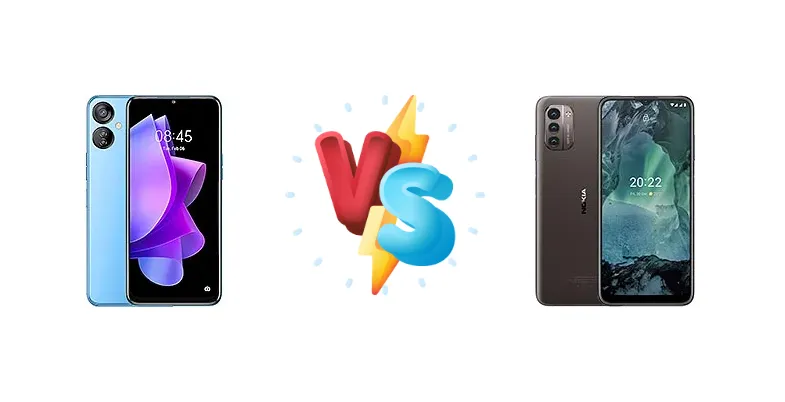
The Tecno Spark 9T and Nokia G21 represent compelling options in the ultra-budget smartphone space. Both aim to deliver essential features at a price point that won't break the bank, but they take different approaches. The Spark 9T prioritizes a slightly more modern chipset, while the G21 focuses on maximizing battery endurance and offering faster charging capabilities. This comparison will dissect their strengths and weaknesses to help you choose the right device.
🏆 Quick Verdict
For the average user prioritizing consistent performance for everyday tasks, the Tecno Spark 9T emerges as the better choice. Its Helio G37 chipset, while not a powerhouse, offers a more responsive experience than the Unisoc T606 in the Nokia G21. However, the Nokia G21’s 18W charging and endurance rating make it a strong contender for users who prioritize battery life above all else.
| Network |
|---|
| 2G bands | GSM 850 / 900 / 1800 / 1900 | GSM 850 / 900 / 1800 / 1900 |
| 3G bands | HSDPA 850 / 900 / 2100 | HSDPA 850 / 900 / 2100 - International |
| 4G bands | LTE | 1, 3, 5, 7, 8, 20, 28, 38, 40, 41 - International |
| Speed | HSPA, LTE | HSPA 42.2/5.76 Mbps, LTE Cat4 150/50 Mbps |
| Technology | GSM / HSPA / LTE | GSM / HSPA / LTE |
| | - | 1, 2, 3, 4, 5, 7, 8, 12, 17, 28, 40, 66 - LATAM |
| Launch |
|---|
| Announced | 2022, June 20 | 2022, February 14 |
| Status | Available. Released 2022, July | Available. Released 2022, February 15 |
| Body |
|---|
| Build | - | Glass front, plastic frame, plastic back |
| Dimensions | 164.3 x 75.6 x 8.7 mm (6.47 x 2.98 x 0.34 in) | 164.6 x 75.9 x 8.5 mm (6.48 x 2.99 x 0.33 in) |
| SIM | Nano-SIM + Nano-SIM | · Nano-SIM· Nano-SIM + Nano-SIM |
| Weight | - | 190 g (6.70 oz) |
| Display |
|---|
| Resolution | 720 x 1600 pixels, 20:9 ratio (~266 ppi density) | 720 x 1600 pixels, 20:9 ratio (~270 ppi density) |
| Size | 6.6 inches, 105.2 cm2 (~84.7% screen-to-body ratio) | 6.5 inches, 102.0 cm2 (~81.6% screen-to-body ratio) |
| Type | IPS LCD, 90Hz | IPS LCD, 90Hz, 400 nits (typ) |
| Platform |
|---|
| CPU | Octa-core (4x2.3 GHz Cortex-A53 & 4x1.8 GHz Cortex-A53) | Octa-core (2x1.6 GHz Cortex-A75 & 6x1.6 GHz Cortex-A55) |
| Chipset | Mediatek MT6765V/CB Helio G37 (12 nm) | Unisoc T606 (12 nm) |
| GPU | PowerVR GE8320 | Mali-G57 MP1 |
| OS | Android 12, HIOS 8.6 | Android 11, upgradable to Android 13 |
| Memory |
|---|
| Card slot | microSDXC | microSDXC (dedicated slot) |
| Internal | 64GB 4GB RAM, 128GB 4GB RAM | 64GB 3GB RAM, 64GB 4GB RAM, 128GB 4GB RAM, 128GB 6GB RAM |
| | - | eMMC 5.1 |
| Main Camera |
|---|
| Features | Quad-LED flash, HDR | LED flash, HDR, panorama |
| Single | 32 MP, (wide) | 8 MP, f/2.0, (wide) |
| Triple | 13 MP, f/1.9, 27mm (wide), AF
Auxiliary lenses | 50 MP, f/1.8, 28mm (wide), 1/2.76", 0.64µm, PDAF
2 MP (macro)
Auxiliary lens |
| Video | 1080p@30fps | 1080p@30fps |
| Selfie camera |
|---|
| Features | Dual-LED flash | - |
| Single | 32 MP, (wide) | 8 MP, f/2.0, (wide) |
| Video | 1080p@30fps | 1080p@30fps |
| Sound |
|---|
| 3.5mm jack | Yes | Yes |
| 35mm jack | Yes | Yes |
| Loudspeaker | Yes | Yes |
| Comms |
|---|
| Bluetooth | Yes | 5.0, A2DP, LE |
| NFC | No | Yes (market/region dependent) |
| Positioning | GPS | GPS, GLONASS, GALILEO |
| Radio | FM radio | FM radio, RDS |
| USB | USB Type-C 2.0, OTG | USB Type-C 2.0, OTG |
| WLAN | Yes | Wi-Fi 802.11 a/b/g/n/ac, dual-band, Wi-Fi Direct |
| Features |
|---|
| Sensors | Fingerprint (side-mounted), accelerometer, proximity | Fingerprint (side-mounted), accelerometer, proximity |
| Battery |
|---|
| Charging | 10W wired | 18W wired, PD3.0 |
| Type | 5000 mAh | Li-Po 5050 mAh |
| Misc |
|---|
| Colors | Quantum Black, Burano Blue, Particle Silver, Vitality Green | Nordic Blue, Dusk |
| Models | KH6 | TA-1418, TA-1477, TA-1415, TA-1405, TA-1404, TA-1412 |
| Price | About 180 EUR | About 90 EUR |
| SAR | - | 1.00 W/kg (head) 1.10 W/kg (body) |
| SAR EU | - | 0.34 W/kg (head) 1.05 W/kg (body) |
| Tests |
|---|
| Battery life | - |
Endurance rating 126h
|
| Camera | - |
Photo / Video |
| Display | - |
Contrast ratio: 1631:1 (nominal) |
| Loudspeaker | - |
-30.7 LUFS (Below average)
|
| Performance | - |
AnTuTu: 171299 (v9)
GeekBench: 1193 (v5.1)
GFXBench: 8.9fps (ES 3.1 onscreen) |
Tecno Spark 9T
- More responsive processor for everyday tasks
- Potentially better gaming performance
- Slightly more modern chipset architecture
- Slower charging speed (10W)
- Battery life likely inferior to Nokia G21
Nokia G21
- Excellent battery endurance (126h rating)
- Faster 18W charging with PD3.0
- Higher peak display brightness
- Slower processor for demanding tasks
- Unisoc chipset may have limited software support
Display Comparison
Both the Tecno Spark 9T and Nokia G21 feature displays with a 1631:1 contrast ratio, suggesting similar visual pop. However, the Nokia G21 boasts a measured peak brightness of 500 nits, which will translate to better visibility outdoors compared to the Spark 9T, for which brightness data is unavailable. While both likely utilize IPS LCD panels, the Nokia G21’s higher brightness gives it a slight edge in usability under direct sunlight. The lack of high refresh rate support on either device is typical for this price bracket.
Camera Comparison
Both phones offer 'Photo / Video' capabilities, but lack detailed camera specifications. Without sensor size or aperture information, a direct comparison is difficult. It’s safe to assume both feature basic camera setups geared towards casual photography. The inclusion of a 2MP macro camera on either device is likely a marketing feature with limited real-world utility. Image processing will likely be the differentiating factor, and brand reputation suggests Nokia may have a slight edge in software optimization.
Performance
The core difference lies in the chipsets. The Tecno Spark 9T utilizes the Mediatek Helio G37, featuring a mix of Cortex-A53 cores clocked up to 2.3 GHz. The Nokia G21, on the other hand, employs the Unisoc T606, with a configuration of two Cortex-A75 cores at 1.6 GHz and six Cortex-A55 cores also at 1.6 GHz. While the G37 has more cores, the A75 cores in the T606 offer a performance advantage in single-core tasks. However, the G37’s higher clock speeds and more modern architecture generally translate to better overall responsiveness and gaming performance. The G37 is likely to handle graphically intensive apps and games with slightly fewer stutters.
Battery Life
The Nokia G21 shines in the battery department with an endurance rating of 126 hours. While the Spark 9T’s battery capacity is unknown, the G21’s rating suggests excellent longevity. Crucially, the G21 supports 18W wired charging with PD3.0, allowing for faster top-ups compared to the Spark 9T’s slower 10W charging. This means the G21 can replenish its battery significantly quicker, minimizing downtime. The faster charging is a significant advantage for users who dislike waiting for their phone to charge.
Buying Guide
Buy the Tecno Spark 9T if you need a phone that feels snappier for social media, light gaming, and general app usage. Its processor architecture is more modern, leading to a smoother experience. Buy the Nokia G21 if you prioritize extended battery life and faster charging, and are willing to accept slightly slower performance in exchange. This phone is ideal for users who frequently find themselves away from a power outlet.
Frequently Asked Questions
❓ Is the Unisoc T606 in the Nokia G21 sufficient for playing games like PUBG Mobile?
While the Unisoc T606 can run PUBG Mobile, expect to play at lower graphics settings and potentially experience occasional frame drops. The chipset isn't optimized for demanding gaming, and the experience won't be as smooth as on devices with more powerful processors like the Helio G37 in the Tecno Spark 9T.
❓ How long does it realistically take to fully charge the Nokia G21 from 0% to 100%?
With its 18W charging and PD3.0 support, the Nokia G21 should fully charge from 0% to 100% in approximately 2.5 to 3 hours, depending on usage during charging. This is significantly faster than the Tecno Spark 9T's 10W charging, which could take upwards of 4-5 hours.
❓ Does the Tecno Spark 9T support any form of fast charging?
No, the Tecno Spark 9T only supports 10W wired charging. This is a relatively slow charging speed compared to the Nokia G21's 18W PD3.0 charging, meaning longer charging times.
❓ Which phone is better for watching videos on the go?
The Nokia G21 has a slight advantage due to its higher peak brightness of 500 nits. This will make videos more visible and enjoyable to watch outdoors or in brightly lit environments. While both have similar contrast ratios, brightness is key for outdoor viewing.