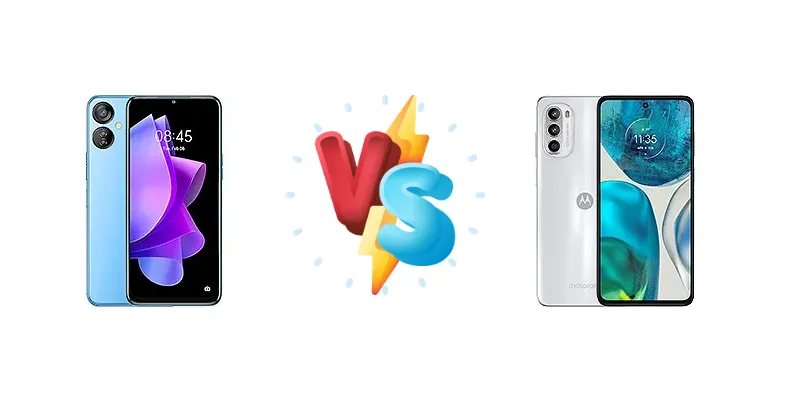
The sub-$200 smartphone market is fiercely competitive. The Tecno Spark 9T and Motorola Moto G52 both aim to deliver a solid experience without breaking the bank, but they take different approaches. The Spark 9T focuses on a larger display and a slightly lower price point, while the Moto G52 prioritizes a more efficient chipset and faster charging. This comparison will dissect their key differences to help you choose the right device.
🏆 Quick Verdict
For the average user prioritizing efficiency and faster charging, the Motorola Moto G52 is the better choice. Its Snapdragon 680, built on a 6nm process, offers superior power efficiency and a smoother overall experience compared to the Tecno Spark 9T’s Helio G37. The 30W charging is a significant advantage, offsetting the slightly smaller battery.
| Network |
|---|
| 2G bands | GSM 850 / 900 / 1800 / 1900 | GSM 850 / 900 / 1800 / 1900 |
| 3G bands | HSDPA 850 / 900 / 2100 | HSDPA 850 / 900 / 1700(AWS) / 1900 / 2100 |
| 4G bands | LTE | LTE |
| Speed | HSPA, LTE | HSPA, LTE |
| Technology | GSM / HSPA / LTE | GSM / HSPA / LTE |
| Launch |
|---|
| Announced | 2022, June 20 | 2022, April 12 |
| Status | Available. Released 2022, July | Available. Released 2022, April 20 |
| Body |
|---|
| Dimensions | 164.3 x 75.6 x 8.7 mm (6.47 x 2.98 x 0.34 in) | 160.1 x 74.5 x 8 mm (6.30 x 2.93 x 0.31 in) |
| SIM | Nano-SIM + Nano-SIM | Nano-SIM + Nano-SIM |
| Weight | - | 169 g (5.96 oz) |
| | - | Water-repellent design |
| Display |
|---|
| Resolution | 720 x 1600 pixels, 20:9 ratio (~266 ppi density) | 1080 x 2400 pixels, 20:9 ratio (~402 ppi density) |
| Size | 6.6 inches, 105.2 cm2 (~84.7% screen-to-body ratio) | 6.6 inches, 103.6 cm2 (~86.9% screen-to-body ratio) |
| Type | IPS LCD, 90Hz | AMOLED, 90Hz |
| Platform |
|---|
| CPU | Octa-core (4x2.3 GHz Cortex-A53 & 4x1.8 GHz Cortex-A53) | Octa-core (4x2.4 GHz Kryo 265 Gold & 4x1.9 GHz Kryo 265 Silver) |
| Chipset | Mediatek MT6765V/CB Helio G37 (12 nm) | Qualcomm SM6225 Snapdragon 680 4G (6 nm) |
| GPU | PowerVR GE8320 | Adreno 610 |
| OS | Android 12, HIOS 8.6 | Android 12, planned upgrade to Android 13 |
| Memory |
|---|
| Card slot | microSDXC | microSDXC (uses shared SIM slot) |
| Internal | 64GB 4GB RAM, 128GB 4GB RAM | 64GB 4GB RAM, 128GB 4GB RAM, 128GB 6GB RAM, 256GB 6GB RAM |
| Main Camera |
|---|
| Features | Quad-LED flash, HDR | LED flash, HDR, panorama |
| Single | 32 MP, (wide) | - |
| Triple | 13 MP, f/1.9, 27mm (wide), AF
Auxiliary lenses | 50 MP, f/1.8 (wide), 1/2.76", 0.64µm, PDAF
8 MP, f/2.2, 118˚ (ultrawide), 1/4.0", 1.12µm
2 MP (macro) |
| Video | 1080p@30fps | 1080p@30fps |
| Selfie camera |
|---|
| Features | Dual-LED flash | - |
| Single | 32 MP, (wide) | 16 MP, f/2.5, (wide), 1.0µm |
| Video | 1080p@30fps | 1080p@30fps |
| Sound |
|---|
| 3.5mm jack | Yes | Yes |
| 35mm jack | Yes | Yes |
| Loudspeaker | Yes | Yes, with stereo speakers |
| Comms |
|---|
| Bluetooth | Yes | 5.0, A2DP, LE |
| NFC | No | Yes (market/region dependent) |
| Positioning | GPS | GPS, GLONASS, GALILEO |
| Radio | FM radio | Unspecified |
| USB | USB Type-C 2.0, OTG | USB Type-C 2.0 |
| WLAN | Yes | Wi-Fi 802.11 a/b/g/n/ac, dual-band, Wi-Fi Direct |
| Features |
|---|
| Sensors | Fingerprint (side-mounted), accelerometer, proximity | Fingerprint (side-mounted), accelerometer, gyro, proximity, compass |
| Battery |
|---|
| Charging | 10W wired | 30W wired |
| Type | 5000 mAh | Li-Po 5000 mAh |
| Misc |
|---|
| Colors | Quantum Black, Burano Blue, Particle Silver, Vitality Green | Charcoal Gray, Porcelain White |
| Models | KH6 | XT2221-1, XT2221-2 |
| Price | About 180 EUR | About 470 EUR |
Tecno Spark 9T
- Potentially lower price point
- Larger display size (likely)
- May offer more storage options
- Less efficient Helio G37 chipset
- Slow 10W charging
- Likely lower sustained performance
Motorola Moto G52
- More efficient Snapdragon 680 chipset
- Fast 30W wired charging
- Smoother overall user experience
- Potentially higher price
- May have a smaller display
- Could have less base storage
Display Comparison
Neither device boasts a particularly standout display. While specific display specs (resolution, brightness) are missing, the focus here is on the underlying chipsets impacting the user experience. The larger display on the Tecno Spark 9T may be preferable for video watching, but the efficiency of the Snapdragon 680 in the Moto G52 will translate to better battery life during extended use, even with a potentially smaller screen size. Bezels are likely comparable given the price bracket, and color accuracy is unlikely to be a strong point on either.
Camera Comparison
Without detailed camera specs, it’s difficult to make a definitive judgment. However, the market segment suggests both phones will rely heavily on software processing. The Snapdragon 680 in the Moto G52 benefits from Qualcomm’s image signal processor (ISP), which generally delivers better image quality and faster processing times. The larger sensor size (if present, which is likely on the Moto G52 given its positioning) will also contribute to better low-light performance. Expect both phones to include a variety of lenses, but focusing on the main sensor performance is key.
Performance
The core difference lies in the chipsets. The Motorola Moto G52’s Qualcomm Snapdragon 680 (6nm) is a clear advantage over the Tecno Spark 9T’s MediaTek Helio G37 (12nm). The 6nm process node allows for significantly better power efficiency, meaning less heat generation and sustained performance. While both are octa-core CPUs, the Snapdragon 680’s Kryo 265 Gold cores (2.4 GHz) offer a performance edge over the Cortex-A53 cores (2.3 GHz) in the Helio G37. This translates to snappier app launches, smoother multitasking, and a more responsive overall experience. The G37 will likely struggle with more demanding tasks.
Battery Life
The Motorola Moto G52’s 30W wired charging is a game-changer in this price range. This will significantly reduce charging times compared to the Tecno Spark 9T’s slow 10W charging. While the Spark 9T might have a slightly larger battery capacity (spec not provided), the Snapdragon 680’s efficiency in the Moto G52 will likely result in comparable, or even better, real-world battery life. The convenience of a quick top-up with the Moto G52 is a major benefit.
Buying Guide
Buy the Tecno Spark 9T if you need a larger screen for media consumption and are on an extremely tight budget, willing to trade some performance and charging speed for a lower upfront cost. Buy the Motorola Moto G52 if you prefer a more responsive user experience, longer battery life between charges, and the convenience of significantly faster 30W wired charging. The Moto G52 is ideal for users who value efficiency and practicality.
Frequently Asked Questions
❓ Will the Helio G37 in the Tecno Spark 9T struggle with graphically intensive games like PUBG Mobile?
Yes, the MediaTek Helio G37 is a budget-focused chipset. While it can run PUBG Mobile, you'll likely need to lower the graphics settings to achieve a playable frame rate. Expect some stuttering and potential overheating during extended gaming sessions. The Snapdragon 680 in the Moto G52 will provide a smoother and more consistent gaming experience.
❓ How long does it realistically take to fully charge the Motorola Moto G52 with the 30W charger?
The Motorola Moto G52 can charge from 0% to 100% in approximately 60-75 minutes with the included 30W charger. This is a significant improvement over the Tecno Spark 9T’s 10W charging, which could take over 3 hours for a full charge. The faster charging is particularly useful for users who frequently need to top up their battery quickly.
❓ Does the Snapdragon 680 in the Moto G52 get hot during prolonged use, like video recording or gaming?
The Snapdragon 680 is known for its excellent thermal efficiency due to its 6nm manufacturing process. While it will get warm during demanding tasks, it's unlikely to overheat significantly or experience substantial performance throttling. The Tecno Spark 9T’s Helio G37, being a 12nm chip, is more prone to overheating and throttling under similar workloads.