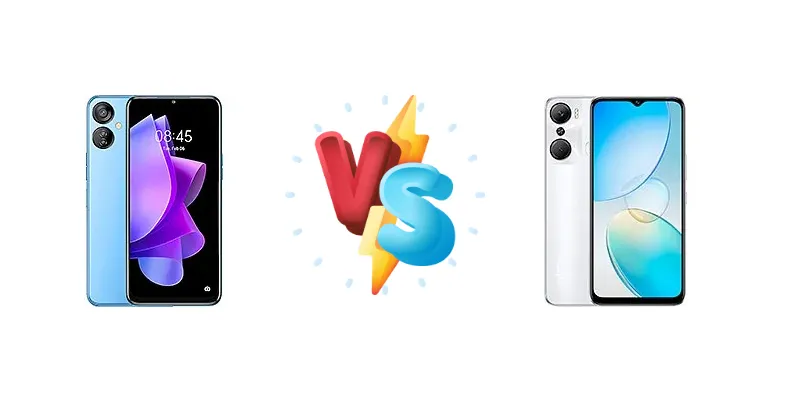
The sub-$150 smartphone market is fiercely competitive, and the Tecno Spark 9T and Infinix Hot 12 Pro are two contenders vying for your attention. Both aim to deliver a solid experience without breaking the bank, but they take different approaches to achieving that goal, primarily in chipset choice and charging capabilities. This comparison dives deep into the specifics to determine which phone offers the best value.
🏆 Quick Verdict
For the average user prioritizing responsiveness and faster charging, the Infinix Hot 12 Pro is the better choice. Its Unisoc Tiger T616 chipset, with its Cortex-A75 cores, provides a noticeable performance edge over the Tecno Spark 9T’s Helio G37, and the 18W charging significantly reduces downtime.
| Network |
|---|
| 2G bands | GSM 850 / 900 / 1800 / 1900 | GSM 850 / 900 / 1800 / 1900 |
| 3G bands | HSDPA 850 / 900 / 2100 | HSDPA 850 / 900 / 1700(AWS) / 1900 / 2100 |
| 4G bands | LTE | 1, 2, 3, 4, 5, 7, 8, 20, 28, 38, 40, 41 |
| Speed | HSPA, LTE | HSPA, LTE |
| Technology | GSM / HSPA / LTE | GSM / HSPA / LTE |
| Launch |
|---|
| Announced | 2022, June 20 | 2022, August 02 |
| Status | Available. Released 2022, July | Available. Released 2022, August 02 |
| Body |
|---|
| Build | - | Glass front, plastic back, plastic frame |
| Dimensions | 164.3 x 75.6 x 8.7 mm (6.47 x 2.98 x 0.34 in) | 164.2 x 75.8 x 8.4 mm (6.46 x 2.98 x 0.33 in) |
| SIM | Nano-SIM + Nano-SIM | Nano-SIM + Nano-SIM |
| Weight | - | 191 g (6.74 oz) |
| Display |
|---|
| Resolution | 720 x 1600 pixels, 20:9 ratio (~266 ppi density) | 720 x 1612 pixels, 20:9 ratio (~267 ppi density) |
| Size | 6.6 inches, 105.2 cm2 (~84.7% screen-to-body ratio) | 6.6 inches, 104.6 cm2 (~84.1% screen-to-body ratio) |
| Type | IPS LCD, 90Hz | IPS LCD, 90Hz |
| Platform |
|---|
| CPU | Octa-core (4x2.3 GHz Cortex-A53 & 4x1.8 GHz Cortex-A53) | Octa-core (2x2.0 GHz Cortex-A75 & 6x1.8 GHz Cortex-A55) |
| Chipset | Mediatek MT6765V/CB Helio G37 (12 nm) | Unisoc Tiger T616 (12 nm) |
| GPU | PowerVR GE8320 | Mali-G57 MP1 |
| OS | Android 12, HIOS 8.6 | Android 12, XOS 10.6 |
| Memory |
|---|
| Card slot | microSDXC | microSDXC (dedicated slot) |
| Internal | 64GB 4GB RAM, 128GB 4GB RAM | 128GB 8GB RAM |
| Main Camera |
|---|
| Dual | - | 50 MP, f/1.6, (wide), AF
Auxiliary lens |
| Features | Quad-LED flash, HDR | Dual-LED flash |
| Single | 32 MP, (wide) | 8 MP |
| Triple | 13 MP, f/1.9, 27mm (wide), AF
Auxiliary lenses | - |
| Video | 1080p@30fps | 1080p@30fps |
| Selfie camera |
|---|
| Features | Dual-LED flash | LED flash |
| Single | 32 MP, (wide) | 8 MP |
| Video | 1080p@30fps | 1080p@30fps |
| Sound |
|---|
| 3.5mm jack | Yes | Yes |
| 35mm jack | Yes | Yes |
| Loudspeaker | Yes | Yes |
| Comms |
|---|
| Bluetooth | Yes | Yes |
| NFC | No | Yes |
| Positioning | GPS | GPS |
| Radio | FM radio | FM radio |
| USB | USB Type-C 2.0, OTG | Yes |
| WLAN | Yes | Wi-Fi 802.11 a/b/g/n/ac, dual-band |
| Features |
|---|
| Sensors | Fingerprint (side-mounted), accelerometer, proximity | Fingerprint (rear-mounted), accelerometer, proximity, compass |
| Battery |
|---|
| Charging | 10W wired | 18W wired |
| Type | 5000 mAh | Li-Ion 5000 mAh |
| Misc |
|---|
| Colors | Quantum Black, Burano Blue, Particle Silver, Vitality Green | Racing Black, Electric Blue, Lightsaber Green, Halo White |
| Models | KH6 | X668C |
| Price | About 180 EUR | About 180 EUR |
Tecno Spark 9T
- Potentially better software support from Tecno.
- Reliable for basic smartphone tasks.
- Likely a more established brand presence in some markets.
- Slower Helio G37 chipset limits performance.
- Significantly slower 10W charging.
- May struggle with demanding games and multitasking.
Infinix Hot 12 Pro
- Faster Unisoc Tiger T616 chipset for improved performance.
- 18W fast charging reduces downtime.
- Better suited for gaming and multitasking.
- Unisoc chipsets may have less widespread software optimization.
- Infinix software experience can be more heavily customized.
- Potentially less brand recognition than Tecno in some regions.
Display Comparison
Neither device boasts a standout display. Both likely utilize LCD panels, common in this price bracket. Without specific brightness data, it’s difficult to declare a clear winner. However, the focus should be on usability rather than visual fidelity. Expect adequate viewing angles and color reproduction for everyday tasks, but neither will excel in direct sunlight. Bezels are likely comparable, prioritizing cost-effectiveness over premium aesthetics.
Camera Comparison
Camera performance is likely to be similar, relying heavily on software processing. Both phones likely feature a primary camera and several lower-resolution sensors for depth and macro photography. Without specific sensor size or aperture information, it’s difficult to make a definitive judgment. However, the image processing algorithms will be crucial. Expect decent results in good lighting conditions, but image quality will degrade significantly in low light. The inclusion of a 2MP macro camera on both devices is largely a marketing tactic, offering limited practical benefit due to the low resolution and lack of autofocus.
Performance
The core difference lies in the chipsets. The Infinix Hot 12 Pro’s Unisoc Tiger T616 features 2x 2.0 GHz Cortex-A75 cores alongside 6x 1.8 GHz Cortex-A55 cores. This configuration provides a significant advantage in multi-threaded tasks and gaming compared to the Tecno Spark 9T’s MediaTek Helio G37, which uses 4x 2.3 GHz Cortex-A53 and 4x 1.8 GHz Cortex-A53 cores. The A75 cores in the T616 are architecturally superior, offering better IPC (Instructions Per Clock) and overall responsiveness. While both are 12nm chips, the T616’s core arrangement translates to a smoother experience when switching between apps and running demanding applications. The Helio G37 is adequate for basic tasks, but will show its limitations more quickly.
Battery Life
While battery capacity isn’t specified, both phones likely house batteries in the 5000mAh range, typical for this segment. The key differentiator is charging speed. The Infinix Hot 12 Pro’s 18W wired charging is a significant advantage over the Tecno Spark 9T’s 10W charging. This translates to a much faster 0-100% charge time, reducing downtime and making the Hot 12 Pro more convenient for users who rely heavily on their phones throughout the day. The 18W charging will be particularly noticeable for users who frequently top up their battery throughout the day.
Buying Guide
Buy the Tecno Spark 9T if you prioritize a brand with established software support and are comfortable with slower charging speeds. It’s a reliable option for basic tasks and light usage. Buy the Infinix Hot 12 Pro if you need a phone that can handle moderate gaming, multitasking, and appreciate the convenience of faster 18W charging, making it ideal for users on the go.
Frequently Asked Questions
❓ Will the Infinix Hot 12 Pro handle popular games like PUBG Mobile smoothly?
The Unisoc Tiger T616 in the Hot 12 Pro is better equipped for gaming than the Helio G37 in the Spark 9T. While you won't be maxing out settings, you should be able to play PUBG Mobile at medium settings with a reasonably stable frame rate. Expect some frame drops during intense action, but the experience will be noticeably smoother than on the Spark 9T.
❓ How long will it take to fully charge the Tecno Spark 9T with its 10W charger?
With a 10W charger, expect the Tecno Spark 9T to take approximately 3-4 hours to fully charge from 0%. This is significantly slower than the Infinix Hot 12 Pro’s 18W charging, which can reduce charging time to around 2 hours or less.
❓ Does the Unisoc Tiger T616 chipset in the Infinix Hot 12 Pro get hot during prolonged use?
The Unisoc Tiger T616 is a 12nm chip, similar to the Helio G37. While it offers better performance, it can generate heat under sustained load. However, Infinix likely implements thermal management solutions to prevent overheating and throttling. Expect some warmth during gaming, but it shouldn't become uncomfortably hot.
❓ Are software updates guaranteed for both the Tecno Spark 9T and Infinix Hot 12 Pro?
Tecno generally has a slightly better track record for software updates compared to Infinix, though both brands are improving. Expect at least one major Android update for both devices, but the frequency of security patches may vary. Checking online forums and communities for user reports is recommended to gauge the actual update experience.