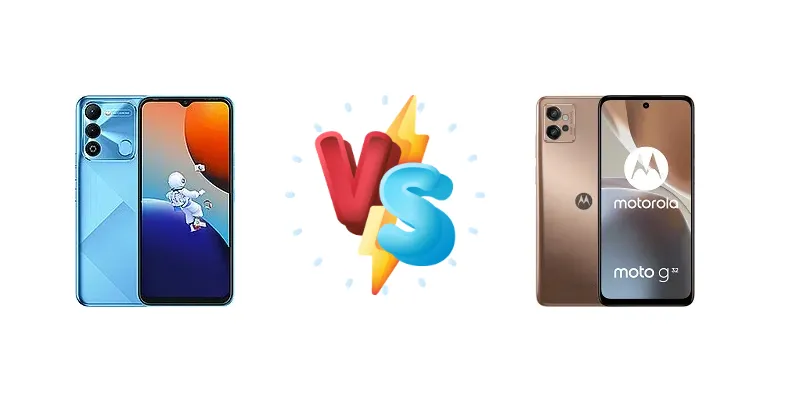
The sub-$150 smartphone market is fiercely competitive. The Tecno Spark 9 and Motorola Moto G32 both aim to deliver essential features at an accessible price point, but they take different approaches. The Spark 9 relies on MediaTek’s Helio G37, while the Moto G32 leverages Qualcomm’s more efficient Snapdragon 680. This comparison dissects these key differences to determine which device offers the best value.
🏆 Quick Verdict
For the average user prioritizing efficiency and sustained performance, the Motorola Moto G32 is the better choice. Its Snapdragon 680, built on a 6nm process, offers superior power efficiency and smoother multitasking compared to the Tecno Spark 9’s Helio G37. While the Spark 9 may offer slightly more raw CPU clock speed, the G32’s architecture and process node provide a more refined user experience.
| Network |
|---|
| 2G bands | GSM 850 / 900 / 1800 / 1900 | GSM 850 / 900 / 1800 / 1900 |
| 3G bands | HSDPA 850 / 900 / 2100 | HSDPA 850 / 900 / 1900 / 2100 |
| 4G bands | LTE | 1, 3, 5, 7, 8, 20, 28, 38, 40, 41 |
| Speed | HSPA, LTE | HSPA, LTE |
| Technology | GSM / HSPA / LTE | GSM / HSPA / LTE |
| Launch |
|---|
| Announced | 2022, July 18 | 2022, July 28 |
| Status | Available. Released 2022, August 15 | Available. Released 2022, August 16 |
| Body |
|---|
| Build | - | Glass front, plastic frame, plastic back |
| Dimensions | 164.6 x 76 x 9 mm (6.48 x 2.99 x 0.35 in) | 161.8 x 73.8 x 8.5 mm (6.37 x 2.91 x 0.33 in) |
| SIM | Nano-SIM + Nano-SIM | · Nano-SIM· Nano-SIM + Nano-SIM |
| Weight | - | 184 g (6.49 oz) |
| | - | Water-repellent design |
| Display |
|---|
| Resolution | 720 x 1600 pixels, 20:9 ratio (~266 ppi density) | 1080 x 2400 pixels, 20:9 ratio (~405 ppi density) |
| Size | 6.6 inches, 105.2 cm2 (~84.1% screen-to-body ratio) | 6.5 inches, 102.0 cm2 (~85.4% screen-to-body ratio) |
| Type | IPS LCD, 90Hz | IPS LCD, 90Hz |
| Platform |
|---|
| CPU | Octa-core (4x2.3 GHz Cortex-A53 & 4x1.8 GHz Cortex-A53) | Octa-core (4x2.4 GHz Kryo 265 Gold & 4x1.9 GHz Kryo 265 Silver) |
| Chipset | Mediatek MT6765V/CB Helio G37 (12 nm) | Qualcomm SM6225 Snapdragon 680 4G (6 nm) |
| GPU | PowerVR GE8320 | Adreno 610 |
| OS | Android 12, HIOS 8.6 | Android 12, upgradable to Android 13 |
| Memory |
|---|
| Card slot | microSDXC (dedicated slot) | microSDXC (dedicated slot) |
| Internal | 64GB 3GB RAM, 64GB 4GB RAM, 128GB 6GB RAM | 64GB 4GB RAM, 128GB 4GB RAM, 128GB 6GB RAM, 128GB 8GB RAM, 256GB 8GB RAM |
| Main Camera |
|---|
| Dual | 13 MP, f/1.9, 27mm (wide), AF
0.08 MP, (depth) | - |
| Features | Dual-LED flash, panorama, HDR | LED flash, HDR, panorama |
| Single | 13 MP, f/1.9, 27mm (wide), AF
Auxiliary lens | - |
| Triple | - | 50 MP, f/1.8 (wide), 1/2.76", 0.64µm, PDAF
8 MP, f/2.2, 118˚ (ultrawide), 1/4.0", 1.12µm
2 MP, f/2.4, (macro/depth) |
| Video | 1080p@30fps | 1080p@30fps |
| Selfie camera |
|---|
| Features | LED flash | - |
| Single | 8 MP, (wide) | 16 MP, f/2.4, (wide), 1.0µm |
| Video | Yes | 1080p@30fps |
| Sound |
|---|
| 3.5mm jack | Yes | Yes |
| 35mm jack | Yes | Yes |
| Loudspeaker | Yes | Yes, with stereo speakers |
| Comms |
|---|
| Bluetooth | Yes | 5.2, A2DP, LE |
| NFC | No | Yes (market/region dependent) |
| Positioning | GPS | GPS, GLONASS, GALILEO |
| Radio | FM radio | FM radio |
| USB | microUSB 2.0, OTG | USB Type-C 2.0 |
| WLAN | Yes | Wi-Fi 802.11 a/b/g/n/ac, dual-band, Wi-Fi Direct |
| Features |
|---|
| Sensors | Fingerprint (rear-mounted), accelerometer, proximity | Fingerprint (side-mounted), accelerometer, gyro, proximity, compass |
| Battery |
|---|
| Charging | - | 30W wired |
| Type | 5000 mAh | Li-Po 5000 mAh |
| Misc |
|---|
| Colors | Infinity Black, Sky Mirror | Mineral Grey, Satin Silver, Rose Gold |
| Models | KG5p | XT2235-2, XT2235-3 |
| Price | About 120 EUR | ₹ 8,990 |
Tecno Spark 9
- Potentially lower price point
- Slightly higher CPU clock speeds (on paper)
- May appeal to users prioritizing absolute lowest cost
- Less efficient Helio G37 chipset
- Likely inferior thermal management
- Slower charging speeds (assumed)
- Potentially less smooth multitasking
Motorola Moto G32
- More efficient Snapdragon 680 chipset (6nm)
- Faster 30W wired charging
- Better multitasking and app responsiveness
- Improved thermal management
- Potentially higher price point
- May not offer significant camera improvements
- Still a budget device with inherent limitations
Display Comparison
Neither device boasts a standout display. Both likely utilize LCD panels, a common cost-saving measure in this segment. The key difference lies under the hood. While specific display specs are unavailable for the Spark 9, the Moto G32’s focus on efficiency suggests a panel tuned for power conservation rather than peak brightness or color accuracy. Bezels are expected to be relatively substantial on both devices, reflecting their budget positioning. Users prioritizing media consumption should temper expectations.
Camera Comparison
Camera performance is likely to be similar, with both phones relying on budget sensors and image processing. Without specific sensor details, it’s difficult to make definitive claims. However, the Snapdragon 680’s ISP (Image Signal Processor) is generally more capable than the Helio G37’s, potentially leading to slightly better image quality in challenging lighting conditions. Expect both phones to feature a primary camera accompanied by auxiliary lenses of limited utility (likely a depth or macro sensor). Focusing on the main sensor’s performance is key; image processing will be crucial in differentiating the two.
Performance
The core of the difference lies in the chipsets. The Motorola Moto G32’s Qualcomm Snapdragon 680 (6nm) is a significant advantage over the Tecno Spark 9’s MediaTek Helio G37 (12nm). The 6nm process node translates directly to improved power efficiency and reduced heat generation. While the Spark 9’s CPU boasts slightly higher clock speeds (2.3 GHz vs 2.4 GHz), the Snapdragon 680’s Kryo 265 Gold cores are architecturally more advanced, offering better performance per clock cycle. This means the Moto G32 will likely handle multitasking and demanding apps more smoothly. The G32’s GPU will also provide a more consistent gaming experience with less throttling. The Spark 9 may struggle with graphically intensive titles.
Battery Life
The Moto G32’s 30W wired charging is a clear advantage. While battery capacity isn’t specified for the Spark 9, the G32’s faster charging will significantly reduce downtime. The Snapdragon 680’s efficiency also contributes to better battery life. The 6nm process consumes less power, allowing the Moto G32 to extract more usage from its battery. Users who frequently find themselves away from a charger will benefit from the Moto G32’s combination of efficient hardware and faster charging.
Buying Guide
Buy the Tecno Spark 9 if you need a phone primarily for basic tasks like calls, messaging, and light social media use, and are highly sensitive to upfront cost. Its lower price point makes it an attractive option for first-time smartphone users or those on a very tight budget. Buy the Motorola Moto G32 if you prefer a more responsive and efficient experience, especially if you engage in moderate multitasking, enjoy occasional gaming, or value faster charging capabilities. The G32’s Snapdragon 680 provides a noticeable performance uplift and better long-term usability.
Frequently Asked Questions
❓ Will the Tecno Spark 9 struggle with popular games like PUBG Mobile or Call of Duty?
The Helio G37 is a basic gaming chipset. While you might be able to run PUBG Mobile at lower settings, expect significant frame drops and potential overheating during extended gaming sessions. The Moto G32’s Snapdragon 680 will provide a noticeably smoother and more stable gaming experience, even if it’s not a high-end gaming phone.
❓ How much faster is the Motorola Moto G32's charging compared to what we expect from the Tecno Spark 9?
The Moto G32’s 30W charging is a substantial upgrade. While the Spark 9 likely supports standard 10W or 18W charging, the Moto G32 can significantly reduce charging times. Expect a full charge in around 60-75 minutes with the Moto G32, compared to potentially 2-3 hours with the Spark 9.
❓ Does the Snapdragon 680 in the Moto G32 get hot during prolonged use?
The Snapdragon 680 is known for its excellent thermal efficiency thanks to the 6nm manufacturing process. It’s unlikely to overheat during typical usage, even with moderate gaming or multitasking. The Tecno Spark 9’s Helio G37, being a 12nm chip, is more prone to thermal throttling under sustained load.