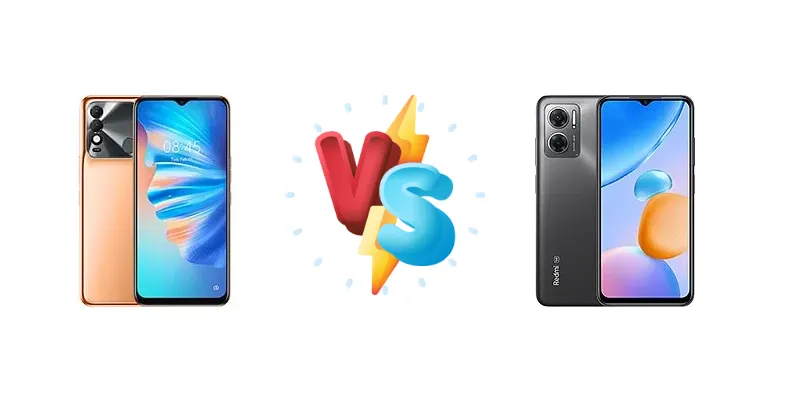
The sub-$200 5G smartphone market is heating up, and the Tecno Spark 8T and Xiaomi Redmi 10 5G are two key contenders. While both aim to deliver 5G connectivity at an accessible price, they take drastically different approaches to achieving this, particularly in their core processing power. This comparison dissects those differences to help you choose the right phone for your needs.
🏆 Quick Verdict
For most users, the Xiaomi Redmi 10 5G is the superior choice. Its Mediatek Dimensity 700 chipset, built on a more efficient 7nm process, provides a significantly more responsive experience for everyday tasks and gaming, justifying the slight price premium. The 18W charging is also a welcome addition.
| Network |
|---|
| 2G bands | GSM 850 / 900 / 1800 / 1900 | GSM 850 / 900 / 1800 / 1900 |
| 3G bands | HSDPA 850 / 900 / 2100 | HSDPA 850 / 900 / 1700(AWS) / 1900 / 2100 |
| 4G bands | LTE | 1, 2, 3, 4, 5, 7, 8, 20, 28, 38, 40, 41 |
| 5G bands | - | 1, 3, 5, 7, 8, 20, 28, 38, 40, 41, 77, 78 SA/NSA |
| Speed | HSPA 42.2/5.76 Mbps, LTE Cat4 150/50 Mbps | HSPA, LTE, 5G |
| Technology | GSM / HSPA / LTE | GSM / HSPA / LTE / 5G |
| Launch |
|---|
| Announced | 2021, December 15 | 2022, March 29 |
| Status | Available. Released 2021, December 15 | Available. Released 2022, September 23 |
| Body |
|---|
| Build | Glass front, plastic frame, plastic back | - |
| Dimensions | 164.3 x 75.9 x 8.9 mm (6.47 x 2.99 x 0.35 in) | 164 x 76.1 x 8.9 mm (6.46 x 3.00 x 0.35 in) |
| SIM | Nano-SIM + Nano-SIM | Nano-SIM + Nano-SIM |
| Weight | - | 200 g (7.05 oz) |
| Display |
|---|
| Protection | - | Corning Gorilla Glass 3 |
| Resolution | 1080 x 2408 pixels, 20:9 ratio (~400 ppi density) | 1080 x 2408 pixels, 20:9 ratio (~401 ppi density) |
| Size | 6.6 inches, 104.9 cm2 (~84.1% screen-to-body ratio) | 6.58 inches, 104.3 cm2 (~83.6% screen-to-body ratio) |
| Type | IPS LCD | IPS LCD, 90Hz |
| Platform |
|---|
| CPU | Octa-core (4x2.3 GHz Cortex-A53 & 4x1.8 GHz Cortex-A53) | Octa-core (2x2.2 GHz Cortex-A76 & 6x2.0 GHz Cortex-A55) |
| Chipset | Mediatek MT6765G Helio G35 (12 nm) | Mediatek Dimensity 700 (7 nm) |
| GPU | PowerVR GE8320 | Mali-G57 MC2 |
| OS | Android 11, HIOS 7.6 | Android 12, MIUI 13 |
| Memory |
|---|
| Card slot | microSDXC (dedicated slot) | microSDXC (dedicated slot) |
| Internal | 64GB 4GB RAM | 64GB 4GB RAM, 128GB 4GB RAM, 128GB 6GB RAM |
| | eMMC 5.1 | UFS 2.2 |
| Main Camera |
|---|
| Dual | - | 50 MP, f/1.8, (wide), PDAF
Auxiliary lens |
| Features | Quad-LED flash, HDR, panorama | LED flash, HDR, panorama |
| Single | 8 MP, f/2.0, 26mm (wide) | 5 MP, f/2.2 |
| Triple | 50 MP, f/1.6, (wide), PDAF
Auxiliary lens | - |
| Video | 1080p@30fps | 1080p@30fps |
| Selfie camera |
|---|
| Features | Dual-LED flash | HDR |
| Single | 8 MP, f/2.0, 26mm (wide) | 5 MP, f/2.2 |
| Video | 1080p@30fps | 1080p@30fps |
| Sound |
|---|
| 3.5mm jack | Yes | Yes |
| 35mm jack | Yes | Yes |
| Loudspeaker | Yes | Yes |
| | - | 24-bit/192kHz audio |
| Comms |
|---|
| Bluetooth | Yes | 5.1, A2DP, LE |
| Infrared port | - | Yes |
| NFC | No | Yes (market/region dependent) |
| Positioning | GPS | GPS, GLONASS, BDS, GALILEO |
| Radio | FM radio | FM radio |
| USB | Yes | USB Type-C 2.0, OTG |
| WLAN | Yes | Wi-Fi 802.11 a/b/g/n/ac, dual-band, Wi-Fi Direct |
| Features |
|---|
| Sensors | Fingerprint (rear-mounted), accelerometer, proximity | Fingerprint (side-mounted), accelerometer, proximity, compass |
| Battery |
|---|
| Charging | - | 18W wired |
| Type | 5000 mAh | Li-Po 5000 mAh |
| Misc |
|---|
| Colors | Atlantic Blue, Turquoise Cyan, Iris Purple, Cocoa Gold | Graphite Gray, Chrome Silver, Aurora Green |
| Models | KG6p | 22041219G, 22041219NY |
| Price | About 120 EUR | About 100 EUR |
| SAR | - | 1.09 W/kg (head) 1.09 W/kg (body) |
| SAR EU | - | 0.60 W/kg (head) 0.99 W/kg (body) |
Tecno Spark 8T
- Potentially lower price point
- Large display for media consumption
- Functional for basic tasks
- Significantly weaker processor
- Less efficient 12nm chipset
- Likely slower charging speeds
Xiaomi Redmi 10 5G
- More powerful Mediatek Dimensity 700 chipset
- 7nm process for better efficiency and thermals
- 18W fast charging
- May be slightly more expensive
- Display quality is likely similar to the Spark 8T
- Camera performance will be incremental
Display Comparison
Neither device boasts a standout display. While specific details like brightness nits are unavailable, both likely utilize IPS LCD panels common in this price bracket. The focus here isn't on visual fidelity, but rather functionality. Bezels are expected to be noticeable on both, and color accuracy will likely be standard for budget phones. The key difference will be software optimization for color calibration, which is difficult to predict without testing.
Camera Comparison
Both phones likely feature a multi-camera setup, but details beyond the presence of sensors are limited. It's safe to assume both will include a primary camera, depth sensor, and potentially a macro lens. Given the price point, image quality will be adequate in good lighting conditions, but struggle in low light. The Redmi 10 5G *may* benefit from slightly better image processing capabilities due to its more powerful chipset, allowing for faster processing of HDR and night mode algorithms. The inclusion of a 2MP macro camera on either device is largely a marketing gimmick and shouldn't be a deciding factor.
Performance
This is where the Redmi 10 5G pulls ahead decisively. The Mediatek Dimensity 700, fabricated on a 7nm process, is a substantial upgrade over the Tecno Spark 8T’s Mediatek Helio G35 (12nm). The Dimensity 700’s CPU configuration – 2x2.2 GHz Cortex-A76 and 6x2.0 GHz Cortex-A55 – offers significantly better single-core and multi-core performance compared to the Spark 8T’s 4x2.3 GHz Cortex-A53 & 4x1.8 GHz Cortex-A53. This translates to snappier app launches, smoother multitasking, and a more enjoyable gaming experience. The 7nm process also contributes to better thermal efficiency, reducing the likelihood of performance throttling under sustained load. Users who play PUBG Mobile or other demanding games will see a clear advantage with the Redmi 10 5G.
Battery Life
Battery capacity is not specified for the Tecno Spark 8T, but typical budget phones in this class range from 5000mAh to 6000mAh. The Redmi 10 5G’s 18W wired charging is a significant advantage. While not exceptionally fast, it’s considerably quicker than the charging speeds often found on Tecno’s budget offerings. The Dimensity 700’s 7nm efficiency also contributes to better battery life under load, meaning the Redmi 10 5G will likely last longer during gaming or video streaming sessions.
Buying Guide
Buy the Tecno Spark 8T if your primary need is a large display for media consumption and basic tasks, and you're on a very tight budget. It's a functional device for light use. Buy the Xiaomi Redmi 10 5G if you prioritize smoother performance, 5G connectivity for faster data speeds, and a more future-proof chipset capable of handling demanding apps and games.
Frequently Asked Questions
❓ Will the Redmi 10 5G's Dimensity 700 handle demanding games like Genshin Impact?
While the Dimensity 700 isn't a flagship chipset, it can run Genshin Impact at lower settings (medium or low) with acceptable frame rates. Expect some frame drops during intense scenes. The Tecno Spark 8T's Helio G35 would struggle significantly with this title.
❓ How much faster is 5G on the Redmi 10 5G compared to 4G?
5G speeds on the Redmi 10 5G will vary depending on network availability and coverage. However, in ideal conditions, you can expect download speeds several times faster than 4G – potentially exceeding 100Mbps, compared to 20-50Mbps on 4G. This translates to quicker downloads, smoother streaming, and lower latency.
❓ Is the Tecno Spark 8T a good option for someone who primarily uses WhatsApp and social media?
Yes, the Tecno Spark 8T is sufficient for basic tasks like WhatsApp, Facebook, and browsing. However, you may experience occasional lag or slowdowns when multitasking or opening multiple apps. The Redmi 10 5G will provide a much smoother experience even with heavy social media use.
❓ Does the Redmi 10 5G support VoWiFi (WiFi Calling)?
Support for VoWiFi varies by carrier and region. You'll need to check with your mobile provider to confirm if VoWiFi is supported on the Redmi 10 5G in your area. This feature allows you to make and receive calls over a WiFi network when cellular signal is weak or unavailable.