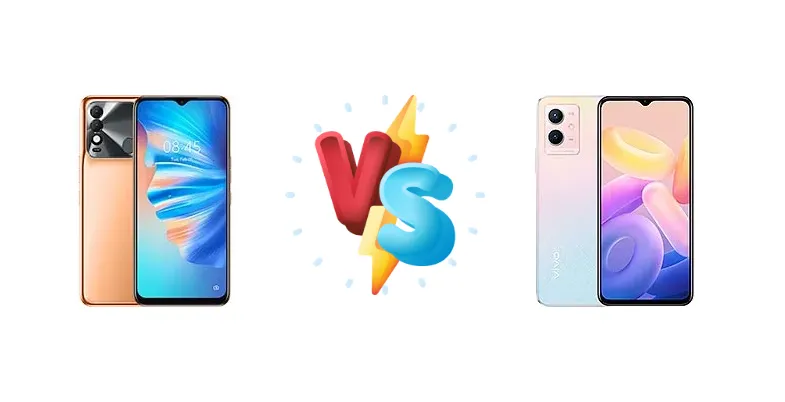
The Tecno Spark 8T and vivo Y33s 5G represent two compelling options in the increasingly competitive sub-$200 smartphone market. While both aim to deliver 5G connectivity at an accessible price point, they take drastically different approaches to achieving this, primarily through their chipset choices. This comparison will dissect those differences and determine which device offers the best value for your money.
🏆 Quick Verdict
For the average user prioritizing responsiveness and future-proofing, the vivo Y33s 5G is the clear winner. Its Mediatek Dimensity 700 chipset, built on a more efficient 7nm process, delivers significantly better performance than the Tecno Spark 8T’s Helio G35. While the Spark 8T may offer slightly longer battery life due to its less powerful processor, the Y33s 5G’s performance advantage outweighs this trade-off.
| Network |
|---|
| 2G bands | GSM 850 / 900 / 1800 / 1900 | GSM 850 / 900 / 1800 / 1900 |
| 3G bands | HSDPA 850 / 900 / 2100 | HSDPA 850 / 900 / 2100 |
| 4G bands | LTE | 1, 3, 5, 8, 28, 34, 38, 39, 40, 41 |
| 5G bands | - | 1, 28, 41, 77, 78 SA/NSA |
| Speed | HSPA 42.2/5.76 Mbps, LTE Cat4 150/50 Mbps | HSPA, LTE, 5G |
| Technology | GSM / HSPA / LTE | GSM / CDMA / HSPA / CDMA2000 / LTE / 5G |
| | - | CDMA2000 1x |
| Launch |
|---|
| Announced | 2021, December 15 | 2022, March 01 |
| Status | Available. Released 2021, December 15 | Available. Released 2022, March 01 |
| Body |
|---|
| Build | Glass front, plastic frame, plastic back | Glass front, plastic frame, plastic back |
| Dimensions | 164.3 x 75.9 x 8.9 mm (6.47 x 2.99 x 0.35 in) | 164 x 75.9 x 8.3 mm (6.46 x 2.99 x 0.33 in) |
| SIM | Nano-SIM + Nano-SIM | Nano-SIM + Nano-SIM |
| Weight | - | 185 g (6.53 oz) |
| Display |
|---|
| Resolution | 1080 x 2408 pixels, 20:9 ratio (~400 ppi density) | 720 x 1600 pixels, 20:9 ratio (~269 ppi density) |
| Size | 6.6 inches, 104.9 cm2 (~84.1% screen-to-body ratio) | 6.51 inches, 103.1 cm2 (~82.8% screen-to-body ratio) |
| Type | IPS LCD | IPS LCD |
| Platform |
|---|
| CPU | Octa-core (4x2.3 GHz Cortex-A53 & 4x1.8 GHz Cortex-A53) | Octa-core (2x2.2 GHz Cortex-A76 & 6x2.0 GHz Cortex-A55) |
| Chipset | Mediatek MT6765G Helio G35 (12 nm) | Mediatek Dimensity 700 (7 nm) |
| GPU | PowerVR GE8320 | Mali-G57 MC2 |
| OS | Android 11, HIOS 7.6 | Android 12, OriginOS Ocean |
| Memory |
|---|
| Card slot | microSDXC (dedicated slot) | microSDXC |
| Internal | 64GB 4GB RAM | 128GB 4GB RAM, 128GB 6GB RAM, 128GB 8GB RAM |
| | eMMC 5.1 | UFS 2.1 |
| Main Camera |
|---|
| Dual | - | 13 MP, f/2.2, 26mm (wide), AF
2 MP (macro) |
| Features | Quad-LED flash, HDR, panorama | LED flash, HDR, panorama |
| Single | 8 MP, f/2.0, 26mm (wide) | 8 MP, f/1.8, (wide) |
| Triple | 50 MP, f/1.6, (wide), PDAF
Auxiliary lens | - |
| Video | 1080p@30fps | 1080p@30fps, gyro-EIS |
| Selfie camera |
|---|
| Features | Dual-LED flash | - |
| Single | 8 MP, f/2.0, 26mm (wide) | 8 MP, f/1.8, (wide) |
| Video | 1080p@30fps | 1080p@30fps |
| Sound |
|---|
| 3.5mm jack | Yes | Yes |
| 35mm jack | Yes | Yes |
| Loudspeaker | Yes | Yes |
| Comms |
|---|
| Bluetooth | Yes | 5.1, A2DP, LE, aptX HD |
| NFC | No | - |
| Positioning | GPS | GPS, GLONASS, GALILEO, BDS, QZSS |
| Radio | FM radio | Unspecified |
| USB | Yes | USB Type-C, OTG |
| WLAN | Yes | Wi-Fi 802.11 a/b/g/n/ac, dual-band, Wi-Fi Direct |
| Features |
|---|
| Sensors | Fingerprint (rear-mounted), accelerometer, proximity | Fingerprint (side-mounted), accelerometer, proximity, compass |
| Battery |
|---|
| Charging | - | 18W wired |
| Type | 5000 mAh | 5000 mAh |
| Misc |
|---|
| Colors | Atlantic Blue, Turquoise Cyan, Iris Purple, Cocoa Gold | Black, Blue, Gradient |
| Models | KG6p | - |
| Price | About 120 EUR | About 180 EUR |
Tecno Spark 8T
- Potentially longer battery life due to less powerful chipset
- Likely more affordable price point
- Simple and straightforward user experience
- Significantly slower performance compared to the Y33s 5G
- Less efficient chipset (12nm)
- Limited multitasking capabilities
vivo Y33s 5G
- Much faster and more responsive performance with Dimensity 700
- More efficient 7nm chipset
- 18W fast charging support
- Potentially slightly shorter battery life
- May be slightly more expensive
- More complex software features (potentially)
Display Comparison
Neither device boasts a particularly standout display. Details regarding panel type (IPS vs AMOLED) and resolution are missing, but both likely feature 720p+ displays common in this price bracket. The key difference lies under the hood: processing power impacts UI smoothness. A faster processor like the Dimensity 700 in the Y33s 5G will translate to smoother scrolling and animations, even on a similar-resolution display. Bezels are likely comparable, and color accuracy will be typical for budget devices.
Camera Comparison
Without detailed camera specs beyond the chipsets, a direct comparison is difficult. However, the processing power of the Dimensity 700 in the Y33s 5G will likely result in better image processing, particularly in low-light conditions. The Helio G35 in the Spark 8T will struggle with complex image algorithms. Expect both phones to feature a primary camera and potentially multiple auxiliary lenses (often 2MP macro/depth sensors of limited utility). The Y33s 5G’s ISP (Image Signal Processor) will be more capable, leading to sharper images and better dynamic range.
Performance
This is where the chasm between these two phones appears. The vivo Y33s 5G’s Mediatek Dimensity 700 (7nm) is a substantial upgrade over the Tecno Spark 8T’s Mediatek Helio G35 (12nm). The Dimensity 700 utilizes more modern CPU cores – 2x Cortex-A76 at 2.2 GHz and 6x Cortex-A55 at 2.0 GHz – compared to the Spark 8T’s 4x Cortex-A53 at 2.3 GHz and 4x Cortex-A53 at 1.8 GHz. The A76 cores offer significantly better single-core performance, crucial for app launch speeds and general responsiveness. The 7nm fabrication process also means the Dimensity 700 is more power-efficient, reducing heat and improving sustained performance. The Y33s 5G will handle multitasking and moderately demanding games with far greater ease.
Battery Life
Battery capacity details are missing for both devices. However, the Tecno Spark 8T, with its less power-hungry Helio G35 chipset, will likely offer slightly longer battery life on a single charge. The vivo Y33s 5G compensates with 18W wired charging, a feature absent in the Spark 8T (charging speed is unspecified). This means the Y33s 5G can replenish its battery faster, mitigating any potential battery life disadvantage. The 7nm process of the Dimensity 700 also contributes to improved power efficiency, narrowing the gap.
Buying Guide
Buy the Tecno Spark 8T if you primarily need a phone for basic tasks like calling, texting, and light social media use, and battery life is your absolute top priority. You're willing to accept slower app loading times and less demanding gaming performance. Buy the vivo Y33s 5G if you want a smoother, more responsive experience, especially when using 5G networks, and enjoy occasional gaming or multitasking. The Dimensity 700 provides a noticeable performance uplift for everyday tasks and beyond.
Frequently Asked Questions
❓ Will the vivo Y33s 5G overheat during extended gaming sessions?
The Mediatek Dimensity 700, built on a 7nm process, is relatively efficient and includes thermal management features. While it may get warm during prolonged gaming, it's unlikely to experience significant throttling like the Tecno Spark 8T’s Helio G35, which is more prone to overheating due to its 12nm process and less advanced thermal design.
❓ Is the 5G connectivity on the vivo Y33s 5G actually useful, or is it just a marketing gimmick?
The usefulness of 5G depends on your location and carrier coverage. However, the Dimensity 700 chipset includes an integrated 5G modem, offering significantly faster download and upload speeds where 5G networks are available. This translates to quicker app downloads, smoother streaming, and a more responsive online experience compared to 4G, making it a valuable feature for users in supported areas.
❓ How much of a performance difference will I actually notice between the Helio G35 and the Dimensity 700 in everyday use?
The difference is substantial. The Dimensity 700’s more powerful CPU cores and efficient architecture result in noticeably faster app launch times, smoother multitasking, and a more responsive user interface. The Helio G35 will feel sluggish in comparison, especially when switching between apps or running demanding applications.